Destinations / Asia
Fenghuang, China travel guide
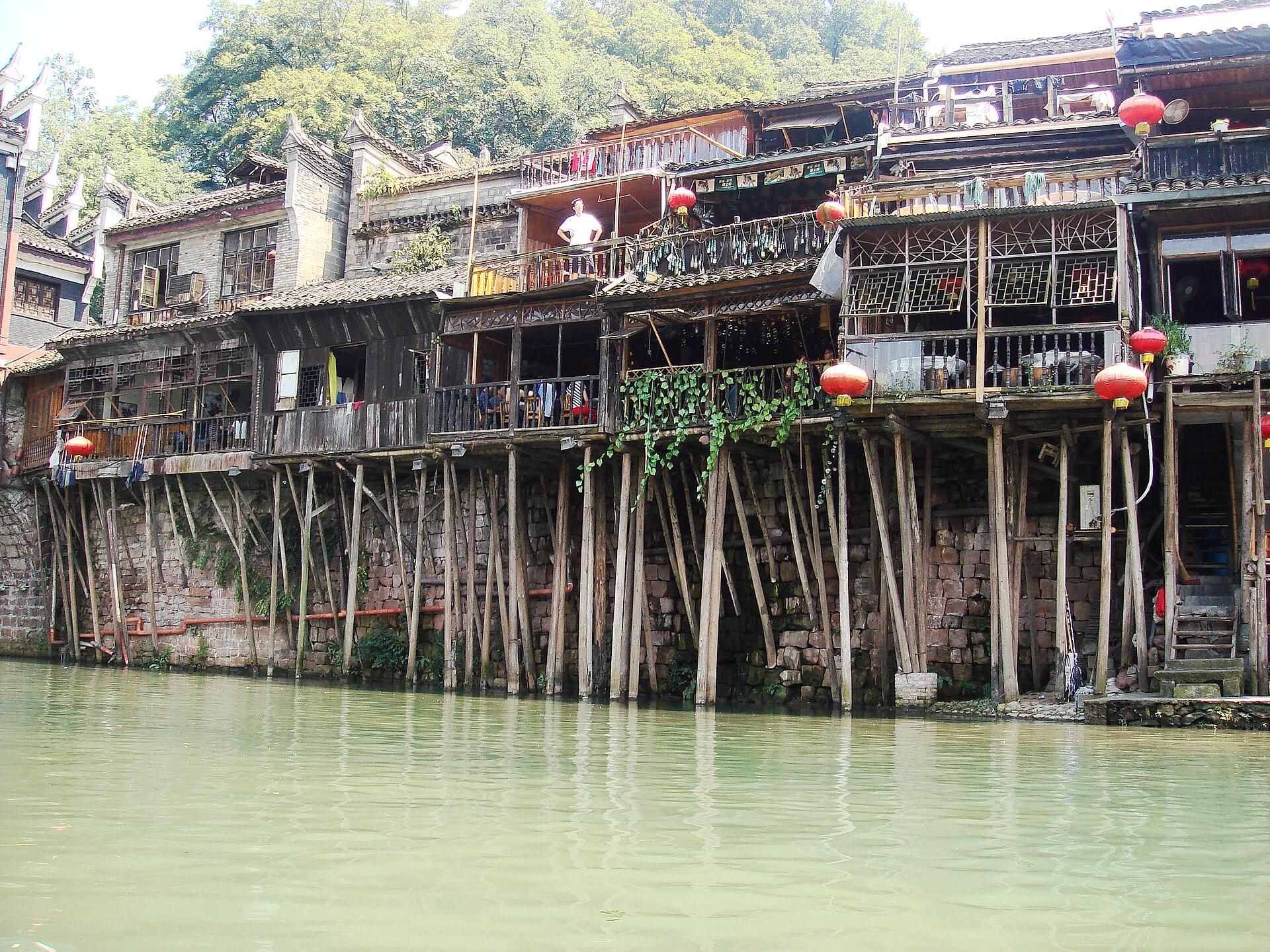
A riverside town of stilt houses, stepping stones and lantern-lit lanes in western Hunan, where Miao and Tujia culture meets a Ming-era frontier wall and the views are free.
- Best time to visit: March to May and September to November
- Daily budget (budget traveller): $30 to $125 USD
- Ideal trip length: 3 to 7 days
Fenghuang sits in the hills of western Hunan, in the Xiangxi Tujia and Miao Autonomous Prefecture. Its old town runs along both banks of the green Tuojiang River. Wooden stilt houses lean out over the water, stone steps cross the current and covered bridges link the two sides. The town was once a garrison on the edge of Miao territory, and the old Southern Great Wall still runs along ridges to the west. Walking around the old town costs nothing. Since April 2016 there has been no gate ticket, and you only pay to go inside the main historic buildings. By day it is busy with tour groups and silver shops. Early in the morning it goes quiet and misty, and at night the lanterns come on and the whole river glows. Getting here is easy now. High-speed trains stop at Fenghuang Gucheng station, about 10km north of town, and a cheap shuttle bus runs into the centre. For a solo traveller, Fenghuang is affordable, walkable and safe. The real trick is choosing where to stay and when to go.
Fenghuang means 'phoenix'. The town grew up as a garrison on the old frontier between Han China and Miao territory, which is why there are city walls, gate towers and a stone 'Southern Great Wall' in the hills to the west. Today it is one of China's most famous old towns. The Tuojiang River runs through the middle, lined with wooden stilt houses, and the old lanes are full of ginger candy, silver shops and snack stalls. The writer Shen Congwen grew up here, and his novel Border Town made the place famous. Walking the town is free. The paid part is a combo ticket of about ¥128 for nine historic buildings and a short boat ride. Fenghuang can feel commercial, especially by day. But get up early, stay out late, and walk downstream past the Hong Bridge, and you find the version people fall for.
The logistics are much easier than they used to be. Since the end of 2021, high-speed trains have stopped at Fenghuang Gucheng station, about 10km north of town. Zhangjiajie West is about an hour away and Changsha South about 2.5 hours. A ¥7 shuttle bus runs to the tourist centres on the edge of the old town, and a maglev line also connects the station to town. Once you are here, you walk. Choose your base carefully. The north bank has the famous views but also the loud bars. The upstream and downstream ends are calmer, and the new town has the chain hotels that reliably take foreign passports. Use the combo ticket over two days, and save a third day for the Southern Great Wall and Huangsiqiao to the west.
Timing matters more than anything else. Chinese public holidays, especially the first week of October and the May Day break, fill the narrow lanes to the point where you can barely move. Spring brings mild days and frequent rain. Summer is hot, humid and stormy, and the river can flood. Autumn is the sweet spot, with clearer skies and cooler evenings. Winter is cold and damp, but the town is at its quietest and cheapest. Fenghuang is safe and friendly for solo travellers. Plenty of hostels attract young Chinese backpackers, though English is limited, so a translation app is essential. Set up Alipay or WeChat Pay before you arrive and you will find the town cheap and easy.
Fenghuang itinerary
Arrive and walk the river at dusk
Morning: Take a high-speed train to Fenghuang Gucheng station, about 1 hour from Zhangjiajie West or 2.5 hours from Changsha South.
Afternoon: Ride the ¥7 shuttle bus to the Nanhuali or Qifeng Square tourist centre and check in. Get your bearings with a slow loop of the south bank lanes.
Evening: Walk both riverbanks as the lanterns come on, and cross the Hong Bridge. Eat mi doufu and grilled skewers from the stalls, then turn in early for a dawn start.
Dawn photos and the combo ticket
Morning: Be at the stepping stones by the North Gate at about 6.30am, before the crowds. Buy the nine-sight combo (about ¥128) and visit Shen Congwen's Former Residence and the East Gate tower.
Afternoon: Visit Xiong Xiling's Former Residence, the Yang Family Ancestral Hall and the town museum, then take the short boat ride included in the ticket.
Evening: Try blood duck for dinner, then walk downstream to Wanming Pagoda for the quieter night view back towards the bridge.
Southern Great Wall and Huangsiqiao
Morning: Take a DiDi or a hired driver about 13km west to the Southern Great Wall (about ¥45). Walk the restored ridge section while it is still cool.
Afternoon: Continue to Huangsiqiao, the stone-walled garrison town, and wander its gates and lanes. Ask your driver to wait, because return rides are scarce.
Evening: Back in town, finish the combo sights you missed, such as Wanshou Palace or Chongde Hall. Have a quiet dinner away from the main strip.
Shanjiang Miao village and Qiliang Cave
Morning: Head about 20km northwest to Shanjiang Miao village for the museum and old houses. Ask before photographing anyone.
Afternoon: Stop at Qiliang Cave on the way back for its lit chambers and underground river. Allow 1.5 to 2 hours inside.
Evening: Rest your legs at a riverside café on the upstream side, then have sour fish soup for dinner.
Nanhua Mountain and a slow day
Morning: Climb Nanhua Mountain early for the panorama over the rooftops (about ¥50 online, ¥88 at the gate).
Afternoon: Walk out to Shen Congwen's grave on the hill east of town. Watch ginger candy being pulled in the lanes, and use the combo ticket's second day for anything left.
Evening: If it suits you, book an evening show such as the Border Town performance, or simply sit by the water with a drink.
Day trip to Furong Town
Morning: Take a short high-speed train north towards Jishou and Furong Town. Check 12306 for times and book a seat the day before.
Afternoon: Explore Furong Town, an old Tujia town built on a cliff above a waterfall. Check the current ticket price on arrival.
Evening: Train back to Fenghuang Gucheng and take the shuttle into town. Final night walk and a farewell plate of larou.
Last morning and depart
Morning: One more dawn walk upstream to watch the river wake up. Buy ginger candy to take home.
Afternoon: Shuttle bus or taxi back to the station. Allow time for the passport check at security.
Evening: Connect onwards to Zhangjiajie, Changsha or Guangzhou.
Best neighbourhoods
- South bank old town: The main walled town, with Shen Congwen's Former Residence, the East Gate and narrow lanes full of snack stalls and silver shops. It is central and good for sightseeing, but it is crowded from mid-morning until late evening.
- North bank riverside: The stretch of stilt houses facing the old town across the river. It has the classic postcard view of the south bank, but many buildings are bars with live music, so rooms here can be noisy until well after midnight.
- Upstream by the stepping stones: The area around the North Gate and the stepping stones, plus the riverside beyond. It is a little quieter than the core, with inns a short walk from everything. It is the best spot for early morning photos.
- Downstream by Wanming Pagoda: East of the Hong Bridge, towards Wanming Pagoda and Wanshou Palace. The crowds thin out here, the river opens up and the night views back towards the bridge are some of the best in town.
- New town and tourist centres: The modern streets outside the old walls, near the Nanhuali and Qifeng Square tourist centres where the station shuttles stop. Chain hotels here are cheaper and more likely to accept foreign guests, and the old town is a 10 to 15 minute walk away.
Must-do experiences
- Walk the river at dawn and after dark: Fenghuang is two towns. At 6.30am the river is misty and nearly empty. From dusk, the stilt houses light up in red and gold. Walk both banks at both times, because the free views are the best thing here.
- Cross the stepping stones: The stone blocks near the North Gate cross the Tuojiang in a line of short hops. It is free and fun, but the stones get slippery and queues build up at busy times. Do not cross when the water is high.
- Use the nine-sight combo ticket: About ¥128 covers Shen Congwen's Former Residence, Xiong Xiling's Former Residence, the Yang Family Ancestral Hall, the East Gate tower, Wanshou Palace, Chongde Hall, the town museum, the Hong Bridge and a short boat ride. It is valid for about two days, so spread the sights out.
- Take a boat on the Tuojiang: The short boat ride in the combo ticket drifts past the stilt houses and under the bridges. Go in the morning when the water is calm, or pay extra for a night boat package if you want the lanterns from the water.
- Climb Nanhua Mountain for the panorama: The forested hill just south of the old town gives a view over the rooftops and the river. It is not part of the combo ticket. Recent guides list about ¥88 at the gate and around ¥50 online.
- Walk the Southern Great Wall: About 13km west of town, a restored section of the Ming-era wall climbs along a ridge. It was built to control the Miao frontier and has a very different feel from the walls near Beijing. Entry has been about ¥45.
- Visit Shanjiang Miao village: About 20km northwest of town, this Miao settlement in a gorge has a small museum, stone houses and local women in traditional dress. It is touristy but still gives you useful context for Fenghuang's frontier history.
Hidden gems
- Wanming Pagoda at the downstream end of town, where the riverside is quieter and the night view back up the river is excellent
- Shen Congwen's grave on the hill east of the old town, a simple, peaceful spot with a stone engraved in his own words
- Huangsiqiao, a stone-walled garrison town west of Fenghuang that sees a fraction of the crowds and still has families living inside its walls
- The upstream riverside path past the stepping stones at about 7am, when women wash clothes in the river and boatmen sweep their decks
- Ginger candy being pulled by hand on a hook in the lanes, which is a free show and a cheap snack
Daily budget
- Accommodation: budget ¥40-90 / night (hostel dorm bed), mid-range ¥200-450 (riverside inn or new town chain hotel), splurge ¥600+ (best river-view rooms and boutique inns). Prices can double or triple on holiday weekends. Confirm that the place accepts foreign passports. River-view rooms on the north bank may be noisy.
- Food: budget ¥50-90 / day (street snacks and noodle shops), mid-range ¥100-180 (sit-down Xiangxi meals), splurge ¥250+ (riverside restaurants with a view). Noodle bowls and snacks cost roughly ¥10-25. Riverside restaurants charge for the view, so check menu prices before you order, especially for fish priced by weight.
- Transport: budget ¥7-30 / day (station shuttle, local buses), mid-range ¥60-150 (DiDi rides to sights outside town), splurge ¥300-500 (private driver for a full day). The station shuttle costs about ¥7. Maglev tickets have been quoted from about ¥28 single to about ¥58 for a multi-day pass. The high-speed train from Zhangjiajie West has been around ¥90.
- Activities: budget ¥0-60 / day (free town walks, combo ticket spread across two days), mid-range ¥128-250 (combo ticket plus the Southern Great Wall or Nanhua Mountain), splurge ¥400+ (night boat bundle, evening show, Miao village tickets). The nine-sight combo is about ¥128. The Southern Great Wall has been about ¥45 and Nanhua Mountain about ¥88 at the gate (cheaper online). Evening shows run roughly ¥60-110 for basic seats. Prices change, so check on arrival.
- Drinks & nightlife: budget ¥10-30 (shop beer by the river), mid-range ¥60-150 (a couple of drinks at a riverside bar), splurge ¥250+ (live music bars with table charges). North bank bars can add table or minimum-spend charges, so ask before you sit down. Quieter cafés and teahouses cost far less.
Where to stay
- Social hostel in Upstream by the stepping stones (¥40-90 / night): Several hostels sit in the old houses around the upstream river and the North Gate. They have dorms, common rooms and staff who can help with rides out of town. It is close to the dawn views without being right on the bar strip.
- Boutique hotel in Downstream by Wanming Pagoda (¥250-500 / night): Small inns in converted stilt houses face the river on the quieter downstream stretch. Ask for a river-view room and check whether it has heating or air conditioning, depending on the season.
- Apartment in New town near the tourist centres (¥150-300 / night): Serviced apartments and chain hotels outside the walls are cheaper, quieter and more likely to accept foreign passports. The station shuttle stops nearby, and the river is a 10 to 15 minute walk.
- Splurge in South bank or north bank riverside (¥600-1,200+ / night): The best rooms in the larger riverside inns have balconies straight over the Tuojiang and the classic lantern view. On the north bank, ask for a room away from the bars.
What to eat
- Blood duck (xueba ya): duck stir-fried with chilli and squares of rice soaked in duck blood. It is a Fenghuang classic and better than it sounds.
- Sour fish soup: river fish in a tangy, fermented sour broth, a Miao and Xiangxi favourite that is good for a shared pot if you find dining companions
- Mi doufu: soft rice tofu in a spicy, sour sauce with peanuts and pickles, a cheap street snack for a few yuan
- Cured pork (larou): smoked Xiangxi bacon stir-fried with garlic shoots or bamboo, found on almost every menu
- Jiangtang ginger candy: chewy, hand-pulled sweets sold in the lanes, a warming snack on cold winter evenings
- Pickled radish and fruit: sour, chilli-dusted pickles sold in little cups by street vendors
Day trips
- Southern Great Wall and Huangsiqiao (About 13km to the wall and around 25km to Huangsiqiao, 20 to 40 minutes by car): A restored section of the Ming-era Miao frontier wall climbs a ridge west of town. Nearby Huangsiqiao is a small garrison town ringed by stone walls, quiet and still lived in, with far fewer visitors than Fenghuang. A DiDi or a half-day driver arranged through your inn is easiest. Ask the driver to wait or book your return, because rides out here are scarce. The wall's entry has been about ¥45, and Huangsiqiao charges a small separate fee.
- Shanjiang Miao village and Qiliang Cave (About 20km northwest for Shanjiang, a few kilometres outside town for Qiliang Cave): Shanjiang is a Miao settlement in a gorge with a small museum and stone houses. Qiliang Cave is a long limestone cave with lit chambers and an underground river. The two pair well in a single day. Hire a driver or use DiDi. Ticket prices quoted online vary widely, at roughly ¥55-98 for the cave and around ¥58 or more for Shanjiang, so check before you go and book return transport in advance.
- Furong Town (North of Jishou on the high-speed line, under an hour by train with a short transfer): An old Tujia town perched on a cliff above a waterfall, with stone lanes and stilt houses. It is busy by day, but makes a good contrast with Fenghuang's riverside setting. Take a high-speed train from Fenghuang Gucheng to Furong Town station, then a short taxi or shuttle into the old town. Check train times on 12306 and the current ticket price on arrival.
When to visit
- Spring (March - May): 12-26°C, mild, frequent drizzle and some heavy showers. Crowds: Moderate, with a big spike around May Day. Green hills and misty mornings on the river. Pack a rain jacket and avoid the May Day holiday.
- Summer (June - August): 24-34°C, hot and humid, thunderstorms. Crowds: Busy with Chinese school holidays in July and August. Long evenings and lively nights, but sticky days and a real flood risk on the Tuojiang. Sightsee early and late, and rest at midday.
- Autumn (September - November): 12-28°C, drier, clearer skies, cool evenings. Crowds: Very heavy in the first week of October, moderate otherwise. The best all-round season. Late October and November are the locals' pick for calm, clear days, as long as you avoid Golden Week.
- Winter (December - February): 2-12°C, damp and grey, the occasional frost. Crowds: Quiet, apart from Chinese New Year. Cold, and many inns have weak heating, but rooms are cheap and the misty river is atmospheric. Chinese New Year is busy and some places close.
Entry rules for your passport
Visa rules for China depend on the passport you travel on. Check the official source before you book: China National Immigration Administration
Getting there
High-speed rail is the easiest way in. Fenghuang Gucheng station opened in December 2021 on the Zhangjiajie-Jishou-Huaihua line, about 10km north of the old town. Zhangjiajie West is about 1 hour away, with fares around ¥90. Changsha South takes about 2.5 hours, Guangzhou about 5 hours and Shanghai about 8 hours, and there are some direct trains from Beijing. Book on the 12306 app or through Trip.com with your passport, and expect fares to vary by train and class. From the station, take the ¥7 shuttle bus (about 20 minutes) to the Qifeng Square or Nanhuali tourist centre, a taxi for roughly ¥20-40, or the maglev. The nearest airport is Tongren Fenghuang Airport (TEN) in Guizhou. A direct bus runs to the old town in about 1.5 hours for around ¥25. Zhangjiajie Hehua and Changsha Huanghua airports have more flights, and both connect well by train. Long-distance buses to Changsha and Jishou still run from the bus station northwest of town, but the train is faster and easier for foreign visitors.
Getting around
The old town is compact, hilly in places and closed to cars, so you will walk almost everywhere. Wear shoes with grip, because the stone steps and lanes get slippery in the rain. From Fenghuang Gucheng high-speed rail station, about 10km north of town, shuttle buses run to the Qifeng Square and Nanhuali tourist centres for about ¥7. They take around 20 minutes and run from roughly 7am to the evening. A taxi or DiDi takes about 15 minutes and costs roughly ¥20-40. The Fenghuang Maglev also links the station with the edge of town and a viewpoint station above the river. Fares have been quoted from about ¥28 for a single ride up to around ¥58 for a multi-day pass, so check the current price at the station. For the Southern Great Wall, Huangsiqiao, Qiliang Cave and Shanjiang, local buses exist but are hard to use without Chinese. A DiDi or a driver hired for a half day is simpler, and your inn can usually help. Download DiDi or use it inside Alipay before you arrive.
Safety
Fenghuang is safe, and violent crime against visitors is rare. The main problems are slips, crowds and small scams. Steps, riverside paths and the stepping stones are slippery when wet, and the stepping stones close when the river runs high. Summer storms can flood the Tuojiang, so follow local warnings. Touts at the station and in town may claim you need a gate ticket. There is no entry fee for the old town itself. Agree prices before boat rides, photos with people in costume or taxi trips, and be careful with 'pure silver' jewellery, which is often plated. During Chinese holidays, crowds on the bridges and in the narrow lanes can be crushing, so keep your bag in front. By law, hotels must register foreign guests, and some small inns cannot do so. Check that your booking accepts foreign passports before you arrive. Carry your passport for train stations and ticket offices. The tap water is not for drinking.
Solo travel tips
- Sleep away from the bar strip: The north bank has the best views and the loudest nights. If you want to sleep, stay upstream near the stepping stones, downstream towards Wanming Pagoda or in the new town.
- Check foreign guest rules before booking: Hotels must register foreign passports, and some small inns cannot. Message ahead or filter for places that accept foreigners, so you are not turned away at 10pm.
- Hostels are the social option: Fenghuang is popular with young Chinese backpackers, and hostel common rooms are the easiest way to find someone to share a hot pot or a driver to the Southern Great Wall.
- Own the early morning: Tour groups arrive mid-morning. Between 6am and 8am you get the river, the stepping stones and the light almost to yourself, which matters a lot when you are photographing alone.
- Safety for solo travellers: The risks are slippery steps, holiday crowds and small scams. Agree prices first, wear shoes with grip, keep your bag in front on the bridges and avoid the stepping stones after heavy rain.
- Set up your phone properly: Install Alipay or WeChat Pay with a foreign card, a translation app, DiDi and offline maps before you arrive. Google services are blocked in China, so arrange an eSIM that works around this or a VPN in advance.
Cultural etiquette
- This is Miao and Tujia country. A simple 'ni hao' (hello) and 'xie xie' (thank you) go a long way, and a translation app covers the rest.
- Ask before photographing people, especially Miao women in costume. Some charge a small fee for posed photos, so agree it first.
- Keep your voice down in ancestral halls and temples, and do not touch altars or offerings.
- Haggle politely in silver and craft shops. A friendly counter-offer is normal, but walking away is better than arguing.
- Queue patiently at the stepping stones and on narrow bridges. Stopping for long photo sessions in a crowd is unpopular.
- Locals still live in many of the riverside houses. Do not wander into open doorways or courtyards, and keep noise down late at night.
- When sharing a meal, dishes go in the middle and everyone helps themselves. Pouring tea for others is a kind gesture.
Frequently asked questions
How do I get to Fenghuang and from the station to the old town?
Take a high-speed train to Fenghuang Gucheng station. It takes about 1 hour from Zhangjiajie West and about 2.5 hours from Changsha South, and there are direct trains from Guangzhou, Shanghai, Beijing and other cities. Book on the 12306 app or through Trip.com with your passport. From the station, shuttle buses run to the Qifeng Square and Nanhuali tourist centres for about ¥7, a taxi costs roughly ¥20-40, or you can take the maglev.
Do I have to pay to enter Fenghuang old town?
No. There has been no gate ticket since April 2016, and touts who say otherwise are wrong. You only pay to go inside the main historic buildings. The nine-sight combo ticket costs about ¥128 and lasts around two days. Bigger bundles that include a night boat ride cost more, so check the board at the ticket office for current prices.
How many days do I need in Fenghuang?
Two nights covers the old town, the combo ticket sights and both dawn and night views. Three to four nights lets you add the Southern Great Wall, Huangsiqiao and a Miao village without rushing. A week works if you also want day trips to Furong Town or Dehang and plenty of slow mornings by the river.
When is the best time to visit Fenghuang?
April to May and September to November have the most comfortable weather. Late autumn is often the clearest and calmest time. Avoid Chinese New Year, the May Day holiday (around 1 to 5 May) and National Day week (1 to 7 October), when the lanes are packed and prices jump. Summer is hot and humid, and winter is cold and damp but very quiet.
Can I pay with foreign cards in Fenghuang?
Almost everything runs on Alipay and WeChat Pay, and both now accept many foreign Visa and Mastercard cards. Set them up before you arrive. Hotels may accept international cards, but small restaurants and stalls usually will not. Carry some yuan in cash as a backup, and withdraw it from a bank ATM in a bigger city or in the new town.
Will my hotel accept a foreign passport?
Not always. Chinese hotels must register foreign guests with the police, and some small family inns in the old town are not set up for it. Book through a platform that shows whether foreign guests are accepted, or message the inn first. If you arrive and they refuse, chain hotels in the new town are the safest fallback.
Is Fenghuang safe for solo female travellers?
Yes. The town is busy late into the night and well lit along the river, and people are generally helpful. Watch for slippery steps, pickpockets in holiday crowds and overpriced 'silver'. The north bank bar strip is lively at night but not threatening. Choose a room away from it if you want to sleep.
What are the entry rules for China in 2026?
China has widened visa-free entry in recent years. Many nationalities can now visit for up to 30 days without a visa, and there is a 240-hour visa-free transit scheme for travellers flying onwards to a third country. Which countries qualify, and the dates of each scheme, change often. Check the Chinese embassy website for your country and your own government's travel advice before you book.
Tours and activities in Fenghuang | Fenghuang in 2 days | Fenghuang in 3 days | Fenghuang in 4 days | Fenghuang in 5 days | Fenghuang in 7 days
Joy Plus home | Destinations | Itineraries | Activities | Flights | Budget planner | Calendar | Map | Blog | Lifetime access