Destinations / Europe
Folegandros, Greece travel guide
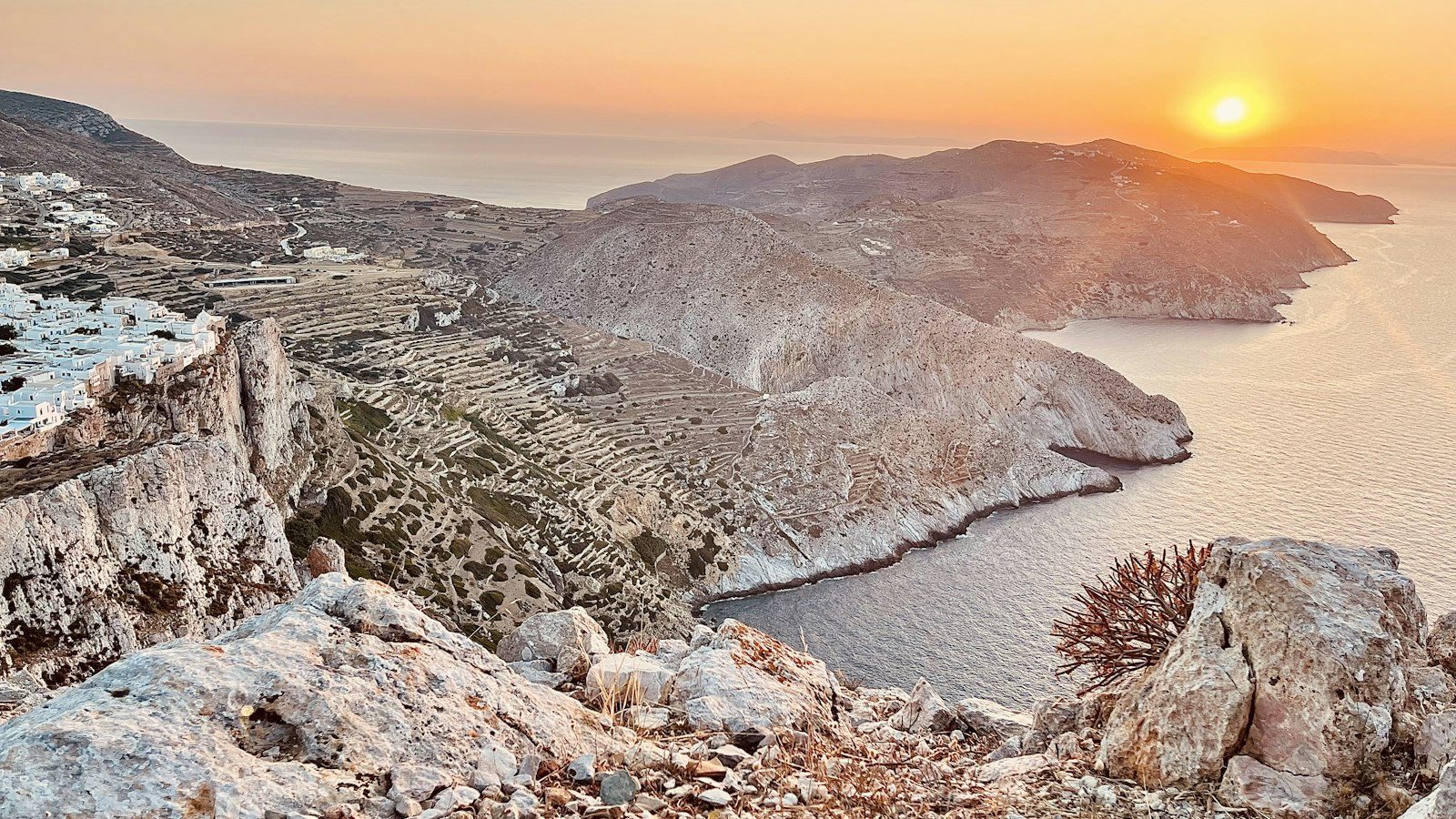
A small, steep Cycladic island between Milos and Santorini, with a cliff-top Chora, one main road and beaches you reach by boat or footpath. You walk up to the Panagia church at sunset, swim at Katergo and eat matsata in a farm village at the far end of the island.
- Best time to visit: June and September
- Daily budget (budget traveller): $85 to $270 USD
- Ideal trip length: 4 to 6 days
Folegandros is a rocky island in the southwestern Cyclades, about 180km south of Athens and between Milos and Sikinos. There is no airport, so everyone arrives by ferry at the small port of Karavostasis. Fast boats from Piraeus take around three and a half to four and a half hours, and slower ones take most of the day. The island has three places worth the name: the port, the Chora and the long farming village of Ano Meria. One road joins them. The Chora is the reason most people come. It sits about 200m above the sea on the edge of a cliff, a chain of small squares shaded by trees, with the medieval Kastro quarter built into the rock behind them. Cars are kept out of the centre, so evenings are spent walking between tavernas and bars rather than dodging traffic. Beaches are mostly pebbly and many can only be reached by a walk or a small boat. Katergo, in the south, is the famous one. Rooms are not cheap in July and August and there are no hostels. Even so, cheap buses, free hiking paths and simple tavernas make it a good island for a solo traveller who wants quiet, not parties.
Folegandros is a narrow, rocky island of about 32 square kilometres in the southwestern Cyclades, with fewer than 800 people living on it all year. For a long time it was a place of exile, and it has kept a slightly remote, unhurried feel even as its reputation has grown. The Chora is the main draw. It is a cluster of whitewashed houses and linked squares on a cliff edge, with the medieval Kastro behind it, where the backs of the houses form the outer wall above the sea. Most visitors come for a few nights after Santorini or Milos. Stay longer and you get the better version: the squares empty at breakfast, a walk up to the Panagia at sunset, a morning boat to Katergo and a long lunch in Ano Meria. Rooms cost more than they used to, but buses, footpaths and simple tavernas keep the rest of the trip reasonable.
Getting here takes some planning. Fast boats from Piraeus take around 3.5 to 4.5 hours and cost from about €84, while slower ferries take 6 to 8 hours but cost from about €48. There are also connections to Milos, Sifnos, Santorini, Ios and Sikinos. Every boat docks at Karavostasis, and a €2 bus climbs to the Chora in about 10 to 15 minutes. Once you are here, walk and use the buses. The Chora is car-free and small. Base yourself there for evenings out, at the port or Livadi for swimming and early ferries, or in Ano Meria for hiking and quiet. Use small boats for Katergo, Agios Nikolaos and Livadaki.
Timing shapes everything. June and September bring warm sea, working boats and fewer people. July and August are hot, full and the most expensive, and the meltemi wind can stop beach boats for days at a time. May and October are lovely for hiking, but the sea is cooler and some places keep short hours. From November to April most of the island closes, ferries are fewer and you should check that your room and a taverna will be open. Folegandros is very safe and English is widely spoken. Nightlife means wine and cocktails on the squares and a few small bars, not clubs. If you want parties, go to Ios. If you want a cliff-top village, a swim and a long dinner outside, stay here.
Folegandros itinerary
Arrive and find your feet
Morning: Take the morning fast boat from Piraeus (around 3.5 to 4.5 hours). Ride the €2 bus up from Karavostasis to the Chora.
Afternoon: Check in, then walk the squares and the Kastro lanes. Have a late lunch under the trees.
Evening: Walk up to the Panagia (10 to 15 minutes) for sunset, then come down for dinner on one of the Chora squares.
Agali and Agios Nikolaos
Morning: Take the private bus to Agali (about €2.50, buy your ticket in the Chora). Swim before the bay fills up.
Afternoon: Walk the coast path to Agios Nikolaos (15 to 20 minutes) or take a taxi boat. Late lunch at an Agali taverna.
Evening: Bus back to the Chora. A gyros dinner and a rakomelo on the square.
Katergo and the port
Morning: Bus down to Karavostasis and take a morning boat to Katergo (about €10-15 return). Bring water, snacks and shade.
Afternoon: Back at the port, eat grilled octopus by the water and swim at one of the small beaches nearby.
Evening: Return to the Chora for a slow evening. Try a cliff-edge bar for a drink.
Ano Meria and matsata
Morning: Take an early bus to Ano Meria. Walk the lanes past threshing floors and windmills, and visit the folklore museum if it is open.
Afternoon: Long lunch of matsata at Irini's or Synantisi. Walk down to Livadaki for a swim if you have the legs for the climb back.
Evening: Watch the sunset from the rocks at the west end of Ano Meria, then take the last bus or a taxi back.
Round the island by boat
Morning: Join a shared boat tour from Karavostasis (about €45-80), booked a day or two ahead and subject to the wind.
Afternoon: Swim at coves you cannot reach by land and look into the mouth of Chrysospilia cave from the water.
Evening: An easy dinner in the Chora and an early night.
Livadi and the lighthouse
Morning: Walk or ride from the port to Livadi, then follow the track south to the Aspropounta lighthouse. Start early and take plenty of water.
Afternoon: Swim at Livadi on the way back and rest through the heat.
Evening: Farewell dinner in the Chora, with fish by the kilo if you want to splash out.
Slow morning and depart
Morning: Have a last walk round the Kastro and breakfast on the square before the day trippers arrive.
Afternoon: Take the bus down to Karavostasis an hour before your ferry, as boats can run early or late.
Evening: Arrive in Piraeus, or carry on to Milos, Santorini or another island.
Best neighbourhoods
- Chora and the Kastro: The main village, on the cliff edge, with its linked squares, the medieval Kastro quarter, most of the tavernas, bars and shops, and the bus stop for the port, Agali and Ano Meria. It is the best base if you are here for one trip. Rooms here cost the most, and those near the squares can be noisy until late in August.
- Karavostasis: The small port 3.5km below the Chora, with a few beaches within walking distance, some cheaper hotels and rooms and the boats for Katergo. It is practical for early or late ferries and for swimming every day. In the evening you will probably take the bus or a taxi up to the Chora.
- Ano Meria: A farming village strung out for several kilometres along the road northwest of the Chora, with windmills, terraced fields, the folklore museum and some of the island's best tavernas. It is very quiet and good for hikers. Without a scooter you rely on a bus that runs only a few times a day.
- Agali: A sandy and pebbly bay on the west coast, with a few tavernas, rooms and a summer bus to the Chora. Taxi boats and footpaths go on from here to Agios Nikolaos and Livadaki. Stay here if you want to swim before breakfast. Nights are dark and very quiet.
- Livadi: A long, shallow bay south of the port, with a handful of rooms and a few smart hotels. It is a 20 to 30 minute walk from Karavostasis and close to the path to the Aspropounta lighthouse. It is peaceful, but you will need wheels or a taxi to reach the Chora at night.
Must-do experiences
- Walk up to the Panagia at sunset: A zigzag path climbs from the edge of the Chora to the white church of the Panagia on the hill above. It takes 10 to 15 minutes and is free. Go about an hour before sunset and wear proper shoes. The path is steep and the evening light over the cliffs is the island's best view.
- Get lost in the Kastro: The medieval Kastro is the oldest part of the Chora. The backs of its houses form the outer wall above the cliff. Walk its two parallel lanes early in the morning, when the bougainvillea is still in shade and the only noise is cats and brooms. Keep your voice down, as people live here.
- Take the boat to Katergo: Katergo is a pebbly cove at the southern tip of the island, with clear water and cliffs around it. In summer, small boats run from Karavostasis for about €10-15 return, and the ride takes around 20 minutes. Go in the morning, when the sea is calmer. There is no shade or food, so bring both.
- Swim at Agali and walk on to Agios Nikolaos: Take the summer bus from the Chora (around €2.50) to Agali, then follow the coast path for 15 to 20 minutes to Agios Nikolaos beach. You can also take a taxi boat for a few euros. Come back to Agali for a late lunch in one of the beach tavernas.
- Eat matsata in Ano Meria: Take the bus to Ano Meria and visit the small folklore museum, which is set in an old farmhouse with its oven, threshing floor and tools. Opening times change with the season, so ask locally. Then eat matsata, the island's handmade pasta, at a taverna such as Irini's or Synantisi.
- Go round the island by boat: Shared boat tours leave Karavostasis in summer and cost about €45-80, depending on how long they last and whether lunch is included. They pass the mouth of the Chrysospilia cave below the Chora and stop at beaches you cannot reach by land. The route depends on the wind, so book a day or two ahead and be flexible.
- Hike an old path across the island: Old mule paths cross the island between chapels and terraces. Popular routes run from the Chora to Agali, which takes about 50 minutes, and from Ano Meria down to Livadaki or Agios Georgios. Start early, carry more water than you think you need, and avoid the middle of the day in summer.
Hidden gems
- The Aspropounta lighthouse at the southern tip, reached on foot from Livadi along a dirt track, with almost nobody around and huge views over the sea towards Sikinos
- The small threshing floors and stone farmhouses (themonies) along the lanes off the main road in Ano Meria, best seen on foot in the late afternoon
- The mouth of the Chrysospilia cave in the cliff below the Panagia, closed to visitors but clearly visible from the water on a boat tour
- Livadaki beach below Ano Meria, about a 45-minute walk down or a taxi boat from Agali, which stays quiet even in August
- The Chora's squares at 8am, when the café chairs are still stacked and locals are buying bread
Daily budget
- Accommodation: budget €45-80 / night (simple room to let or studio, off-peak), mid-range €100-180 (Chora hotel or studio with a view), splurge €300+ (boutique suite with pool or a 5-star hotel). There are no hostels. Prices roughly double in July and August. A climate resilience fee is added per room per night: €2 for rooms to let, €8 for short-term rentals and €2-15 for hotels from April to October, with much lower rates in winter.
- Food: budget €25-35 / day (bakery pie, gyros, supermarket picnic), mid-range €45-70 (taverna lunch and a sit-down dinner), splurge €100+ (fish by the kilo, wine, cocktails). Taverna mains run roughly €12-20, and a plate of matsata is in the same range. Whole fish is priced per kilo, so ask before ordering. Prices are rough guides.
- Transport: budget €4-10 / day (buses at €2-2.50), mid-range €25-45 (scooter hire or a few taxis), splurge €60-90 (small car or ATV in high season). Ferries from Piraeus cost from about €48 on slow boats and around €84 on fast ones. A taxi from the port to the Chora is roughly €10-12. Katergo boats are about €10-15 return.
- Activities: budget €0-5 / day (hiking, beaches, the Panagia walk), mid-range €10-20 (folklore museum, beach taxi boats, Katergo), splurge €45-80 (shared boat tour round the island). Most sights are free. You pay for the folklore museum, the boats and the tours. Boat trips depend on the wind, so keep a spare day.
- Drinks & nightlife: budget €5-10 (a beer or glass of wine on a square), mid-range €20-35 (sunset drinks and a few rakomelos), splurge €50+ (cocktails at a cliff-edge bar). A freddo espresso costs about €3-4.50 and a beer €4-6. Nightlife is bars in the Chora and nothing else.
Where to stay
- Room to let in Chora edges and Karavostasis (€45-110 / night): Family-run rooms and studios are the island's budget option, as there are no hostels. They are simple, often have a kitchenette and pay the lowest climate fee. Many hosts will pick you up from the port.
- Boutique hotel in Chora (€130-300 / night): Small hotels on the edge of the village, often with a pool and views over the sea, a few minutes' walk from the squares. It is the easiest way to have both quiet nights and dinner on foot.
- Beach studio in Agali or Livadi (€70-160 / night): A studio by the water lets you swim before breakfast and sleep in real silence. Check the bus times or hire a scooter, as the Chora is a ride away at night.
- Splurge in Karavostasis (€250-500+ / night): Anemi is the island's 5-star hotel, just above the port, with pools and sea views. It opens from roughly April to October, and the Chora is a short bus or taxi ride away.
What to eat
- Matsata: hand-cut flat pasta, usually served with rooster or rabbit in tomato sauce, found in Ano Meria tavernas
- Kalasouna: a local cheese pie, good for breakfast or a beach picnic from a bakery in the Chora
- Souroto: a soft, slightly sour local goat's cheese, on salads or simply with bread and oil
- Grilled fish and octopus at Karavostasis and Agali, where whole fish is sold by the kilo, so ask the price first
- Rakomelo: warm raki with honey and spices, drunk in the Chora's bars on cool evenings in spring and autumn
- Souvlaki pita or gyros from a grill in the Chora for a cheap dinner, then a freddo espresso on a square in the morning
Day trips
- Katergo and the south coast (About 20 minutes by boat from Karavostasis): A pebbly cove at the southern tip of the island, with very clear water and cliffs around it, and nothing built. It is the island's best-known beach and is quietest in the morning. Small boats run from Karavostasis in summer for about €10-15 return. There is also a rough path from Livadi. Bring water, food and shade, as there are no facilities.
- Sikinos (Roughly 30 to 45 minutes by ferry, depending on the boat): A tiny neighbouring island with a quiet Chora and Kastro on a ridge and very few visitors. It is a good contrast if Folegandros feels busy in August. Take a scheduled ferry when the timetable allows a same-day return, which is most likely in high summer. Check both directions before you go, as some days have only one boat.
- Milos (About 1 hour 20 minutes by fast ferry): A bigger volcanic island with strange white rocks at Sarakiniko, the fishing villages of Klima and Plaka, and plenty of beaches. A day is short, but it works as a taste or a next stop. Take a fast ferry to Adamantas and hire a scooter or take a bus. A day trip only works on days with a morning boat out and an evening boat back, so it is often better as an onward stop.
When to visit
- Spring (April - May): 17-24°C, sunny and fresh, sea still cool until late May. Crowds: Low, busier over Greek Easter. Best for hiking and wild flowers, with cheap rooms. Not everything is open in April, and swimming is bracing. Easter here has a famous procession with the Panagia icon.
- Early summer (June): 24-28°C, dry, sea around 21-23°C. Crowds: Moderate, rising late in the month. Arguably the best month. Long days, warm water, boats running and the Chora still relaxed. Book ferries and rooms a few weeks ahead.
- High summer (July - August): 27-31°C, hot, often windy, sea up to about 25°C. Crowds: Busy, very busy in August. Great for swimming and a lively Chora, but rooms cost the most and buses fill up. The meltemi can cancel beach boats. Book everything well ahead.
- Autumn and winter (September - March): September 24-28°C, cooling to 10-15°C in winter, with wind and some rain. Crowds: Moderate in September, very quiet from mid-October. September is the locals' pick, with warm water and calm squares. From November most hotels, tavernas and boats shut, and ferries are fewer.
Entry rules for your passport
Visa rules for Greece depend on the passport you travel on. Check the official source before you book: European Commission: Schengen visa policy
Getting there
There is no airport on Folegandros, so you arrive by sea. From Piraeus, Seajets fast boats take around 3.5 to 4.5 hours and start at about €84, while slower Fast Ferries sailings take 6 to 8 hours from about €48. Some Blue Star routes call too. Book a few weeks ahead for July and August. The nearest airports are Athens, Milos and Santorini, and from Milos or Santorini you can take a ferry here. Milos is about 1 hour 20 minutes away by fast boat. Folegandros is also linked to Sifnos, Ios, Sikinos, Paros and Naxos, though some of these routes run only a few times a week. All boats arrive at Karavostasis. The public bus meets the ferries and runs up to the Chora in 10 to 15 minutes for €2, cash to the driver. Taxis cost roughly €10-12 but are few, so arrange one ahead. Timetables shrink sharply from November to April, so check them before you book a room.
Border checks: non-EU visitors (other than Swiss, Norwegian, Icelandic, Liechtenstein, Andorran, Monegasque, San Marinese and Vatican citizens, and holders of an EU residence permit or long-stay visa) are registered in the EU's Entry/Exit System (EES) instead of getting a passport stamp. On your first crossing, officers take your photo and/or fingerprints, so allow extra time at passport control. ETIAS, the planned travel authorisation, is not in operation yet, so don't pay any website for one.
Getting around
Folegandros has one main road from Karavostasis through the Chora to the end of Ano Meria. KTEL public buses link the port and the Chora in about 10 to 15 minutes for €2, and you pay the driver in cash. In summer they run often from early morning until around midnight, and they meet the ferries. A less frequent bus runs from the Chora to Ano Meria for about €2.50. Agali has its own private summer bus from the Chora, at about €2.50 each way, so buy tickets at the travel agency office near the bus stop and check the current timetable. Taxis exist, but there are not many. Port to Chora costs roughly €10-12, so book through your host in high season. Scooters, ATVs and small cars are hired at the port and in the Chora, and you should book ahead in July and August. Many beaches are reached only by footpath or small boat: boats run from Karavostasis to Katergo and from Agali to Agios Nikolaos and Livadaki. The Chora itself is car-free and you walk everywhere in it.
Safety
Folegandros is very safe, and crime against visitors is rare. The real risks are the landscape and the weather. Paths are rocky, steep and unshaded, so wear proper shoes, carry plenty of water and avoid hiking in the midday heat. Unfenced cliff edges are common, including near the Chora. Scooter and ATV accidents are the most common cause of injury, as roads are narrow, gravelly and windy, so wear a helmet and do not ride after drinking. In July and August the meltemi wind can make the sea rough and cancel small boats. Swim near other people, watch for sea urchins on rocky entries and take water shoes. The island has a small health centre in the Chora, and serious cases are transferred off the island. Tap water is not generally drunk, so buy bottled or refill where your host says it is safe. The EU emergency number is 112. EU travellers should carry an EHIC and UK travellers a GHIC, and everyone else needs travel insurance with medical cover.
Solo travel tips
- Stay in the Chora: You can walk to dinner, the Panagia and the bus stop, and evenings are sociable without being loud. Pick a room a lane or two back from the squares if you sleep lightly.
- Book ferries first: Fast boats cost far more than slow ones and some days have no sailing at all. Fix your ferries, then build the rest of the trip around them and the bus times.
- Watch the wind: In summer the meltemi can stop beach boats and tours. Keep one flexible day and do Katergo or the boat tour on the first calm morning.
- Eat well for less: Bakery pies, gyros and supermarket picnics on the beach keep costs down. Save the per-kilo fish for one dinner, and have your big meal at lunch in Ano Meria.
- Safety for solo travellers: The main risks are scooters, unshaded paths and unfenced cliffs. Tell your host where you are hiking, carry water and a charged phone, and swim near other people.
- Meet people on the water or a walk: Shared boat tours and guided walks are easy places to start a conversation. So are the Chora's squares at sunset, where the tables are close together and people talk.
Cultural etiquette
- Greet people with 'kaliméra' (good morning) or 'kalispéra' (good evening), and say 'efharistó' (thank you). A little Greek goes a long way in Ano Meria.
- Cover up when you leave the beach. Walking through the Chora in swimwear is not welcome.
- Dress modestly in churches, including the Panagia, with covered shoulders and knees, and keep quiet if a service is on.
- Keep noise down in the Kastro and the back lanes at night. People live there, and sound carries between the walls.
- Ask the price of whole fish per kilo before you order, so the bill is not a surprise.
- Rounding up or leaving 5-10% for good service is appreciated, though not compulsory.
- Stick to marked paths, close any farm gates behind you and take your rubbish with you from beaches and trails.
Frequently asked questions
How do I get to Folegandros and from the port to my room?
Take a ferry from Piraeus. Seajets fast boats take roughly 3.5 to 4.5 hours and start at around €84, while slower Fast Ferries sailings take 6 to 8 hours from about €48. There are also links to Milos, Sifnos, Santorini, Ios and Sikinos. From Karavostasis, the public bus meets the boats and goes up to the Chora in 10 to 15 minutes for €2, paid in cash. A taxi costs about €10-12, but there are few, so ask your host to book one or arrange a pickup.
How many days do I need in Folegandros?
Three nights covers the Chora, the Panagia walk, a day at Agali and a boat to Katergo. Four to six nights lets you add Ano Meria, a long hike, the boat tour round the island and slow mornings. A week works well if you want to add a day on Sikinos or simply do very little.
When is the best time to visit Folegandros?
June and September are the best months. The sea is warm, the boats and buses are running and rooms cost less than in August. July and August are hot, busy and expensive, and the meltemi wind can be strong. May and early October are good for hiking. From November to April most hotels, tavernas and boat services close and ferries run less often.
Do I need a car or scooter on Folegandros?
No, unless you want to reach the remoter beaches below Ano Meria or explore at odd hours. Buses link the port, the Chora, Agali and Ano Meria, and boats and footpaths cover most beaches. If you hire a scooter or ATV, wear a helmet, take the gravel tracks slowly and book ahead for July and August.
Where can I swim on Folegandros?
Agali, on the west coast, is the easiest beach to reach, with a summer bus and tavernas. From there, walk or take a taxi boat to Agios Nikolaos and Livadaki. Katergo, in the south, is reached by a short boat from Karavostasis. The port has small beaches within walking distance, and Livadi has a long shallow bay just to the south. Most beaches are pebbly and have little shade.
Can I visit the Chrysospilia cave?
Not inside. Chrysospilia is a large cave in the cliff below the Chora, where ancient inscriptions have been found, and it is closed to visitors. Boat tours round the island pass close to its mouth when the wind allows, so you can see it from the sea.
Is Folegandros safe for solo female travellers?
Yes. It is one of the calmest islands in the Cyclades, and the Chora is busy and friendly in the evenings. Take normal care with drinks in bars, tell your host where you are going if you hike alone, and avoid riding a scooter on the unlit roads late at night.
What entry rules apply to Greece in 2026?
Greece is in the EU and the Schengen area. Many non-EU visitors, including those from the UK, US, Canada and Australia, can stay visa-free for up to 90 days in any 180-day period across Schengen. The EU's Entry/Exit System has been fully running since April 2026, recording non-EU travellers' fingerprints and photos at the external border. ETIAS is not running yet and has no confirmed start date, so do not pay any website for it. Check official EU and Greek government sites and your own government's travel advice before you go.
Tours and activities in Folegandros | Folegandros in 2 days | Folegandros in 3 days | Folegandros in 4 days | Folegandros in 5 days | Folegandros in 7 days
Joy Plus home | Destinations | Itineraries | Activities | Flights | Budget planner | Calendar | Map | Blog | Lifetime access