Destinations / Europe
Graz, Austria travel guide
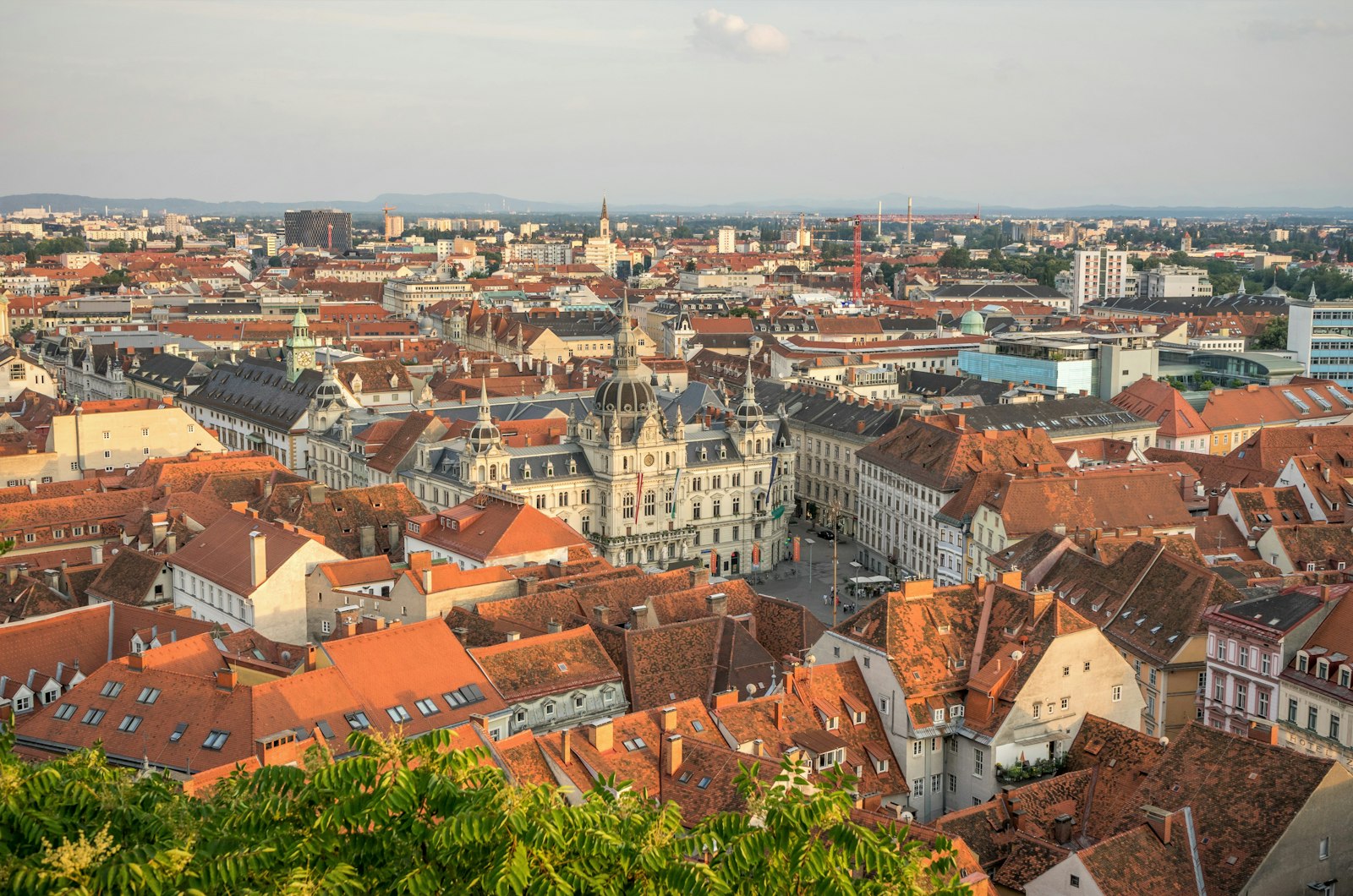
Austria's second city: a UNESCO Renaissance old town, a hilltop clock tower and a serious food scene.
- Best time to visit: May-June, September-October
- Daily budget (budget traveller): $110 to $220 USD
- Ideal trip length: 2 to 3 days
Graz is Vienna's relaxed younger sibling: a UNESCO-listed old town of red roofs and Italianate courtyards, topped by the Schlossberg hill and its landmark clock tower. Styria's pumpkin-seed oil, wine and produce make it Austria's culinary capital, and a 60,000-strong student body keeps prices and pretension down. The blue blob of the Kunsthaus art museum on the Mur river signals a city not stuck in its past.
Graz is the city Austria doesn't brag about, which is exactly why it works. The Altstadt is a UNESCO-listed tangle of arcaded courtyards and red roofs that looks like Florence moved north, but you'll share it with students rather than tour groups. The Schlossberg hill rises right out of the centre, topped by the Uhrturm clock tower whose hour and minute hands are famously swapped. And the Kunsthaus, a blue blob on the Mur, tells you the city doesn't live in its past.
The real draw is the table. Styria is Austria's green heart: pumpkin-seed oil (Kürbiskernöl) that is almost black, Backhendl, Käferbohnensalat, Schilcher rosé, and in autumn cloudy, fizzy Sturm. Graz sits ten minutes from farms and an hour from the Südsteiermark wine roads, so the Kaiser-Josef-Platz market and a Gasthaus lunch menu for €11 are the highlights, not the filler. A student population of around 60,000 keeps beer cheap and bars open late.
Plan for two or three days in town and one day out. The centre is flat and walkable, trams inside the Innenstadt zone are free, and almost everything shuts on Sunday, so Saturday is the day to shop and eat at markets. Come between May and October, when the Schlossberg terraces, Stadtpark and the wine taverns are open. Stay for the Advent season only if you like mulled wine in the fog.
How many days in Graz?
For Graz, we recommend 2 to 3 days. With more time, add a day trip to Südsteirische Weinstraße or Lurgrotte Peggau.
| Trip length | What you'll see | Itinerary |
|---|---|---|
| 2 days · Recommended | Altstadt and Hauptplatz; Schlossberg and the armoury | Graz in 2 days |
| 3 days · Recommended | Adds: Market, Kunsthaus and the Mur | Graz in 3 days |
| 4 days | Adds: Schloss Eggenberg and Stadtpark | Graz in 4 days |
| 5 days | Adds: Südsteiermark wine road | Graz in 5 days |
| 7 days | Adds: Riegersburg castle and Zotter chocolate; Mariatrost, last markets | Graz in 7 days |
Graz itinerary
Arrive, settle, Altstadt and Hauptplatz
Morning: Train to Graz Hbf, or bus 630 from the airport. Tram 1, 3, 6 or 7 to Hauptplatz, free inside the zone. Drop bags, then breakfast and a Semmel at Hofbäckerei Edegger-Tax on Hofgasse.
Afternoon: Walk Herrengasse, step into the Landhaushof and the Burg courtyard with its 1499 double spiral staircase. Glockenspiel at Glockenspielplatz plays at 11:00, 15:00 and 18:00.
Evening: Dinner at Landhauskeller on Schmiedgasse. Then a Puntigamer or a Schilcher in the Bermudadreieck around Prokopigasse and Färberplatz.
Schlossberg and the armoury
Morning: Schlossbergbahn funicular up (about €3), or take the glass Schlossberglift. Uhrturm, the Kasematten terraces and the views over the red roofs. Walk down the 260-step Schlossbergstiege in daylight.
Afternoon: Landeszeughaus on Herrengasse (Tue to Sun) for 32,000 historic weapons. Quick lunch at Frankowitsch on Stempfergasse, a deli famous for its egg spreads.
Evening: Back up for sunset at Aiola Upstairs on the Schlossberg, or a drink at the Schlossberg Restaurant. Take the funicular down after dark.
Market, Kunsthaus and the Mur
Morning: Kaiser-Josef-Platz market (Mon to Sat, best on Saturday, closes around 13:00): pumpkin-seed oil, cheese, a glass of wine at the stalls.
Afternoon: Kunsthaus Graz at opening (Tue to Sun, 10am). Then the Murinsel floating café, and Lend and Gries for Turkish and Syrian food on the west bank.
Evening: Dinner at Der Steirer on Belgiergasse. Then a gig at Orpheum, or drinks around Lendplatz and Mariahilferstrasse.
Schloss Eggenberg and Stadtpark
Morning: Tram 1 to Schloss Eggenberg (Apr to Oct for the guided state rooms, Tue to Sun). Park peacocks and the Alte Galerie.
Afternoon: Tram back and walk Stadtpark and Opernring. Coffee and Apfelstrudel at Operncafé.
Evening: Backhendl dinner at In's Pfandl on Puntigamer Straße, then a last drink in the Altstadt.
Südsteiermark wine road
Morning: Regional train from Graz Hbf to Leibnitz (about 25 min, around €7 each way). Bus or e-bike hire onwards to Gamlitz and Ehrenhausen.
Afternoon: Lunch at a Buschenschank (pine branch over the door) with a Jause plate, Schilcher and pumpkin-seed oil. Ride between vineyards.
Evening: Train back to Graz. Light dinner near your hotel, early night.
Riegersburg castle and Zotter chocolate
Morning: Train to Feldbach, then bus to Riegersburg (about 1h45 total). Castle on its volcanic rock, with views over the Styrian hills.
Afternoon: Zotter Schokoladen-Theater at Bergl nearby: a guided chocolate tasting tour, around €15.
Evening: Return to Graz. Sturm or Schilcher at the Altstadt cellars, then a Kernöl ice cream for dessert.
Mariatrost, last markets, depart
Morning: Tram 1 to the Mariatrost terminus for the twin-towered baroque basilica above the valley. Coffee and a walk through the wooded Rettenbach.
Afternoon: Last stop at Kaiser-Josef-Platz or Lendplatz to buy Kernöl and Styrian cheese to take home. Lunch menu at a Gasthaus.
Evening: Bus 630 or the S5 to the airport, or Railjet to Vienna or Ljubljana.
Best neighbourhoods
- Altstadt: The UNESCO core of arcaded courtyards, Hauptplatz, the Landhaus and narrow shopping lanes.
- Schlossberg: The wooded hill over the city with the Uhrturm clock tower, tunnels and terraced restaurants.
- Lend & Gries: The creative west bank with Kunsthaus, Lendplatz market, ethnic food and the best bars.
- Jakomini & St Leonhard: Student districts of cheap eats, cafés and the university quarter.
Must-do experiences
- Ride up the Schlossberg: Take the Schlossbergbahn funicular or the Schlossberg lift up to the Uhrturm clock tower for the classic red-roof view.
- Explore the Landhaushof: A Renaissance arcaded courtyard that would look at home in Florence, next to the world's largest historic armoury.
- See the Kunsthaus Graz: The biomorphic 'friendly alien' art museum, with rotating contemporary exhibitions.
- Eat at Kaiser-Josef-Platz market: Styria's best produce market, with pumpkin-seed oil, cheeses and morning wine stands.
- Visit Schloss Eggenberg: A UNESCO-listed palace where architecture encodes the calendar, with peacocks in the park.
Hidden gems
- The Double Spiral Staircase in the Burg, a 1499 stone illusion.
- The Murinsel, an artificial island-café floating mid-river.
- The Styrian wine road around Leibnitz, an hour south by car.
- The Zeughaus armoury, with 32,000 pieces of preserved 17th-century weaponry.
Daily budget
- Accommodation: budget €28-45 / night (hostel dorm), mid-range €95-150 (design or boutique double), splurge €220+ (Hotel Wiesler, Schlossberghotel). Prices spike during Advent weekends and Steirischer Herbst. Breakfast is almost always included in hotels.
- Food: budget €22-32 / day (market, bakery, Mittagsmenü), mid-range €45-70 (Gasthaus lunch menu + proper dinner), splurge €110+ (tasting menu at a top Styrian restaurant). Lunch menus (Mittagsmenü) at Gasthäuser run €10-14 with soup and a main, the local hack. Mains at dinner are €16-26.
- Transport: budget €0-6.50 / day (free zone trams + day ticket), mid-range €10-20 (day tickets + a regional train), splurge €80+ (private driver on the wine road). The Altstadt is walkable and trams are free inside the Innenstadt zone. The Schlossbergbahn is about €3 single, or covered by a day ticket.
- Activities: budget €0-12 / day (Schlossberg paths, Stadtpark, one museum), mid-range €25-45 (Zeughaus, Kunsthaus, Eggenberg), splurge €100+ (guided wine tour, tasting at a Weingut). Landeszeughaus and Kunsthaus are each around €10-14, and the Eggenberg state rooms tour is €20, a ticket that also covers the other Joanneum museums for 24 hours. The Schlossberg and Uhrturm exterior are free, and Eggenberg park is €3.
- Drinks & nightlife: budget €8-14 (Puntigamer, Achtel of wine, market Sturm), mid-range €25-40 (Bermudadreieck crawl), splurge €70+ (cocktail bar, late club, Aiola terrace). A half-litre beer is €4.20-5. An Achtel (125 ml) of wine is €2.50-4. Sturm is about €3 a glass in season.
Where to stay
- Budget stay in Lend / Gries (Rates vary by season): JUFA Hotel Graz City on Idlhofgasse: private and family rooms and a short walk to Lendplatz market and the river.
- Boutique hotel in Altstadt (€110-190 / night): Hotel Erzherzog Johann on Sackstraße, a historic townhouse hotel in the old town, or Hotel Daniel by the Hbf for a design stay with a lively lobby.
- Apartment in Jakomini or St Leonhard (€70-115 / night): Student streets with bakeries, cheap bars and Kaiser-Josef-Platz market on the doorstep. Best for 4+ night stays, a 10 to 15 minute walk to Hauptplatz.
- Splurge in Schlossberg foot / Gries riverside (€220-330 / night): Schlossberghotel for hill views and a garden, or Hotel Wiesler on the Mur, a design hotel steps from Kunsthaus with a spa.
What to eat
- Steirisches Backhendl, Styrian fried chicken with pumpkin-seed oil salad
- Käferbohnensalat, scarlet runner bean salad
- Sturm and Schilcher rosé from the Styrian wine roads
- Pumpkin-seed oil over vanilla ice cream, which works better than it sounds
Day trips
- Südsteirische Weinstraße (Gamlitz and Ehrenhausen) (About 1 hour by train and bus): Rolling vineyards on the Slovenian border. Taverns serve Sauvignon Blanc, Welschriesling and Schilcher with a Jause plate. Many Weingüter have terraces. Rent an e-bike for the day. Regional train from Graz Hbf to Leibnitz, about €7 each way, then bus or taxi. E-bike hire in Leibnitz or Gamlitz is about €25 to €35 a day.
- Riegersburg and Zotter Chocolate (About 1h45 by train and bus): A fortress on a volcanic rock above orchards, plus Zotter Schokoladen-Theater at Bergl with a tasting tour of bean-to-bar chocolate. Check the castle season and book Zotter ahead in peak weeks. Train from Graz Hbf to Feldbach, then bus to Riegersburg. A car makes it about an hour.
- Lurgrotte Peggau (20 min by S-Bahn): Austria's largest stalactite cave system, with guided tours April to October. Wear a jacket, it stays cool all summer. S1 from Graz Hbf to Peggau-Deutschfeistritz, then a short walk or taxi. Tours around €12.
When to visit
- Spring (April - June): 10-24°C, bright, a few showers, warm by late May. Crowds: Light to moderate, terraces reopen. Great window. Lendwirbel street festival, markets in full swing, Schloss Eggenberg state rooms open from April. May and early June are perfect.
- Summer (July - August): 24-33°C, humid, afternoon thunderstorms. Crowds: Low in town, students are away. Hot basin city but quiet. Great for Schlossberg evenings and La Strada street-arts festival, though some Gasthäuser close for a few weeks of holiday.
- Autumn (September - October): 10-23°C, golden and mostly dry, morning mist. Crowds: Moderate, drops after October. The best season. Sturm and pumpkin harvest, Aufsteirern folk festival, Steirischer Herbst arts festival and the wine roads at their busiest and prettiest.
- Winter (November - March): -4 to 5°C, fog and grey spells, occasional snow. Crowds: Low, except Advent weekends. Cheapest hotels and a lovely Advent market trail across several squares from late November. Otherwise grey, foggy and quiet, so go for food and museums.
Entry rules for your passport
Visa rules for Austria depend on the passport you travel on. Check the official source before you book: European Commission: Schengen visa policy
Getting there
Graz Airport (GRZ) is about 9 km south of the centre, with flights to Vienna, Frankfurt, Munich and holiday routes. Bus 630 or the S5 reach Graz Hbf in about 20 minutes for roughly €3 to €5, and a taxi is about €25 to €30. By train, Railjets run hourly from Wien Hbf in about 2h35, with Sparschiene advance fares from about €10 to €20 and flexible fares around €40. Munich takes 4 to 5 hours, and Ljubljana about 3 hours by Maribor. Graz Hbf is a 15-minute walk from Hauptplatz, or tram 1, 3, 6 or 7. Flixbus from Vienna takes about 2h45 for around €10 to €15.
Border checks: non-EU visitors (other than Swiss, Norwegian, Icelandic, Liechtenstein, Andorran, Monegasque, San Marinese and Vatican citizens, and holders of an EU residence permit or long-stay visa) are registered in the EU's Entry/Exit System (EES) instead of getting a passport stamp. On your first crossing, officers take your photo and/or fingerprints, so allow extra time at passport control. ETIAS, the planned travel authorisation, is not in operation yet, so don't pay any website for one.
Getting around
The old town is pedestrianised and walkable, with trams running free inside the central Altstadt zone. The Schlossbergbahn funicular and the Schlossberglift handle the hill climb. Graz Airport is 20 minutes by train or bus. Vienna is two and a half hours by train, Klagenfurt 45 minutes on the Koralm line that opened in December 2025, Ljubljana about three hours, and Slovenia's border is an hour by car.
Safety
Graz is very safe with low crime rates, even at night in the centre. Standard care applies around the main station after dark and on busy tram lines. The Schlossberg's 260 steps are steep and unlit in places at night, so use the funicular after dark. Cyclists use the Mur riverside paths at speed.
Solo travel tips
- Eat the Mittagsmenü at a Gasthaus: From about 11:30 to 14:00 most traditional Gasthäuser offer a lunch menu with soup and a main for €10-14. Sit at the Stammtisch or the small tables and you'll fit in without trying.
- Use the free tram zone: Trams inside the Innenstadt zone cost nothing, so the old town, Hauptplatz and Jakominiplatz are an easy hop. Check the stop signs for the zone border before you ride out to Eggenberg or Mariatrost.
- Budget pick: JUFA Hotel Graz City: On Idlhofgasse near Lendplatz, with a mix of solo travellers and school groups. Social without a forced party schedule, and a 15-minute walk to Hauptplatz.
- Climb the Schlossberg early or late: Midday has tour groups and sun. Go at 9am for empty paths or at golden hour for the terraces. The 260 steps are unlit in places, so use the funicular back down after dark.
- Solo female travellers: Graz is very safe at night. The Bermudadreieck gets rowdy on weekends and the area around the Hauptbahnhof is a little rough after midnight, so take a taxi or walk the lit Altstadt streets. Taxis can be called by phone or app.
- Find your tribe at Lend or Stadtpark: Lend has the small galleries, music venues and cafés where students linger. In summer Stadtpark and the Murinsel have open-air events, and the Lendwirbel festival in late spring floods the west bank with free gigs.
Cultural etiquette
- Greet with 'Grüß Gott' or 'Servus' when you enter small shops and Gasthäuser, and 'Auf Wiedersehen' when you leave. Silence reads as rude.
- Tip 5-10%. Tell the waiter the total including tip as you pay ('Zwanzig, bitte') rather than leaving coins on the table.
- Almost everything shuts on Sunday and public holidays. Shop for Kernöl and groceries on Saturday, or at Hbf supermarkets.
- Say 'Prost' and make eye contact when you clink glasses, or the old superstition says seven years of bad sex.
- Cash is still king in small Gasthäuser and market stalls. Carry €30 to €50, and don't be surprised if a card minimum applies.
- Pumpkin-seed oil stains. Wear dark colours when eating Käferbohnensalat or Backhendl.
- Keep noise down after 22:00 in residential streets, and sort your rubbish properly in hostels and apartments.
Frequently asked questions
How many days do you need in Graz?
Two days covers the Schlossberg, the UNESCO old town courtyards, the Zeughaus armoury and Kunsthaus, plus a proper Styrian dinner. A third day adds Schloss Eggenberg and a trip out to the southern Styrian wine roads.
Is Graz worth visiting?
Yes. It has Austria's best-preserved old town, a distinctive food culture built on Styrian produce, and a young, affordable atmosphere. It's noticeably cheaper and calmer than Vienna or Salzburg while still feeling like a real city rather than a museum.
Is Graz expensive?
Cheaper than Vienna and much cheaper than Salzburg: budget $110 to $220 a day. Hotels typically run $80 to $150, mains $15 to $25 and the Schlossbergbahn about $3. Trams within the central zone are free, and market lunches are excellent value.
What is Graz famous for?
Its UNESCO World Heritage old town, the Uhrturm clock tower on the Schlossberg, the world's largest historic armoury, the Kunsthaus 'friendly alien' and Styrian pumpkin-seed oil. It's also a UNESCO City of Design.
How do you get from Vienna to Graz?
Railjet trains run about every hour from Vienna Hauptbahnhof to Graz Hauptbahnhof in about two and a half hours, with advance fares from roughly $20. Graz Airport also has connections to Frankfurt, Munich and several holiday routes.
When is the best time to visit Graz?
May to June and September to October for warm weather, terrace season and the Styrian harvest. Late September brings Sturm, the young wine. The Advent markets in December are among Austria's prettiest, spread across several squares.
Is Graz good for solo travellers?
Yes. It's safe, walkable and full of students, so bars and cafés are relaxed for solo visitors and English is widely spoken. The Schlossberg, markets and free-zone trams make it easy to fill days independently and cheaply.
Tours and activities in Graz | Graz in 2 days | Graz in 3 days | Graz in 4 days | Graz in 5 days | Graz in 7 days
Can't decide? Compare Graz with...
Joy Plus home | Destinations | Itineraries | Activities | Flights | Budget planner | Calendar | Map | Blog | Lifetime access