Destinations / Europe
Reims, France travel guide
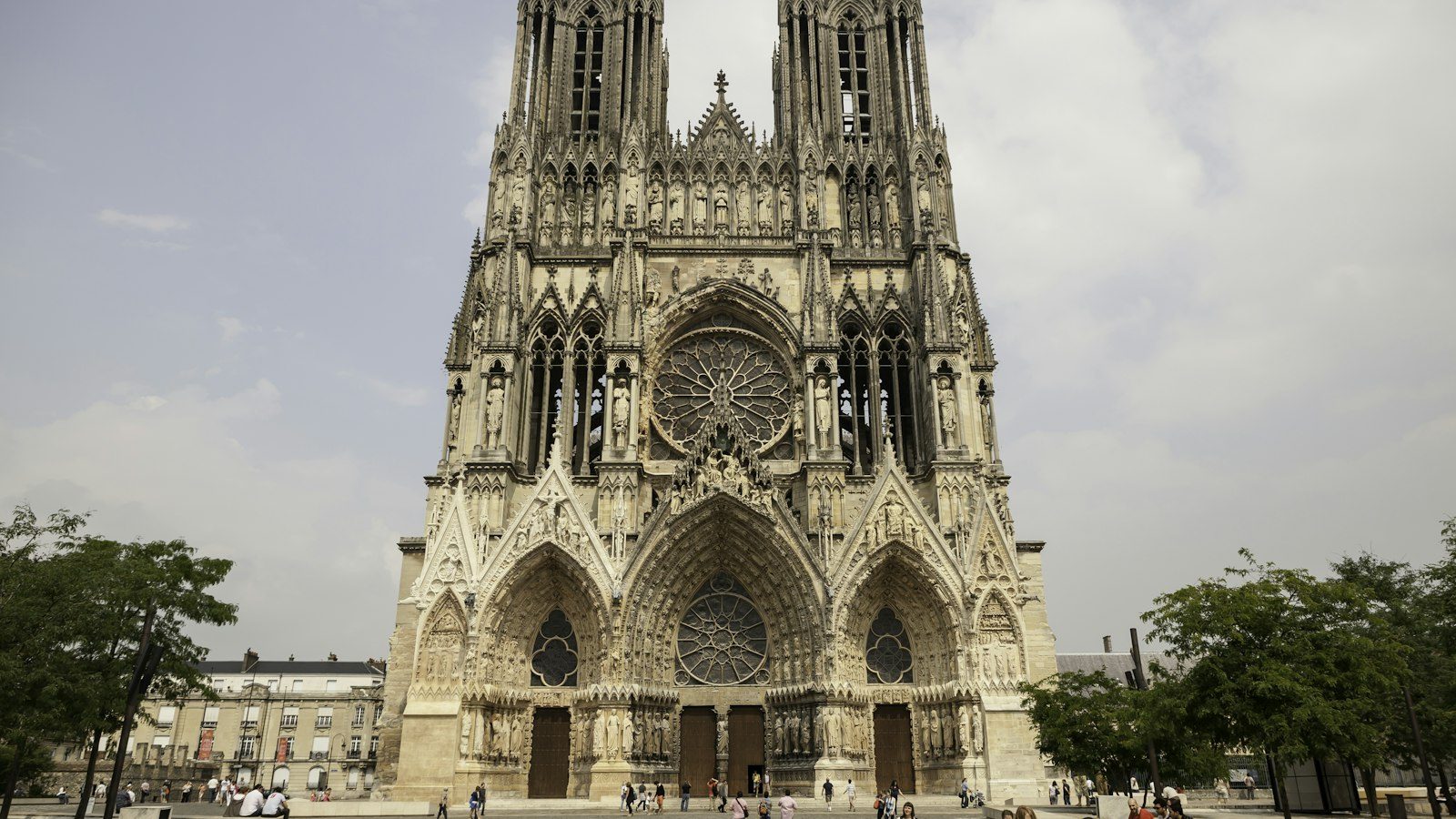
A Champagne city 45 minutes from Paris by TGV, where French kings were crowned. You stand under the Gothic façade of the cathedral, walk through chalk cellars dug by the Romans and finish the day with a glass of something local on a café terrace.
- Best time to visit: May to June and September
- Daily budget (budget traveller): $90 to $270 USD
- Ideal trip length: 3 to 5 days
Reims sits in the north-east of France, about 45 minutes from Paris Gare de l'Est on the fastest TGVs, which makes it one of the easiest escapes from the capital. For more than 800 years French kings were crowned in its cathedral. The building took heavy shelling in the First World War, and its rebuilt Gothic front, its smiling angel and its Chagall windows are still the main reason people come. The other reason is underground. The big Champagne houses age millions of bottles in chalk pits and tunnels beneath the city, and you can go down into them for a tour and a tasting. Reims is not a postcard old town. Much of it was rebuilt in the 1920s, so you get wide streets, Art Deco shopfronts and a pedestrian main drag lined with brasseries instead of medieval lanes. That makes it relaxed, walkable and fairly cheap to sleep in. The centre is compact, a tram links the station with the southern districts and trains run out to Épernay and the vineyards. A solo traveller can easily fill a few days with cellars, churches and long lunches without spending Paris money.
Reims is the unofficial capital of Champagne and one of the most historic cities in France. It is a city of about 180,000 people on the plains east of Paris, ringed by vineyard hills. Clovis was baptised here around the year 500, and almost every French king after him came to Notre-Dame to be crowned. The First World War left the city badly damaged, and much of the centre was rebuilt in the 1920s and 1930s. That is why you see so many Art Deco façades, as well as the Boulingrin market and the Carnegie Library. Most visitors come on a day trip from Paris for the cathedral and one cellar. Stay a few nights and you get the better version: the cathedral almost empty at 8am, a slow lunch at the market, a tasting in the afternoon and dinner on a terrace without rushing for the last train. It costs less than Paris, and the main sights cost little or nothing. Cellar tours are the big expense.
Getting here is easy. Direct TGVs from Paris Gare de l'Est take about 45 minutes, with around 15 to 19 trains a day and advance fares from about €15. From Charles de Gaulle airport, high-speed trains run to Champagne-Ardenne TGV station outside the city, and you connect by tram or a local train. Once you are here, walk. The centre is flat, the station is 10 minutes from the cathedral and the Champagne hill is a 25-minute stroll south-east. Base yourself in the cathedral quarter for sights and quiet nights, near Drouet d'Erlon for bars and the station, or on the hill if cellars are the point of your trip. Use the tram for Saint-Remi and TER trains for Épernay and the vineyard villages.
Timing shapes the trip. Spring and early summer bring green vines, long evenings and the tower climbs. The harvest in late August and September is the most atmospheric time in the villages. Winter is cold and quiet, the towers shut from mid-November to mid-February and some houses cut back their tour times, though the Christmas market brightens December. Two major museums, the Palais du Tau and the Musée des Beaux-Arts, are closed until 2027, so do not plan around them yet. Reims is safe and easy to visit alone, and staff at the big houses speak English. Evenings revolve around brasseries and wine bars rather than clubs. If you want big nightlife, go back to Paris. If you want Gothic stone, chalk cellars and a good glass by the cathedral, stay here.
Reims itinerary
Arrive and see the cathedral
Morning: Take a morning TGV from Paris Gare de l'Est (about 45 minutes). Drop your bag and walk 10 minutes to Notre-Dame.
Afternoon: Spend an hour in the cathedral looking at the Smiling Angel, the gallery of kings and the Chagall windows. Then wander Place du Forum and the Cryptoportique.
Evening: Walk down Place Drouet d'Erlon for a drink on a terrace, then have dinner at a brasserie nearby.
Towers and Saint-Remi
Morning: Join a guided tower climb (€9, 249 steps) if it is between mid-February and mid-November and not a Monday. Otherwise, take your time in the cathedral and the nearby Carnegie Library.
Afternoon: Take the tram or walk to the Basilica of Saint-Remi. It is free and calm. Then visit the Musée Saint-Remi in the old abbey next door.
Evening: Walk back through the quiet streets for dinner in the cathedral quarter, and see the façade lit up after dark.
The Champagne hill
Morning: Book a morning tour at Taittinger (from €40) and go down into the old chalk quarries beneath Place Saint-Nicaise.
Afternoon: Picnic in the Parc de Champagne, then do an afternoon visit at Pommery (from about €30) or Veuve Clicquot (from €36). Leave a gap between the two.
Evening: Keep it light after two tastings. A simple dinner and plenty of water, and walk or take a taxi back down the hill.
Market, Romans and 1945
Morning: Shop and snack at the Halles du Boulingrin, busiest on a Saturday morning. Walk to the Porte de Mars, the Roman arch nearby.
Afternoon: Visit the Musée de la Reddition, where the German surrender was signed in 1945. From May to September, add the Chapelle Foujita.
Evening: Have dinner at a classic brasserie near the Boulingrin, then a glass of grower Champagne at a wine bar.
Épernay and Hautvillers
Morning: Take a TER to Épernay (about 30 minutes). Walk the Avenue de Champagne, past the grand houses of Moët and others.
Afternoon: Take a taxi, a bike or the walking trail up to Hautvillers, where Dom Pérignon is buried in the abbey church. Enjoy the views over the Marne valley.
Evening: Take the train back to Reims. Have a relaxed dinner in the centre and an early night.
Montagne de Reims
Morning: Join a guided e-bike or small-group minibus tour to the vineyard villages, or take the train to Rilly-la-Montagne and walk the vineyard trails.
Afternoon: See the Verzenay lighthouse among the vines and the twisted beeches of the Faux de Verzy in the forest. Taste at a family grower.
Evening: Back in Reims, have a farewell dinner on Place Drouet d'Erlon or in the cathedral quarter.
Slow morning and depart
Morning: Visit the cathedral one last time when it opens, then have breakfast with a coffee on Place du Forum.
Afternoon: Buy biscuits roses at Fossier and a bottle from a grower, then catch an afternoon TGV to Paris or the airport.
Evening: Arrive in Paris, or carry on east towards Strasbourg.
Best neighbourhoods
- Cathedral quarter: The streets around Notre-Dame, the Palais du Tau and Place du Forum. This is the historic core, with most of the sights, the tourist office and plenty of cafés. It is quiet after dark and a 10-minute walk from the station, which makes it the easiest base for a first visit.
- Place Drouet d'Erlon and the station: The long pedestrian street running south from the station is lined with brasseries, bars and cinemas, and it is the liveliest part of town at night. Hotels here are practical and cheaper than near the cathedral. Rooms facing the street can be noisy at weekends, so ask for one at the back.
- Boulingrin and Porte de Mars: The northern edge of the centre, around the Art Deco covered market and the Roman triumphal arch. It feels local, with good bakeries, market stalls and some of the best brasseries in town. The tram and the station are close by.
- Saint-Remi: A calm residential district in the south, built around the Romanesque Basilica of Saint-Remi and its museum. There are fewer restaurants, but it is peaceful, guesthouses cost less and the Champagne hill is a short walk east. It is about 25 minutes on foot to the cathedral, or a short tram ride.
- Saint-Nicaise and the Champagne hill: The slope in the south-east where Taittinger, Pommery, Veuve Clicquot and Ruinart have their cellars, along with the grand Domaine Les Crayères hotel and the Parc de Champagne. It is leafy and quiet, and the best base if cellar visits are the point of your trip. There is little to do in the evenings, though.
Must-do experiences
- See Notre-Dame Cathedral: Entry to the cathedral is free. Look for the Smiling Angel on the west front, the gallery of kings and the blue Chagall windows in the apse. Go early in the morning, before the tour groups arrive, and come back at dusk when the stone turns gold.
- Climb the cathedral towers: The towers are visited only on guided climbs of 249 steps, and adult tickets cost €9. Book online. The climb is free for under-18s and for EU citizens aged 18 to 25. It runs from mid-February to mid-November and is closed on Mondays, so plan ahead if you visit in winter.
- Go down into a Champagne cellar: Pick one or two houses rather than four. Pommery starts at about €30, with a grand staircase and art in the chalk pits, while Veuve Clicquot starts at €36 and Taittinger at €40 for cellars that include Roman-era chalk quarries. Ruinart costs from €90. Book ahead, especially at weekends.
- Visit the Basilica of Saint-Remi: This huge Romanesque church in the south of the city holds the tomb of the bishop who baptised Clovis, the first king of the Franks. It is free, rarely crowded and often more atmospheric than the cathedral. The Musée Saint-Remi next door, in the old abbey, covers local history from Roman times.
- Stand where the war in Europe ended: The Musée de la Reddition is the schoolroom where Germany signed its surrender on 7 May 1945, with the maps still on the walls. It reopened in 2026 after renovation. Like the other city museums, it is free on the first Sunday of the month.
- Eat your way round the Halles du Boulingrin: The 1920s concrete market hall has a huge curved roof and stalls selling cheese, charcuterie, oysters and Champagne by the glass. Go on a Saturday morning, when it is busiest. Have lunch at a stall counter or at the brasserie across the street.
- Walk the Roman city: Start at the Porte de Mars, the largest Roman arch to survive in Roman Gaul, then walk down to Place du Forum and the Cryptoportique, a half-buried Roman gallery. The full loop is free and takes about an hour on foot.
Hidden gems
- The Chapelle Foujita, a small chapel painted by the Japanese-French artist Léonard Foujita, open only from May to September
- The Bibliothèque Carnegie, an Art Deco library near the cathedral, paid for by the Carnegie Foundation after the First World War, with a lobby you can usually walk into for free
- The Parc de Champagne, a large park beside the Pommery estate where locals jog and picnic, a calm break between cellar visits
- The Église Saint-Jacques, the city's only surviving medieval parish church, tucked off a shopping street near Place Drouet d'Erlon
- The view of the cathedral from the gardens behind the Palais du Tau at dusk, when most visitors have gone back to the station
Daily budget
- Accommodation: budget €28-45 / night (hostel bed or basic hotel), mid-range €90-150 (3-star hotel or central apartment), splurge €400+ (Domaine Les Crayères or a 5-star suite). Prices rise at weekends, during the harvest and the Christmas market, and for big events. A small tourist tax is added per night. Single rooms in budget hotels are good value compared with Paris.
- Food: budget €22-32 / day (bakery breakfast, market lunch, supermarket picnic), mid-range €45-70 (brasserie lunch menu and a sit-down dinner), splurge €150+ (a Michelin-starred meal). Brasserie lunch menus run about €18-30, and dinner mains roughly €18-30. Market stalls and bakeries keep lunch cheap. Prices are rough guides.
- Transport: budget €0-5 / day (walking, tram day ticket around €5), mid-range €10-25 (TER to Épernay plus a taxi), splurge €130+ (small-group vineyard minibus tour). A one-hour Citura ticket is about €2. TGV fares from Paris run from about €15 in advance to about €55 for flexible fares. Never drive after tastings.
- Activities: budget €0-10 / day (cathedral and Saint-Remi free, towers at €9), mid-range €30-45 (one Champagne house tour), splurge €90+ (Ruinart or a premium tasting). Entry-level tours start at about €30 at Pommery, €36 at Veuve Clicquot and €40 at Taittinger. City museums are free on the first Sunday of the month.
- Drinks & nightlife: budget €5-12 (a beer or a glass of grower Champagne), mid-range €20-40 (a few glasses at a wine bar), splurge €80+ (a bottle from a top house). A coffee costs about €2-3 and a glass of Champagne about €8-15 in bars. Nightlife centres on Place Drouet d'Erlon and the streets around the Boulingrin.
Where to stay
- Social hostel in West of the centre, by the Parc Léo Lagrange (€28-45 / night): The CIS Reims Champagne is the city's main hostel-style option, with simple dorms and private rooms. It is about a 15-minute walk from the cathedral, and staying there is the easiest way to keep a solo budget low.
- Boutique hotel in Near Place Drouet d'Erlon (€130-220 / night): Hôtel de la Paix is a central four-star with a small pool and garden, a few minutes from the station. You are close to the brasseries, and the cathedral is a short walk away.
- Apartment in Cathedral quarter (€80-140 / night): Flats in older buildings near the cathedral give you a kitchen for market food and a quiet street at night. Check whether there is a lift and how far the place is from the station if you have heavy luggage.
- Splurge in Saint-Nicaise and the Champagne hill (€400-900+ / night): Domaine Les Crayères is a château hotel in its own park, next to the Pommery estate, with a famous restaurant. Several of the big cellars are a short walk away.
What to eat
- Biscuits roses de Reims: pink, crunchy biscuits that locals dunk in Champagne. Buy them from the long-running Fossier shop
- Jambon de Reims: a pork terrine with herbs, set in jelly and crusted with breadcrumbs, from charcuteries and the Boulingrin market
- Chaource and Langres: two creamy regional cheeses, good with a glass of Champagne or on a market picnic
- A brasserie lunch menu: two or three courses for about €18-30 at the brasseries on Place Drouet d'Erlon or near the Boulingrin
- Champagne by the glass: about €8-15 in bars, less at grower stalls. Ask for a grower Champagne (récoltant-manipulant) as well as the big names
- Ratafia and Coteaux Champenois: a sweet fortified aperitif and the region's rare still wines, worth trying at a wine bar
Day trips
- Épernay and Hautvillers (About 30km south of Reims, around 30 minutes by TER): Épernay's Avenue de Champagne is lined with grand houses and their cellars, including Moët & Chandon. The hilltop village of Hautvillers, where Dom Pérignon worked and is buried, has views over the Marne valley vineyards. Take a TER from Reims to Épernay, then walk to the Avenue de Champagne. For Hautvillers, take a taxi, hire a bike or walk the marked trail of about 6km. Check the last train back before you set off.
- Montagne de Reims (About 15 to 20km south of Reims): A forested hill ringed by Grand Cru vineyard villages. The highlights are the Verzenay lighthouse, a museum set among the vines, and the Faux de Verzy, a forest of strange, twisted beech trees. Take a TER to Rilly-la-Montagne for vineyard walks, or join a small-group minibus or guided e-bike tour from Reims, as buses to Verzy and Verzenay are limited. Never drive after tastings.
- Laon (About 50km north-west of Reims, around 40 minutes to 1 hour by TER): A medieval hilltop town with a huge Gothic cathedral, famous for the stone oxen on its towers, and long ramparts with views over the plain. It feels very different from Reims and sees few tourists. Take a direct TER from Reims to Laon. From the lower town station, walk up the steep steps to the old town, which takes about 20 minutes.
When to visit
- Spring (March - May): 8-19°C, mild with some showers, cool in the cellars all year. Crowds: Low to moderate, busier at Easter and on May bank holidays. Good value and pleasant for walking. The tower climbs restart in mid-February, and the Foujita chapel opens in May. Bring a waterproof.
- Early summer (June): 17-24°C, long light evenings. Crowds: Moderate, busier at weekends. Arguably the best month. Green vineyards, terrace weather and easy cellar bookings on weekdays. The Joan of Arc festival usually fills the streets in June.
- High summer and harvest (July - September): 20-27°C, occasionally hotter, cooling in September. Crowds: Busy at weekends and in August, lively in the villages at harvest time. Great for vineyard days and outdoor drinking, but book cellars and rooms ahead. The harvest usually runs from late August into September, a fun time to be around.
- Autumn and winter (October - February): October 10-16°C, then 1-7°C in winter, damp and grey. Crowds: Quiet, except for the Christmas market in December. Cheap rooms and empty churches, but short days. The tower climbs stop from mid-November to mid-February and some houses run fewer tours. The cellars feel the same in any season.
Entry rules for your passport
Visa rules for France depend on the passport you travel on. Check the official source before you book: European Commission: Schengen visa policy
Getting there
Reims has no passenger airport. The nearest major one is Paris Charles de Gaulle. From there, high-speed trains run in about 30 to 45 minutes to Champagne-Ardenne TGV station, south-west of Reims, where you connect by tram B or a short TER hop to the centre. From central Paris, direct TGVs leave Gare de l'Est for Reims station roughly 15 to 19 times a day. The fastest take about 45 minutes, and advance fares start at about €15. Slower TER services and connections take about 1 hour 20 minutes to 1 hour 45 minutes. Book TGVs early for the best prices, especially on Friday evenings and at weekends. Reims station is on the edge of the centre, 10 minutes' walk from the cathedral. Trains also link Reims with Épernay, Laon and Charleville-Mézières, and TGVs continue east towards Strasbourg. If you drive, the A4 links Reims with Paris in about 1.5 to 2 hours, with tolls. Use a city-centre car park and leave the car there while you are tasting.
Border checks: non-EU visitors (other than Swiss, Norwegian, Icelandic, Liechtenstein, Andorran, Monegasque, San Marinese and Vatican citizens, and holders of an EU residence permit or long-stay visa) are registered in the EU's Entry/Exit System (EES) instead of getting a passport stamp. On your first crossing, officers take your photo and/or fingerprints, so allow extra time at passport control. ETIAS, the planned travel authorisation, is not in operation yet, so don't pay any website for one.
Getting around
The centre of Reims is flat and compact, so you will walk most of the time. It takes about 10 minutes from the station to the cathedral and 25 to 30 minutes from the cathedral to Saint-Remi or the Champagne houses on the hill. The Citura network runs two tram lines and a set of buses. A one-hour ticket costs about €2, and a day ticket is around €5. Buy them from machines at tram stops or in the Citura app, and validate every time you board. Tram B runs out to Champagne-Ardenne TGV station, where some high-speed trains stop, but it is not very frequent, so check times before you rely on it. Buses thin out in the evening, so plan late trips home or walk. Taxis wait at the station and can be booked by phone, and ride-hailing apps work in the city. For the vineyards, TER trains run to Épernay and to villages such as Rilly-la-Montagne. Bike hire and guided e-bike tours are the easiest way to reach places like Verzenay and Verzy without a car. Do not drive after tastings, as France has strict drink-driving limits.
Safety
Reims is a safe city for visitors, and violent crime against tourists is rare. Watch your phone and bag on Place Drouet d'Erlon on busy weekend nights, around the station and on crowded trams. The pedestrian street can get rowdy late at night, so walk home on lit main roads. The real risks are underground and in your glass. Cellars stay at about 10-12°C all year, and the steps can be steep and damp, so wear proper shoes and take a layer. Several tastings in one day add up, so eat something between visits, drink water and never drive or cycle on roads afterwards. Tap water is safe to drink. The EU emergency number is 112, and 15 calls an ambulance in France. EU travellers should carry an EHIC, UK travellers a GHIC, and everyone else needs travel insurance with medical cover.
Solo travel tips
- Space out the tastings: One cellar in the morning and one in the afternoon is the sensible limit. Eat in between, drink water and save the expensive tasting for the house you care about most.
- Book tours before you book trains: Weekend slots at the big houses fill up first. Lock in your cellar times, then plan your trains and the rest of the day around them.
- Get to the cathedral early: Coach groups from Paris arrive late in the morning. Go when the doors open, or come back in the late afternoon, and you will have the nave almost to yourself.
- Eat lunch, not dinner, out: Brasserie lunch menus are far cheaper than dinner. Have your big meal at midday and pick up a market or bakery supper for the evening.
- Safety for solo travellers: The main risks are slippery cellar steps, too many glasses and late-night crowds on Drouet d'Erlon. Wear grippy shoes, pace yourself and take a taxi back from the hill after dark.
- Meet people on a tour: Small-group vineyard tours and cellar visits mix you with other travellers, and conversation flows easily over a glass. Wine bars with counter seating are also easy places to chat.
Cultural etiquette
- Say 'bonjour' when you walk into a shop, café or cellar, and 'merci, au revoir' when you leave. Skipping the greeting comes across as rude in France.
- Dress modestly in the cathedral and Saint-Remi, keep your voice down and stay out of the way if a Mass is going on.
- At tastings, it is fine to sip and leave the rest of the glass. No one expects you to finish every pour.
- Arrive on time for cellar tours. They leave at fixed times, and latecomers are often turned away or moved to a later slot.
- Lunch usually runs from about noon to 2pm and dinner from about 7.30pm. Many kitchens close between services.
- Service is included in French bills. Leaving small change or rounding up for good service is appreciated, though not expected.
- Do not drink from open bottles in the street at night in the centre, and keep the noise down on residential streets after the bars close.
Frequently asked questions
How do I get to Reims and from the station to my room?
Most people take a direct TGV from Paris Gare de l'Est. The fastest trains take about 45 minutes, and there are roughly 15 to 19 a day. Advance fares start at about €15 and flexible peak fares reach about €55. Trains arrive at Reims station on the edge of the centre. The cathedral quarter is a flat 10-minute walk away, and Place Drouet d'Erlon starts right outside. For Saint-Remi or the Champagne hill, take the tram or allow 25 to 30 minutes on foot.
How many days do I need in Reims?
Two nights covers the cathedral, one or two Champagne cellars and Saint-Remi. Three to five nights lets you add the Roman sights, the Boulingrin market, the Surrender Museum and a day in Épernay and the vineyards. A week works if you want to slow down, add the Montagne de Reims and a trip to Laon, and space out your tastings.
When is the best time to visit Reims?
May, June and September are the best months. The weather is mild, the vineyards are green and the cathedral towers are open. The grape harvest usually runs from late August into September, which brings a buzz to the villages but busier houses. July and August are warm and busy at weekends. Winter is cold and grey, the tower climbs stop from mid-November to mid-February, and the Christmas market usually sets up by the cathedral from late November.
Do I need to book Champagne house visits?
Yes, for the big names, especially at weekends and in summer. Tours run at fixed times, and many sell out days ahead. Entry-level visits cost from about €30 at Pommery, €36 at Veuve Clicquot and €40 at Taittinger, and Ruinart starts at about €90. Lanson and smaller houses usually start at around €30-35. One or two visits a day is plenty.
Can I see the vineyards without a car?
Yes. TER trains run from Reims to Épernay in about 30 minutes, and from there you can walk the Avenue de Champagne or take a taxi or bike up to Hautvillers. Trains also stop at Rilly-la-Montagne, where walking trails start in the vineyards. Small-group minibus tours and guided e-bike tours from Reims cover family growers, the Verzenay lighthouse and the twisted beeches at Verzy. Half-day minibus tours start from about €130-150.
Which sights are closed at the moment?
Two big ones. The Palais du Tau, which holds the coronation treasures, is closed for works and is due to reopen in 2027. The Musée des Beaux-Arts is closed for a major rebuild and is due to reopen in June 2027. The cathedral itself stays open, and the guided tower climbs are still booked through the Palais du Tau. Check before you go, as reopening dates can slip.
Is Reims safe for solo female travellers?
Yes. It is a calm, walkable city, and the centre is busy and well lit in the evening. Take normal care with drinks in bars on Place Drouet d'Erlon, keep to main streets late at night and use a taxi if you are coming back from the Champagne hill after dark. Cellar tours are a sociable, low-pressure way to meet people when you are on your own.
What entry rules apply to France in 2026?
France is in the EU and the Schengen area. Many non-EU visitors, including those from the UK, US, Canada and Australia, can stay visa-free for up to 90 days in any 180-day period across Schengen. The EU's Entry/Exit System has been fully running since 10 April 2026 and records non-EU travellers' fingerprints and photos at the external border, so expect queues on your first entry. The ETIAS travel authorisation, which will cost €20, had not started by November 2026, so check whether it has begun before you travel. Confirm the rules on official EU and French government websites.
Tours and activities in Reims | Reims in 2 days | Reims in 3 days | Reims in 4 days | Reims in 5 days | Reims in 7 days
Can't decide? Compare Reims with...
Joy Plus home | Destinations | Itineraries | Activities | Flights | Budget planner | Calendar | Map | Blog | Lifetime access