Destinations / Europe
Rocamadour, France travel guide
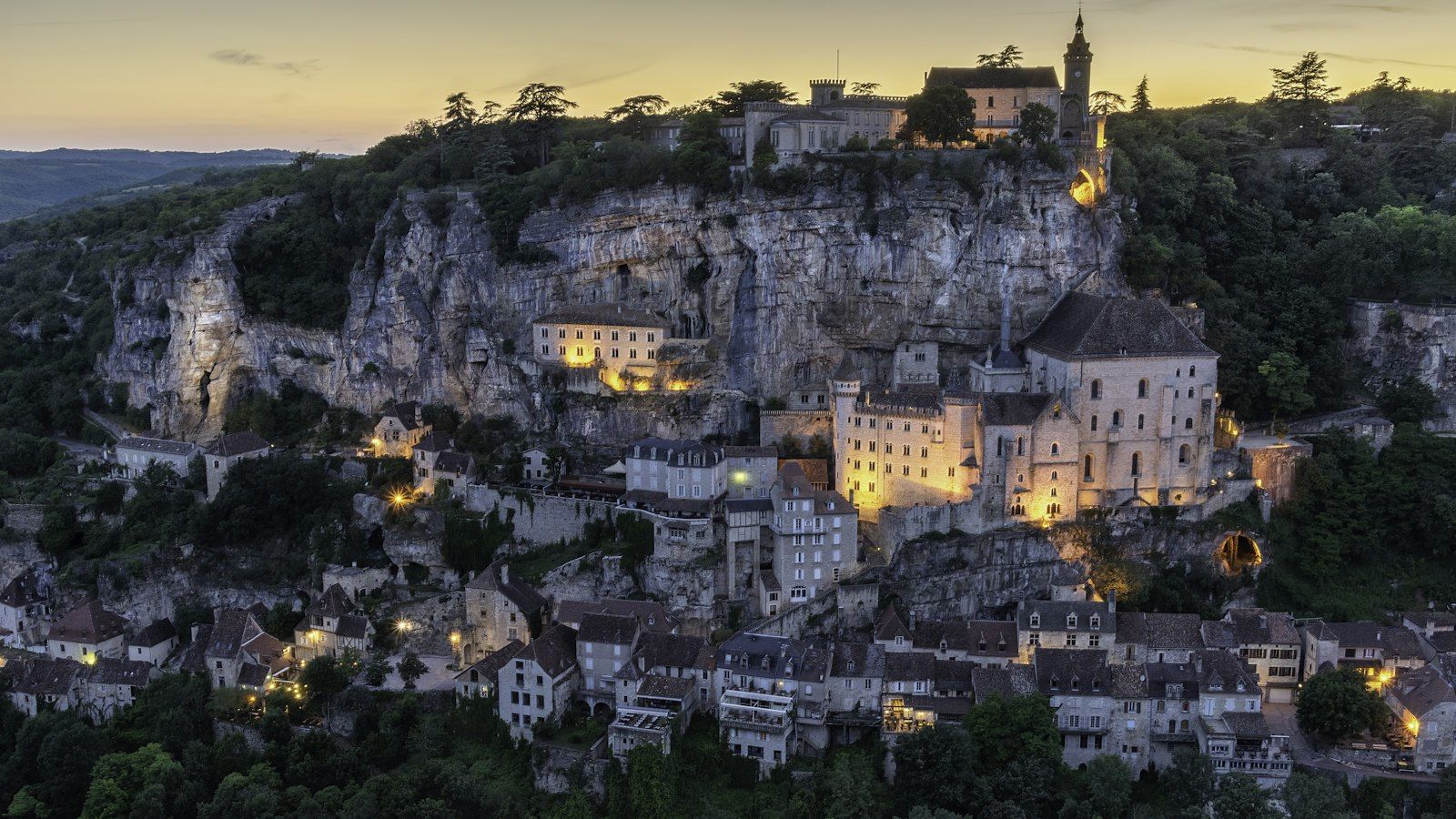
A medieval pilgrimage town built up a limestone cliff above the Alzou canyon. Come for the Black Madonna, the wild causse walks, the cave rivers and a small goat's cheese named after the village.
- Best time to visit: May to June and September to mid-October
- Daily budget (budget traveller): $75 to $240 USD
- Ideal trip length: 3 to 7 days
Rocamadour clings to a limestone cliff in the Lot, in the far north of Occitanie. It's built in tiers: houses at the bottom, churches above them, a château on top. For centuries pilgrims climbed the 216 steps of the Grand Escalier to reach the Black Madonna, and a few still do it on their knees. Today it is one of the most visited villages in France, and in July and August its single shopping street is packed by late morning. Stay the night and it's a different place. The coaches leave in the early evening, the cliff is floodlit, and you can walk the Way of the Cross up to the ramparts almost alone. Around the village lies the Causses du Quercy regional park: dry-stone walls, scrubby oak, sinkholes and stone shepherds' huts. The Gouffre de Padirac, an underground river 103 metres down, is about 20 minutes away by car. The Dordogne valley villages of Carennac, Autoire and Loubressac are close too. The food is Quercy lamb, duck, walnuts, dark Cahors wine and the little Rocamadour AOP goat's cheese. You can arrive by train, but a hire car for part of the trip makes a week here much easier. For a solo traveller it is safe, walkable and calm outside peak summer.
Rocamadour is a village of a few hundred residents and over a million visitors a year, nearly all of them squeezed into the same few hours. The setting explains why: a medieval sanctuary built into a cliff about 120 metres above the dry Alzou canyon, with the houses at the bottom, the churches in the middle and the château on top. Pilgrims have climbed here since the 12th century to see the Black Madonna, and the village sits on a variant of the Way of St James, so you will meet walkers with scallop shells on their packs. Seeing the place costs almost nothing: the sanctuaries are free, the ramparts are €2 and the walks are free. The real costs are getting here and eating, and both are manageable if you plan.
The simplest solo plan is two or three nights in Rocamadour itself, then a hire car for the rest of the week. Sleep in the cité or at L'Hospitalet so you have the village before 10am and after 6pm, when it feels like a pilgrimage site again rather than a car park. Walk the Grand Escalier, the Way of the Cross and the Alzou valley on foot. Then pick up a car to reach the places public transport barely touches: Padirac's underground river, the hill villages of Autoire and Loubressac, Sarlat's Saturday market and the cliff village of Saint-Cirq-Lapopie on the Lot. Trains reach Rocamadour-Padirac station from Brive a few times a day, but the station is about 4 to 5km from the village and taxis must be booked.
Timing matters more here than in most French destinations because almost everything is seasonal. Padirac opens from late March to 1 November, the Rocher des Aigles from April to September, and the lifts stop around mid-November. May, June, September and early October give you open sites, warm days and space on the steps. July and August are hot, crowded and the most expensive. Winter is hushed and atmospheric, but plan around closures. The food is the other reason to come: farm lamb, duck, walnuts, goat's cheese and a good-value lunch menu in almost every village.
Rocamadour itinerary
Arrive, L'Hospitalet and the floodlit cliff
Morning: Take the TER from Brive to Rocamadour-Padirac (about 40-50 minutes) and a pre-booked Gramat taxi to your room. Or collect a hire car at Brive station or airport and drive about an hour.
Afternoon: Drop bags at L'Hospitalet or in the cité. Look into the Grotte des Merveilles if it is open, then walk down the old pilgrim path through the Porte du Figuier into the village.
Evening: Head back up to the L'Hospitalet viewpoint for dusk as the cliff lights up. Dinner on the terrace at Le Bellevue or Au Panorama.
Sanctuaries, Way of the Cross and ramparts
Morning: Climb the 216 steps of the Grand Escalier by 9am. See the Black Madonna in the Chapelle Notre-Dame, the Durandal sword above the door and the Basilique Saint-Sauveur, and spot the exterior frescoes of the Chapelle Saint-Michel.
Afternoon: Walk the Way of the Cross up to the château and pay €2 for the ramparts. Then catch the free-flight show at the Rocher des Aigles (€13.50, April to September, show times vary).
Evening: Take the lifts or the steps back down. Lamb and Rocamadour cheese on the terrace at Jehan de Valon in the Hôtel Beau Site.
Alzou valley walk to the Moulin du Saut
Morning: Start by 8am on the GR6 up the Alzou valley from the bottom of the village. Pack water, snacks and offline maps, and pick up the route from the tourist office the day before.
Afternoon: Picnic at the Moulin du Saut ruins, then walk back or arrange a pick-up from the Gramat side. Rest your legs in a café in the cité.
Evening: Visit the Forêt des Singes earlier if you have energy (€12), or keep it simple with a salade quercynoise and a glass of Cahors.
Gouffre de Padirac, Autoire and Loubressac
Morning: Drive about 20 minutes to Padirac for the first booked slot (€20-24, open until 1 November). Allow 1 hour 30 underground and bring a layer for the 13°C cave.
Afternoon: Continue to Autoire, walk to the waterfall, then drive up to Loubressac for the view over the Château de Castelnau.
Evening: Wander Carennac's riverside lanes and priory, then drive back to Rocamadour or sleep in the Dordogne valley.
Sarlat-la-Canéda
Morning: Drive about an hour west to Sarlat, ideally on a Saturday for the big market (there's a smaller one on Wednesday mornings). Arrive before 9:30am to park.
Afternoon: Walk the honey-coloured old town and the Place de la Liberté, then drop down to the Dordogne at La Roque-Gageac on the way back.
Evening: Back in Rocamadour, have a light dinner and an early night.
Saint-Cirq-Lapopie and the Lot valley
Morning: Drive about 1 hour 15 to 1 hour 30 south to Saint-Cirq-Lapopie and arrive early for the clifftop village before the coaches.
Afternoon: Walk part of the towpath along the Lot, or book a timed visit to the Pech Merle painted cave at Cabrerets nearby. Check the season and book ahead.
Evening: Drive back via Gramat for a supermarket picnic dinner, or eat in Saint-Cirq and return before dark.
The Ouysse mills, Lacave and departure
Morning: Drive 15 minutes to the Moulin de Cougnaguet on the Ouysse. Check the visiting season, or just admire it from the lane. Continue to the caves at Lacave if they are open.
Afternoon: Lunch menu in Souillac or Martel, then drive about 50 minutes to Brive to return the car.
Evening: Take an evening train or flight from Brive, or spend a last night in Brive if connections are tight.
Best neighbourhoods
- Cité médiévale: The village proper, one pedestrian street at the foot of the cliff running from the Porte du Figuier past cafés, cheese shops and hotels. Busy at midday in summer, magical after 7pm and first thing in the morning.
- Le Château (clifftop): The top level of Rocamadour, with the château ramparts, the Relais du Pèlerin gîte, paid car parks and the inclined lift down to the sanctuaries. The Rocher des Aigles bird park is right next door.
- L'Hospitalet: A hamlet on the plateau east of the cliff. It has the classic viewpoint over the village, the tourist office, the Grotte des Merveilles, budget hotels and restaurants, and the Forêt des Singes just up the road.
- Gramat: A real working market town about 12km east, with a railway station, supermarkets, cheaper rooms and taxis. A sensible base if you have a car and want to pay less.
- Carennac and the Dordogne valley: About 25 minutes north by car, Carennac is a riverside village with a priory and cloister, and a quieter, greener base for Padirac, Autoire and Loubressac.
Must-do experiences
- Climb the Grand Escalier to the sanctuaries: Walk up the 216 steps from the village to the Parvis des Églises. There you'll find the Black Madonna in the Chapelle Notre-Dame, the Durandal sword lodged in the rock above its door, and the Basilique Saint-Sauveur. Entry is free, so go before 10am.
- Walk the Way of the Cross to the ramparts: A zigzag path with Stations of the Cross climbs from the sanctuaries to the château. The ramparts cost €2 and give the best view straight down the Alzou canyon.
- Watch the cliff light up from L'Hospitalet: Stand at the viewpoint by the L'Hospitalet tourist office at dusk and watch the floodlights come on across the village. Then walk down the old pilgrim path through the Porte du Figuier for dinner.
- Descend into the Gouffre de Padirac: Go 103 metres underground and take a boat along a subterranean river. The site opens from 28 March to 1 November 2026, adults pay €20 to €24 depending on season, and you must book online. The visit takes about 1 hour 30, at 13°C year-round.
- Hike the Alzou valley to the Moulin du Saut: Follow the GR6 upstream from the village through a dry wooded canyon, past ruined water mills, to the Moulin du Saut. Allow half a day return, start early in summer and carry water.
- See the free-flight show at the Rocher des Aigles: Eagles, vultures and condors fly over the canyon in a show of about an hour. The park opens from 1 April to 30 September and adults pay €13.50. In some months it opens afternoons only, so check show times.
- Taste Rocamadour AOP cheese: Try the little raw-milk goat's cheese young and creamy, aged and nutty, or warm on a salade quercynoise with walnuts. It's in every restaurant, and village shops sell it by the piece.
- Drive to Autoire and Loubressac: These two hill villages sit above the Bave valley. Autoire has a cliff-ringed cirque and a short walk to its waterfall, and Loubressac looks out over the Château de Castelnau.
Hidden gems
- The Grotte des Merveilles at L'Hospitalet, a small cave with stalactites and Palaeolithic paintings, including hand stencils. A quick, quiet contrast to Padirac.
- The Moulin de Cougnaguet, a fortified medieval mill on the Ouysse river near Calès. It's a 15-minute drive west, and the green water and cliffs make it feel far from the crowds.
- The Cascade d'Autoire, a waterfall reached by a short, steep path from the village, with a viewpoint over the red-roofed houses and the cirque.
- The cité at 8am, when the shops are still shuttered, the sanctuary doors are open and you share the Grand Escalier with a handful of pilgrims.
- The causse around Rocamadour on foot: marked loops from L'Hospitalet cross dry-stone walls and stone shepherds' huts called cazelles, and you will rarely meet anyone.
Daily budget
- Accommodation: budget €15-35 / night (pilgrim gîte bunk or dorm), mid-range €70-140 (family hotel double in the cité or L'Hospitalet), splurge €250+ (château hotel in the Dordogne valley). Relais du Pèlerin and the Maison des 4 Chemins take walkers and solo travellers in shared rooms. Hotels in the cité book up for July and August and around Pentecost, so reserve months ahead. Tourist tax is added per night.
- Food: budget €25-40 / day (bakery breakfast, picnic, one set menu), mid-range €50-80 (lunch menu plus a sit-down dinner with wine), splurge €100+ (terrace dinner at Jehan de Valon, foie gras and Cahors). Lunch set menus are the best value in the Lot, usually around €16-25. Buy cheese, bread and fruit in Gramat for picnics. Restaurants in the cité often close early outside peak season.
- Transport: budget €0-15 / day (walking, €2 regional coach, occasional lift), mid-range €50-90 (small hire car plus fuel), splurge €100+ (taxis between sites). Lifts cost €2.30-6.30 depending on route. TER from Brive to Rocamadour-Padirac is roughly €10-15 one way. A taxi from the station to the cité is roughly €15-25, so agree the fare when booking. Car hire is cheapest booked early from Brive.
- Activities: budget €2-15 / day (free sanctuaries, €2 ramparts, free hikes), mid-range €25-40 (Padirac or the bird park plus the monkey forest), splurge €60+ (several paid caves and parks in a day). Padirac is €20-24, the Rocher des Aigles €13.50, the Forêt des Singes €12 and the ramparts €2. Check opening months before planning, as most paid sites close in winter.
- Drinks & nightlife: budget €5-10 (a glass of Cahors or a beer on a terrace), mid-range €15-30 (aperitif, wine with dinner), splurge €50+ (a good Cahors bottle at dinner). Nightlife is a sunset drink and a long dinner. The village goes quiet by 10pm. Summer concerts, including the sacred music festival, are the evening highlight.
Where to stay
- Social hostel in Le Château or Marcayou, above the cliff (€15-35 / night): Rocamadour has no true hostels, but its pilgrim gîtes work like one. The Relais du Pèlerin by the château has simple shared rooms from about €15, and is usually open from April to mid-November. The Maison des 4 Chemins has a dorm, shared meals and a garden in an old truffle orchard, and stays open all year.
- Boutique hotel in Cité médiévale (€95-200 / night): The Hôtel Beau Site on Rue Roland le Preux sits right in the village, with rooms looking at the cliff and the Jehan de Valon restaurant downstairs. You are steps from the Grand Escalier when the day crowds leave.
- Apartment in Gramat or L'Hospitalet (€60-120 / night): Self-catering gîtes and studios around Gramat cost less than village hotels, sit near a station and supermarkets, and suit the car-hire days of the trip. Look for Gîtes de France or tourist office listings.
- Splurge in Lacave, Dordogne valley (€250-600+ / night): The Château de la Treyne is a Relais & Châteaux hotel on a bluff above the Dordogne, about 20 minutes from Rocamadour, with gardens, a fine-dining restaurant and total calm. It's seasonal, so check opening dates.
What to eat
- Rocamadour AOP: a small, flat disc of raw goat's milk cheese, eaten fresh and creamy or aged and firm. Often served warm on toast over salad with walnuts.
- Agneau fermier du Quercy: the region's farm lamb, slow-roasted or served as a carved leg, sometimes with white beans. Jehan de Valon at the Hôtel Beau Site is known for it.
- Duck in all its forms: confit, magret, gizzards on a salade quercynoise and foie gras, the backbone of almost every set menu in the Lot.
- Walnuts: walnut cake, walnut oil on salads and vin de noix, a sweet walnut aperitif made on local farms.
- Pastis quercynois: a crisp, paper-thin apple pastry flavoured with brandy or rum, sold in bakeries and at markets.
- Cahors wine: dark, tannic Malbec from the Lot valley to the south, the default red on every wine list and very good value by the glass.
Day trips
- Gouffre de Padirac (About 15km, 20 minutes by car): A huge sinkhole leads 103 metres down to an underground river. Part of the visit is by boat, past formations including the Grande Pendeloque. Open daily from 28 March to 1 November 2026. Drive via the D673, or take a pre-booked taxi from Rocamadour or Gramat. Book tickets online (€20-24 for adults) and aim for the first slot. Parking is free.
- Sarlat-la-Canéda (About 50km, 1 hour by car): The Périgord Noir's showpiece medieval town, with golden stone lanes and a big Saturday market of walnuts, duck, cheese and truffles in season. Pair it with La Roque-Gageac on the Dordogne. Drive west via Souillac. Public transport needs several changes, so a car is the only practical option. Arrive before 9:30am on market days to find parking.
- Saint-Cirq-Lapopie (About 75km, 1 hour 15 to 1 hour 30 by car): A clifftop village high above the Lot river, with a towpath walk below and the Pech Merle painted cave at Cabrerets nearby for a full day. Drive south via Gramat and Labastide-Murat. Park in the paid car parks above the village. Book Pech Merle's timed visits ahead and check its season.
When to visit
- Spring (April - May): 12-22°C, fresh mornings, some showers, wildflowers on the causse. Crowds: Moderate, with spikes over Easter and the May bank holiday weekends. Excellent for walking and cheaper rooms. Every attraction is open by April, but book Padirac and hotels ahead for the long May weekends.
- Summer (June - August): 25-33°C, hot dry days, occasional violent thunderstorms. Crowds: Very heavy from July to late August, with French and European holidays. June is lovely. July and August mean queues, full car parks and peak prices. Stay overnight, visit the sanctuaries before 10am and hike only at dawn.
- Autumn (September - October): 14-25°C, settled and golden, cooler nights, walnut harvest. Crowds: Moderate in September, quiet by late October. The locals' pick. Warm enough to walk all day, far fewer coaches, and Padirac runs until 1 November. Note that the Rocher des Aigles closes at the end of September.
- Winter (November - March): 2-12°C, frosty mornings, grey spells, occasional fog in the canyon. Crowds: Very low except over Christmas. Atmospheric and peaceful, but Padirac and the bird park are closed, the lifts stop around mid-November and many restaurants shut. Truffle markets in the Lot make it worth it for food lovers.
Entry rules for your passport
Visa rules for France depend on the passport you travel on. Check the official source before you book: European Commission: Schengen visa policy
Getting there
The nearest airport is Brive-Vallée de la Dordogne (BVE), about 40km away, with limited and partly seasonal routes. Toulouse-Blagnac is about 2 hours' drive and has far more flights. Bordeaux is about 3 hours. By rail, take an Intercités train from Paris Austerlitz to Brive-la-Gaillarde (around 4 to 4.5 hours), then a TER to Rocamadour-Padirac (roughly 40 to 50 minutes, only a few trains a day). From Toulouse, allow 3.5 to 4 hours with a change at Brive or Capdenac. Rocamadour-Padirac station is about 4 to 5km from the cité and has no taxi rank. Book a Gramat taxi ahead and expect roughly €15 to €25. Gramat station is 12km away and Souillac 25km. Regional coaches cost €2 a trip, with sparse services on line 877 via Rocamadour and Padirac. By car, leave the A20 at the Rocamadour exit and follow the D840. Visitors from outside the EU go through biometric Entry/Exit System checks at the Schengen border.
Border checks: non-EU visitors (other than Swiss, Norwegian, Icelandic, Liechtenstein, Andorran, Monegasque, San Marinese and Vatican citizens, and holders of an EU residence permit or long-stay visa) are registered in the EU's Entry/Exit System (EES) instead of getting a passport stamp. On your first crossing, officers take your photo and/or fingerprints, so allow extra time at passport control. ETIAS, the planned travel authorisation, is not in operation yet, so don't pay any website for one.
Getting around
Rocamadour itself is all stairs and footpaths. The village, the sanctuaries and the château are stacked vertically and linked by the Grand Escalier, the Way of the Cross and two paid lifts. A single trip on both lifts costs €4.30, or €6.30 return. The lifts usually run from February or March until mid-November, so in winter you walk. L'Hospitalet is about 10 to 15 minutes on foot from the village via the Porte du Figuier. The nearest station is Rocamadour-Padirac, about 4 to 5km from the cité. It has no taxi rank, so pre-book a taxi from Gramat. Regional coaches cost €2 a trip, and line 877 links Souillac, Lacave, Rocamadour, Padirac and Bretenoux, but services are sparse, so check the timetable before you rely on them. To see Padirac, Autoire, Sarlat or Saint-Cirq-Lapopie properly you need a hire car, best collected at Brive station or airport. Roads are narrow but quiet outside July and August. Parking near the cité is paid in season, so check rates at each car park.
Safety
Rocamadour and the Lot are very safe for solo travellers, and violent crime against visitors is rare. The main risks are physical. The Grand Escalier and the Way of the Cross are steep and slippery after rain, so wear shoes with grip and take the lifts if your knees complain. In summer the causse gets hot and shadeless by midday, so walk early and carry at least 1.5 litres of water. Check for ticks after hiking through grass and scrub. Hunting season runs roughly from autumn into late winter, so wear something bright on trails and respect hunt signs. Country roads are narrow, unlit and shared with tractors and cyclists. Taxis must be booked ahead, and trains are infrequent, so plan your evening return before you set off. In peak season, keep an eye on bags in the crowded village street.
Solo travel tips
- Sleep in the village, not just near it: Your best time in Rocamadour is before 10am and after 6pm. Staying in the cité or at L'Hospitalet gives you both, plus the floodlit cliff, for little more than a Gramat hotel.
- Pilgrim gîtes are the social option: There are no backpacker hostels here. Gîtes such as the Relais du Pèlerin and the Maison des 4 Chemins have shared rooms and communal tables, and walkers swap route tips over dinner. Some gîtes, like Lou Cantou, take pilgrims only, so check before booking.
- Book taxis and Padirac the day before: Rocamadour-Padirac station has no taxi rank, and Gramat's few taxis get busy. Book every taxi in advance, and secure Padirac's first slot online so you are underground before the tour groups.
- Hire the car for the middle of the trip: You do not need a car in the village, but you do for Padirac, Autoire, Sarlat and Saint-Cirq-Lapopie. Three or four days of hire from Brive covers the excursions without paying for parking on village days.
- Eat your main meal at lunch: Set lunch menus give you three courses for far less than dinner, and many country restaurants close early or do not open in the evening outside summer. Make lunch the big meal and picnic at night if needed.
- Respect the sanctuary and stay safe on the steps: The Grand Escalier is steep, uneven and slippery when wet. Take it slowly, use the handrails and let pilgrims climbing in prayer pass. On solo hikes, tell your host your route, as signal drops in the canyon.
Cultural etiquette
- Greet everyone. 'Bonjour madame' or 'Bonjour monsieur' when you walk into a shop, café or gîte is expected, and 'merci, bonne journée' when you leave.
- Rocamadour is an active shrine. Dress modestly in the chapels, cover your shoulders, take off your hat, keep your voice down during Mass and do not photograph worshippers.
- Pilgrims sometimes climb the Grand Escalier on their knees. Give them space and do not film them.
- Lunch runs from roughly 12pm to 2pm. Arrive after 1:30pm and many kitchens are closing. Shops in small villages often shut from midday to mid-afternoon.
- Ask for 'la carte' for the menu and 'la formule' or 'le menu' for set courses. Water in a jug ('une carafe d'eau') is free.
- On the causse, close farm gates behind you, stay on marked paths, and never pick truffles or walnuts from private land.
- Bise kisses on the cheek are for friends. A handshake or a smile is right with hosts and strangers.
Frequently asked questions
How do I get to Rocamadour without a car?
Take a TER train from Brive-la-Gaillarde to Rocamadour-Padirac station, a journey of roughly 40 to 50 minutes with only a few services a day. The station is about 4 to 5km from the cité and has no taxi rank, so book a taxi from Gramat in advance. From Toulouse, allow around 3.5 to 4 hours with a change. Paris to Rocamadour-Padirac takes from about 5.5 hours.
How many days do I need in Rocamadour?
One full day plus a night covers the village, the sanctuaries, the ramparts and the L'Hospitalet viewpoint at dusk. Three days adds the Alzou valley walk and Padirac. A week lets you use Rocamadour as a base for Autoire, Carennac, Sarlat and Saint-Cirq-Lapopie.
When is the best time to visit Rocamadour?
May to June and September to mid-October bring mild weather and open attractions without the July and August crowds. Summer is hot and very busy. From November to March the village is beautiful and quiet, but Padirac and the Rocher des Aigles are closed, the lifts stop around mid-November and many restaurants shut.
Is Rocamadour worth staying overnight?
Yes, and it is the best tip in this guide. Day visitors arrive from about 10am and leave by early evening. Staying in the cité or at L'Hospitalet gives you the floodlit cliff at night and an almost empty Grand Escalier before breakfast.
Can I use cards everywhere?
Cards, including contactless, work in hotels, most restaurants, attractions and the lifts. Carry some cash for small cheese producers, markets, pilgrim gîtes and parking machines that sometimes fail. ATMs are limited in the cité, and Gramat has more banks.
Do I need to book the Gouffre de Padirac?
Yes. Tickets are sold online, and the site strongly advises booking ahead, especially in July and August. In 2026 it opens from 28 March to 1 November, with adult tickets from €20 in low season to €24 in high season. The last entry is 1 hour 45 minutes before closing.
Is Rocamadour safe for solo female travellers?
Yes. It is a small, calm pilgrimage village with a low crime rate, and walking alone in the evening is normal. Standard precautions apply: tell someone your route on remote causse hikes, book taxis in advance rather than waiting at a dark station, and keep your phone charged, as signal is patchy in the canyon.
What entry rules apply to travellers visiting France in 2026?
France is in the Schengen Area. The EU Entry/Exit System (EES) has been fully running since 10 April 2026, so non-EU visitors have their fingerprints and a facial image recorded at the external border instead of a passport stamp. ETIAS, the planned €20 travel authorisation for visa-exempt visitors, was not yet operating as of autumn 2026 and had no confirmed start date. Ignore websites selling it early. Rules change, so confirm on the official French government site France-Visas and the EU's official travel portal before you book.
Tours and activities in Rocamadour | Rocamadour in 2 days | Rocamadour in 3 days | Rocamadour in 4 days | Rocamadour in 5 days | Rocamadour in 7 days
Joy Plus home | Destinations | Itineraries | Activities | Flights | Budget planner | Calendar | Map | Blog | Lifetime access