Destinations / Europe
Étretat, France travel guide
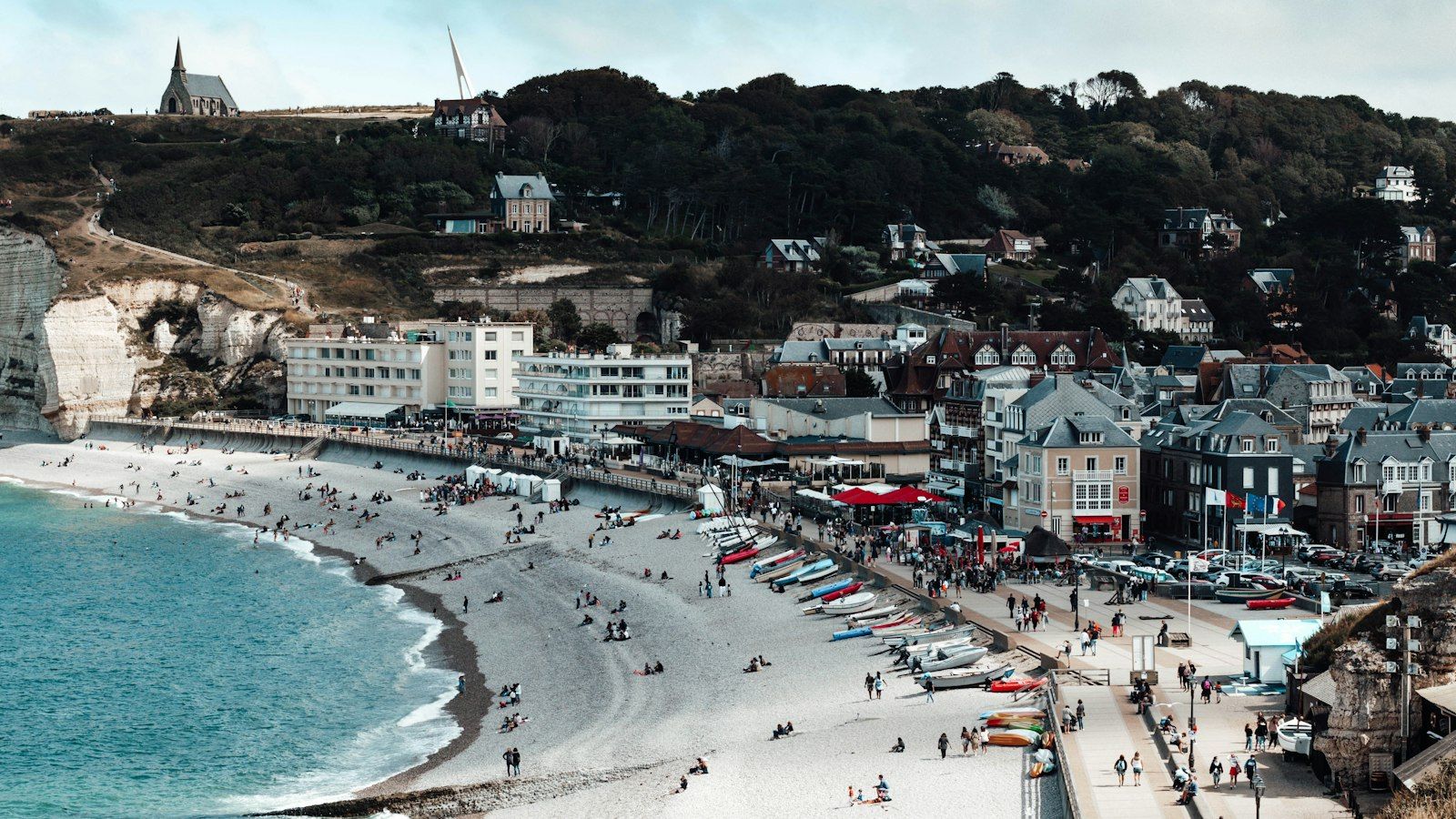
A small Normandy seaside town where chalk arches and a needle of rock frame a pebble beach. Come for the cliff-top walks and the Impressionist history, and finish the day with a pot of mussels.
- Best time to visit: May to June and September
- Daily budget (budget traveller): $140 to $380 USD
- Ideal trip length: 3 to 7 days
Étretat is a Normandy seaside town of around 1,200 people, and its view is one of the most painted in France. Two chalk cliffs enclose a steep pebble beach. To the west is the Falaise d'Aval, with its great arch and the needle-shaped Aiguille rising about 50 metres out of the sea. To the east is the Falaise d'Amont, with a small sailors' chapel on top. Monet and Courbet painted here and Maupassant grew up here. Maurice Leblanc wrote Arsène Lupin's adventures in a villa that is now a museum. Around 1.5 million people visit each year, mostly between June and September and mostly on day trips. Stay the night and the town feels different. The coaches leave, the cliff paths empty and the sun sets into the Channel behind the Porte d'Aval. It is an easy base for a solo traveller. You can cross the centre on foot in ten minutes, the GR21 coastal path runs straight through town, and buses run to Le Havre and Fécamp. The cliffs are eroding quickly, so the town has closed some paths and beaches and fines anyone who ignores the barriers. Respect the closures, check the tides, and you'll have a great place to walk and eat seafood.
Étretat sits on the Alabaster Coast in Seine-Maritime, where the Pays de Caux plateau ends in white chalk cliffs above the Channel. The town is a narrow valley between two of these cliffs. The Falaise d'Aval and its arch and needle lie to the west, the Falaise d'Amont and its chapel to the east, and a steep beach of grey pebbles runs between them. The village became a resort in the 19th century, when Parisian painters and writers discovered it. Monet painted the arches again and again, Maupassant spent his childhood here, and Maurice Leblanc hid the treasure of the kings of France inside the Aiguille in his 1909 Lupin novel. Today the town has about 1,200 residents and receives more than a million visitors a year. Most come on summer afternoons, take a photo from the beach and leave. If you stay, you get the cliffs early in the morning and at sunset almost to yourself.
For a solo traveller, Étretat works as a slow base rather than a quick stop. Arrive by train to Le Havre and bus to the coast, then walk everywhere. Give the Falaise d'Aval a morning, the Falaise d'Amont and the Jardins d'Étretat another, and leave room for the Clos Arsène Lupin and a long seafood lunch. From there, buses reach Le Havre's UNESCO-listed centre and Fécamp's Bénédictine palace. The GR21 coastal path lets you walk east to Yport through farmland, valleuses and Belle Époque villas. Rooms are the biggest cost. Étretat has no hostels, and small hotels charge €85 to €130 a night in season, so book summer weekends early, or stay in Le Havre and visit for the day.
The cliffs set the rules. The chalk is retreating by as much as 20cm a year in places, and the town has banned access to the Trou à l'Homme tunnel and several cliff-foot spots, with €135 fines and rescue costs for anyone who ignores the barriers. Some cliff-top sections are taped off for months at a time. None of this spoils the visit if you follow the signs, check tide times and stay back from the edge. Weather changes fast on this coast, and a sunny morning can turn into Channel drizzle by lunch. Pack a windproof jacket, good shoes and an appetite for mussels, cider and a slower pace.
Étretat itinerary
Arrive and find your feet on the seafront
Morning: Train from Paris Saint-Lazare to Le Havre (about 2 hours), then bus to Étretat (about 45 minutes to an hour on LiA line 13 or a Nomad Car service). Check the stop and timetable the night before.
Afternoon: Drop your bags. Walk the full seafront promenade from the foot of the Falaise d'Amont to the Falaise d'Aval end, then loop back through the centre past Les Halles, the old timber market hall.
Evening: Watch the sunset from the pebbles with the Porte d'Aval in silhouette. Dinner at La Flottille on rue Alphonse Karr for wood-fired grills or mussels.
Falaise d'Aval, the Manneporte and Arsène Lupin
Morning: Start by 8am. Climb the steps at the western end of the beach onto the Falaise d'Aval for the Porte d'Aval and the Aiguille, then follow the open path past the golf course to the Manneporte viewpoint (about 4km return). Stay behind every barrier.
Afternoon: Le Clos Arsène Lupin at 15 rue Guy de Maupassant (around €8.50, closed Mondays; October to March weekends and school holidays only). The audio tour takes about 45 minutes.
Evening: Queue from 6:45pm at Le Clos Lupin restaurant on rue Alphonse Karr (no bookings; usually Tuesday to Saturday, so check), or eat crêpes and cider near the seafront.
Falaise d'Amont, the chapel and the gardens
Morning: Walk up from the eastern end of the beach to the Chapelle Notre-Dame de la Garde and the Nungesser et Coli memorial. Be at the Jardins d'Étretat for the 10am opening (about €11-14 depending on season, timed slots in July and August).
Afternoon: Follow the GR21 east along the cliff tops towards Bénouville for an hour, then turn back. On the way into town, step inside the Église Notre-Dame.
Evening: Seafood at Le Galion on Boulevard René Coty, or mussels at Le Bicorne. If the sky is clear, watch a second sunset from the Amont path.
Day trip to Le Havre
Morning: Bus to Le Havre. Walk Auguste Perret's UNESCO-listed centre: the Hôtel de Ville, avenue Foch and the 107m tower of Église Saint-Joseph, which glows with stained glass inside.
Afternoon: MuMa, the André Malraux modern art museum by the harbour mouth, for Boudin, Monet and one of France's largest Impressionist collections outside Paris (entry roughly €7-10, check). Coffee on the seafront afterwards.
Evening: Walk Le Havre's long pebble beach at golden hour, then take the bus back to Étretat. Check the last departure, which can be around 8:30pm.
GR21 to Yport
Morning: Pack water and a picnic. Walk the GR21 east from Étretat via Bénouville and Vattetot-sur-Mer, following red-and-white waymarks across farmland and cliff tops.
Afternoon: Drop into the wooded valleuse at Vaucottes, then continue to Yport (roughly 14km, 4-5 hours in total). Swim from Yport's beach in summer if the sea is calm.
Evening: Return by bus if one serves Yport that day, or by a taxi booked in advance (roughly €25-40). Easy dinner and an early night.
Fécamp: Bénédictine and the harbour
Morning: Nomad Car line 509 to Fécamp (around 30-40 minutes, check the timetable). Do the Palais Bénédictine discovery visit with tasting, from about €20. Book ahead.
Afternoon: Lunch by the port, then Les Pêcheries museum and its rooftop view. If your legs allow, walk up to Cap Fagnet and the sailors' chapel for the view back along the cliffs.
Evening: Bus back to Étretat. Last dinner out, with scallops if they're in season (roughly October to May).
Slow last morning and departure
Morning: Coffee and a croissant, then one last loop up the Falaise d'Aval or an hour on the seafront wall. Buy cider, Neufchâtel or a bottle of Bénédictine to take home.
Afternoon: Bus to Le Havre for the train to Paris, or for the Brittany Ferries crossing to Portsmouth if you came by sea. Check sailing times in advance.
Evening: Travel home, or spend a final night in Le Havre if your connection is early the next day.
Best neighbourhoods
- Centre and Les Halles: The compact old centre around the timber market hall. Most cafés, crêperies, bakeries and small shops are here, and the beach is a five-minute walk. It's the easiest base if you're arriving by bus.
- Front de mer: The seafront promenade above the pebble beach, running from the foot of the Falaise d'Amont to the Falaise d'Aval. Hotels and terrace restaurants line the front. You get the best sunsets, but also the most day-trippers.
- Falaise d'Amont side: The eastern hill above town, home to the Jardins d'Étretat, the Chapelle Notre-Dame de la Garde and the Nungesser et Coli memorial. It's quiet in the evening and the climb starts right from the beach.
- Saint-Clair and the route du Havre: The higher, leafier edge of town, with villas and bigger hotels such as Le Donjon and Dormy House. You'll walk further to the beach, but you get calm nights and easy access to the Falaise d'Aval and the golf course path.
- Le Havre centre (alternative base): About 30km south, with more rooms, more restaurants and the train to Paris. Auguste Perret's rebuilt concrete centre is UNESCO-listed. Stay here if Étretat is full and visit by bus.
Must-do experiences
- Walk the Falaise d'Aval to the Manneporte: Climb the steps at the western end of the beach for close views of the Porte d'Aval and the Aiguille. Then follow the open cliff path past the golf course to the huge Manneporte arch. Stay well back from the edge and away from any taped-off sections.
- Climb to the Chapelle Notre-Dame de la Garde: A short, steep path from the eastern end of the beach takes you up the Falaise d'Amont to the sailors' chapel and the memorial to Nungesser and Coli, the 1927 transatlantic flyers. The view back over town is the classic one.
- Explore the Jardins d'Étretat: These clifftop gardens mix sculpted topiary and contemporary art and look straight out at the Aiguille. Adult entry is about €11 to €14 depending on season. Arrive at opening, because July and August visits run on timed slots.
- Visit Le Clos Arsène Lupin: Maurice Leblanc's half-timbered villa on rue Guy de Maupassant is now an immersive audio tour of his gentleman thief's world. It's closed on Mondays, and from October to March it opens only at weekends and in school holidays, so check before you go.
- Watch the sunset from the seafront: Sit on the pebbles or the promenade wall as the sun drops behind the Porte d'Aval. It costs nothing, and by 9pm in June most of the day-trippers have gone.
- Hike the GR21 to Yport: The red-and-white waymarked GR21 coastal path heads east over farmland and cliff tops via Bénouville and Vaucottes to the old fishing village of Yport. Allow roughly 4 to 5 hours one way.
- Take a day trip to Le Havre: Auguste Perret's rebuilt centre is UNESCO-listed. Add the soaring tower of Église Saint-Joseph and the MuMa's Impressionist collection, with works by Boudin and Monet.
- Taste Bénédictine in Fécamp: The Palais Bénédictine is a neo-Gothic palace that still houses the liqueur's distillery. Discovery visits with a tasting start at about €20, and booking is strongly recommended.
Hidden gems
- Vaucottes, a tiny wooded valleuse between Vattetot-sur-Mer and Yport, with old seaside villas and a quiet pebble cove on the GR21
- Yport, a low-key former fishing village with a lifeguarded beach in summer, fishermen's houses and far fewer coaches than Étretat
- The Église Notre-Dame d'Étretat, a calm medieval church a short walk inland from the seafront that most cliff visitors never step into
- Les Pêcheries in Fécamp, a museum in a former fish-processing building, with a rooftop terrace looking over the harbour and cliffs
- Cap d'Antifer and its lighthouse, reached on the GR21 heading south-west from Étretat, for big empty cliff views without the crowds
Daily budget
- Accommodation: budget €85-130 / night (simple hotel or chambre d'hôtes), mid-range €140-220 (boutique hotel or sea-view room), splurge €250+ (Le Donjon - Domaine Saint Clair, Dormy House sea-view rooms). There are no hostels, so a solo traveller pays the full room rate. Summer weekends sell out weeks ahead. A small per-person taxe de séjour is added to most bills. Staying in Le Havre can be cheaper and has more choice.
- Food: budget €30-45 / day (bakery breakfast, crêpes, one set lunch), mid-range €60-90 (moules-frites lunch, three-course dinner with wine), splurge €120+ (gastronomic dinner at Le Donjon). Lunchtime set menus (formules) are the best value, typically around €18-28. Kitchens often stop serving around 2pm and again around 9pm. A supermarket picnic of bread, Neufchâtel and fruit costs under €10.
- Transport: budget €0-10 / day (walking, occasional LiA bus at a few euros), mid-range €15-40 (bus day trips, the odd taxi), splurge €60-100+ (hire car plus parking). Paris Saint-Lazare to Le Havre by train costs roughly €20-45 booked ahead, more on the day. Check the latest LiA and Nomad fares online. Étretat car parks charge in season.
- Activities: budget €0-15 / day (free cliff walks, one paid entry), mid-range €20-40 (Jardins d'Étretat €11-14, Clos Lupin around €8.50, Bénédictine from about €20), splurge €60+ (guided tours, Bénédictine cocktail workshop €35). The cliffs, beach, chapel and GR21 are free. Entry prices change by season, so confirm on official sites. Book the Palais Bénédictine ahead at weekends and in school holidays.
- Drinks & nightlife: budget €5-12 (a bolée of cider or a small beer), mid-range €20-35 (wine with dinner, an apéritif on the seafront), splurge €50+ (Champagne at a sea-view bar). Nightlife means a drink on a terrace at sunset, plus the casino on the seafront. Most bars close early outside summer weekends. For more choice, go to Le Havre.
Where to stay
- Social hostel in Centre, Étretat (€85-130 / night): Étretat has no dorm hostels. The nearest equivalent is a chambre d'hôtes (B&B) with a shared breakfast table, where hosts and other guests trade walking tips, or a simple hotel such as Hôtel des Falaises, a few steps from the beach.
- Boutique hotel in Centre, Étretat (€110-200 / night): Hôtel La Résidence Manoir de la Salamandre, an ornate half-timbered building in the middle of town, puts you a short walk from the beach, the restaurants and both cliff paths.
- Apartment in Centre or Le Havre (€80-150 / night): Self-catering gîtes and holiday flats, listed through the Le Havre Étretat tourist office and the usual booking sites, give you a kitchen for market picnics. In Le Havre, a flat near the station makes bus and train day trips easy.
- Splurge in Saint-Clair or route du Havre (€180-400+ / night): Le Donjon - Domaine Saint Clair has individually styled rooms, a spa, a pool and a gastronomic restaurant. Dormy House sits on the Falaise d'Aval side and has some of the best sea views in town.
What to eat
- Moules marinières or moules à la normande: mussels cooked in white wine or a cream and cider sauce, served with frites, on almost every menu in town
- Coquilles Saint-Jacques: Normandy scallops, at their best in season from roughly October to May, often pan-seared with butter or a cider sauce
- Fécamp herring: smoked or marinated hareng, a Pays de Caux fishing staple, often served with warm potatoes
- Neufchâtel cheese: a soft, bloomy, often heart-shaped cheese from the nearby Pays de Bray, great on a baguette for a cliff-top picnic
- Cider, pommeau and Calvados: Normandy's apple drinks, from a bolée of dry cider with crêpes to a small Calvados after dinner
- Bénédictine: the herbal liqueur made in Fécamp since the 19th century, best tasted at the Palais Bénédictine itself
- Tarte normande and crêpes: apple tart with custard, or a crêpe with salted butter caramel from one of the crêperies near the seafront
Day trips
- Le Havre (About 30km, 45 minutes to an hour by bus): Auguste Perret's rebuilt post-war centre is a UNESCO World Heritage Site. Highlights include Église Saint-Joseph's 107m tower, MuMa's Impressionist collection, and a long pebble beach with sunset views. LiA line 13 from Étretat to Grand Hameau, or a Nomad Car service to the Gare Routière. Check the current timetable and the last return bus.
- Fécamp (About 17km, roughly 30-40 minutes by bus): A working harbour town with the neo-Gothic Palais Bénédictine and its distillery, the Abbatiale de la Sainte-Trinité, Les Pêcheries museum and the clifftop chapel at Cap Fagnet. Nomad Car line 509 links Étretat and Fécamp. Book the Palais Bénédictine visit online, from about €20 with tasting.
- Honfleur (About 60km via Le Havre and the Pont de Normandie): A painterly old harbour with tall slate-fronted houses around the Vieux Bassin, the wooden Sainte-Catherine church and the Eugène Boudin museum. It's busy in summer and lovely on a weekday. Bus to Le Havre, then Nomad Car line 111 across the Pont de Normandie to Honfleur. Allow most of the day and check connections both ways.
When to visit
- Spring (March - May): 9-17°C, mixed sun and showers, fresh winds. Crowds: Low in March, busy at Easter and on May bank holidays. A good shoulder season. The gardens and the Lupin museum reopen, the light is clear and rooms are cheaper. Book May's long weekends early, as French bank holidays fill the town.
- Summer (June - August): 17-22°C, long evenings, sea around 16-18°C by August. Crowds: Very heavy in July and August, especially weekend afternoons. June is excellent, with light until about 10pm. July and August bring full car parks, timed slots at the Jardins d'Étretat and peak room prices. Walk the cliffs before 9am and after 6pm.
- Autumn (September - October): 12-19°C, settled spells, more wind and rain in October. Crowds: Moderate in September, quiet on October weekdays. The locals' pick. The water is still swimmable in early September, crowds thin out, prices drop and scallop season starts in October.
- Winter (November - February): 5-9°C, storms, short days, frequent rain. Crowds: Very quiet apart from Christmas and winter school holidays. Dramatic and empty, with the cheapest rooms. Many restaurants cut their hours, the Lupin museum opens mainly at weekends and the Jardins d'Étretat close from late December to mid-February. Paths can be muddy and slippery.
Entry rules for your passport
Visa rules for France depend on the passport you travel on. Check the official source before you book: European Commission: Schengen visa policy
Getting there
Most international travellers fly into Paris Charles de Gaulle or Orly, transfer to Paris Saint-Lazare, and take the train to Le Havre in about 2 hours. From Le Havre, LiA line 13 runs roughly hourly from Grand Hameau to Étretat in about 45 minutes, and Nomad Car line 509 links Le Havre, Étretat and Fécamp, though less often. Check both networks' websites for current timetables and stops. From the UK, Brittany Ferries sails from Portsmouth to Le Havre, about 30km from Étretat, and DFDS sails from Newhaven to Dieppe, roughly 90km away. Driving from Paris takes about 2.5 to 3 hours. Non-EU travellers have their fingerprints and photo taken under the EU Entry/Exit System on first entry. ETIAS pre-travel authorisation had not launched as of late October 2026, so check official sites before travelling. A taxi from Le Havre station to Étretat costs roughly €60-80. Book it in advance, especially in the evening.
Border checks: non-EU visitors (other than Swiss, Norwegian, Icelandic, Liechtenstein, Andorran, Monegasque, San Marinese and Vatican citizens, and holders of an EU residence permit or long-stay visa) are registered in the EU's Entry/Exit System (EES) instead of getting a passport stamp. On your first crossing, officers take your photo and/or fingerprints, so allow extra time at passport control. ETIAS, the planned travel authorisation, is not in operation yet, so don't pay any website for one.
Getting around
Étretat is small enough to walk everywhere. The centre, the seafront and both cliff paths are within 15 minutes of each other on foot, though the climbs are steep. Buses connect Étretat with Le Havre. LiA, the Le Havre Seine Métropole network, runs line 13 from Grand Hameau in Le Havre roughly hourly in about 45 minutes, and other LiA and Nomad Car services also cover the route, including line 509, which links Le Havre, Étretat and Fécamp. Single fares are a few euros. Timetables change at the start of the summer and school-year seasons, so check the LiA and Nomad websites before relying on a connection. There is little evening service, so plan day trips around the last bus back. Taxis are limited and need booking ahead. A hire car lets you reach the valleuses, Yport and Cap d'Antifer at your own pace, but parking in Étretat is paid and fills early on summer weekends. Cycling is possible on quiet inland lanes, but the climbs out of town are long.
Safety
Étretat is very safe for solo travellers. The real dangers here are the cliffs and the sea, not crime. The chalk erodes constantly and blocks fall without warning. A municipal order bans access to the Trou à l'Homme tunnel, cliff cavities, the Chambre des Demoiselles and the Descente au Chaudron. Breaking it means a €135 fine, and you may also have to pay for any rescue. Never walk close to the cliff edge, stay at least five metres from the foot of the cliffs, and never cross barriers or red-and-white tape. The tidal range on this coast is large and the sea comes in quickly, so check tide times before walking along the foreshore and never get caught round a headland. The pebble beach shelves steeply and waves can knock you over. Only swim in calm conditions, ideally in lifeguarded summer months, and wear water shoes. Chalk paths get very slippery after rain. In crowded summer car parks and on the seafront, keep valuables out of sight. The emergency number across Europe is 112.
Solo travel tips
- Stay at least one night: Most visitors arrive mid-morning and leave by 6pm. Sleep in town and you'll have both cliffs nearly to yourself at sunrise and sunset, which is when Étretat looks most like a Monet.
- Read the closure signs every time: Cliff closures change after rockfalls, and the municipal orders are posted at beach entrances and on the promenades. A path that was open last year may be taped off now. The €135 fine is the least of the risks.
- Plan around the last bus: Buses to Le Havre and Fécamp are reliable but thin out in the evening and change timetable by season. Screenshot the timetable, note the last departure and keep a taxi number in case you miss it.
- Eat lunch as your main meal: Set lunch menus give you three courses for far less than dinner, and solo diners get seated more easily at noon than at 8pm. Popular places like Le Clos Lupin don't take bookings, so turn up as the doors open.
- Safety for solo travellers: Crime is rare, so the real risks are falls, tides and slippery chalk. Hike the GR21 in daylight, tell your hotel your route, carry water and a charged phone, and never walk the foreshore on a rising tide.
- Meet people on the trail: The GR21 draws hikers from all over France and Europe, and the tourist office on place Maurice Guillard can point you to guided walks and local events. A seat at a seafront bar at sunset is the town's easiest social scene.
Cultural etiquette
- Say 'Bonjour' when you enter a shop, café or bakery, and 'Merci, au revoir' when you leave. Skipping the greeting comes across as rude.
- Leave the pebbles on the beach. Taking galets is prohibited along this coast because the beach protects the town from the sea.
- Respect the cliff closures and barriers. Locals take the rockfall risk seriously, and rescues put emergency crews in danger.
- Lunch runs roughly noon to 2pm and dinner from about 7pm. Outside those hours, many kitchens are closed, especially out of season.
- Keep your voice down in churches and the Chapelle Notre-Dame de la Garde, which is still a place of prayer and remembrance for sailors.
- Service is included in French bills. Leaving small change or rounding up is a kind gesture, not an obligation.
- Ask before photographing people, and don't walk through private gardens or fields to get a better angle on the arches.
Frequently asked questions
How do I get to Étretat without a car?
Take the train from Paris Saint-Lazare to Le Havre, which takes about 2 hours. From there, LiA buses (line 13 from Grand Hameau, roughly hourly) and Nomad Car services such as line 509 run to Étretat in about 45 minutes to an hour. Fares are a few euros. Timetables change with the seasons, so check the LiA and Nomad websites the day before, especially for the last bus back in the evening.
How many days do I need in Étretat?
One full day covers both cliffs and the town. Two or three nights let you walk them at quiet times, visit the gardens and the Lupin museum, and see a sunset or two. A week works well if you use Étretat as a base for Le Havre, Fécamp, Honfleur and the GR21 coastal path.
When is the best time to visit Étretat?
May, June and September give you long days, mild temperatures and fewer crowds than July and August, when the town fills with day-trippers and the gardens move to timed slots. October is calm and atmospheric. In winter many restaurants cut their hours or close, and the Jardins d'Étretat shut from late December to mid-February.
Can I walk through the Trou à l'Homme tunnel or along the foot of the cliffs?
No. A municipal order bans access to the Trou à l'Homme tunnel and other cliff cavities, as well as spots such as the Chambre des Demoiselles and the Descente au Chaudron, because of rockfall risk. Fines are €135, and you may also have to pay for any rescue. Keep at least five metres from the foot of the cliffs and follow the signs at beach entrances, which list the current closures.
Can I use cards everywhere in Étretat?
Cards, including contactless, are accepted in nearly all hotels, restaurants and shops. Carry a little cash for bakeries, small purchases and market stalls. There are ATMs in the centre of Étretat, and more choice in Le Havre and Fécamp.
Do I need to speak French?
Not really. English is widely understood in hotels, the tourist office and most seafront restaurants. Always start with 'Bonjour' when you walk into a shop or café, though. It matters here, and a few words of French will get you warmer service in smaller places.
Is Étretat safe for solo female travellers?
Yes. Étretat is a small, friendly resort with very little crime. The usual precautions apply: avoid isolated cliff paths after dark, tell someone your route if you're hiking the GR21 alone, and keep your phone charged, as signal can be patchy on the cliff tops.
What are the entry rules for France in 2026?
France is in the Schengen Area. Visitors from visa-exempt countries such as the UK, US, Canada and Australia can stay up to 90 days in any 180-day period. The EU Entry/Exit System (EES) has been fully running since April 2026, so non-EU travellers have their fingerprints and photo taken at the border on their first entry. ETIAS, a planned online travel authorisation expected to cost €20, had not launched as of late October 2026. UK passports must also have been issued less than 10 years before you arrive and be valid for at least 3 months after you leave. Rules change, so always confirm on the official EU travel website, France Diplomatie and your own government's travel advice before you book.
Tours and activities in Étretat | Étretat in 2 days | Étretat in 3 days | Étretat in 4 days | Étretat in 5 days | Étretat in 7 days
Can't decide? Compare Étretat with...
Joy Plus home | Destinations | Itineraries | Activities | Flights | Budget planner | Calendar | Map | Blog | Lifetime access