Étretat in 3 days
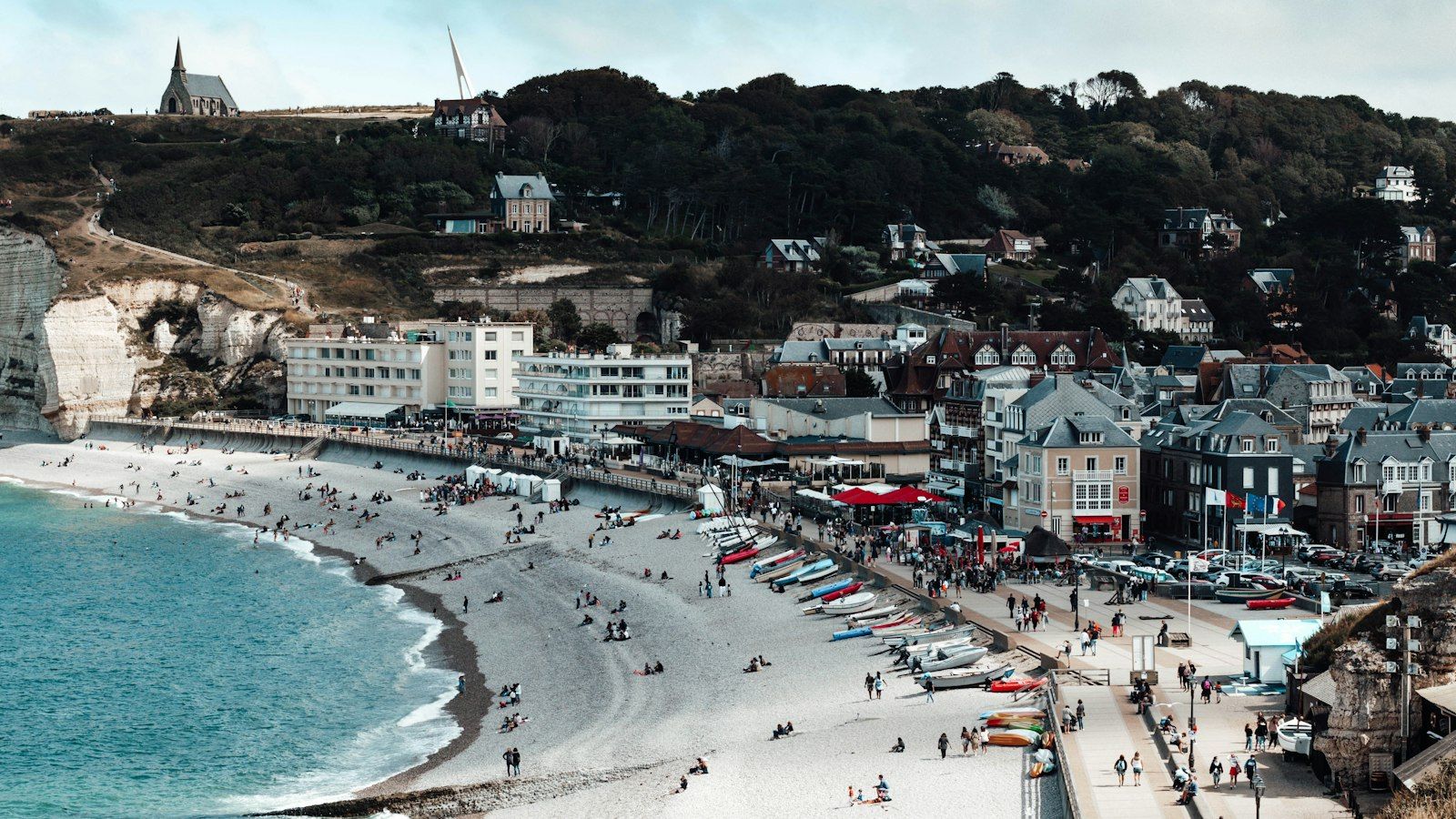
A small Normandy seaside town where chalk arches and a needle of rock frame a pebble beach. Come for the cliff-top walks and the Impressionist history, and finish the day with a pot of mussels. Best time to visit: May to June and September. Daily budget (budget traveller): $140 to $380 USD.
Arrive and find your feet on the seafront
Morning: Train from Paris Saint-Lazare to Le Havre (about 2 hours), then bus to Étretat (about 45 minutes to an hour on LiA line 13 or a Nomad Car service). Check the stop and timetable the night before.
Afternoon: Drop your bags. Walk the full seafront promenade from the foot of the Falaise d'Amont to the Falaise d'Aval end, then loop back through the centre past Les Halles, the old timber market hall.
Evening: Watch the sunset from the pebbles with the Porte d'Aval in silhouette. Dinner at La Flottille on rue Alphonse Karr for wood-fired grills or mussels.
Falaise d'Aval, the Manneporte and Arsène Lupin
Morning: Start by 8am. Climb the steps at the western end of the beach onto the Falaise d'Aval for the Porte d'Aval and the Aiguille, then follow the open path past the golf course to the Manneporte viewpoint (about 4km return). Stay behind every barrier.
Afternoon: Le Clos Arsène Lupin at 15 rue Guy de Maupassant (around €8.50, closed Mondays; October to March weekends and school holidays only). The audio tour takes about 45 minutes.
Evening: Queue from 6:45pm at Le Clos Lupin restaurant on rue Alphonse Karr (no bookings; usually Tuesday to Saturday, so check), or eat crêpes and cider near the seafront.
Falaise d'Amont, the chapel and the gardens
Morning: Walk up from the eastern end of the beach to the Chapelle Notre-Dame de la Garde and the Nungesser et Coli memorial. Be at the Jardins d'Étretat for the 10am opening (about €11-14 depending on season, timed slots in July and August).
Afternoon: Follow the GR21 east along the cliff tops towards Bénouville for an hour, then turn back. On the way into town, step inside the Église Notre-Dame.
Evening: Seafood at Le Galion on Boulevard René Coty, or mussels at Le Bicorne. If the sky is clear, watch a second sunset from the Amont path.
Heading home: For the airport or station, see Getting there in the full Étretat guide.
What to eat in Étretat
- Moules marinières or moules à la normande: mussels cooked in white wine or a cream and cider sauce, served with frites, on almost every menu in town
- Coquilles Saint-Jacques: Normandy scallops, at their best in season from roughly October to May, often pan-seared with butter or a cider sauce
- Fécamp herring: smoked or marinated hareng, a Pays de Caux fishing staple, often served with warm potatoes
- Neufchâtel cheese: a soft, bloomy, often heart-shaped cheese from the nearby Pays de Bray, great on a baguette for a cliff-top picnic
- Cider, pommeau and Calvados: Normandy's apple drinks, from a bolée of dry cider with crêpes to a small Calvados after dinner
- Bénédictine: the herbal liqueur made in Fécamp since the 19th century, best tasted at the Palais Bénédictine itself
- Tarte normande and crêpes: apple tart with custard, or a crêpe with salted butter caramel from one of the crêperies near the seafront
Hidden gems
- Vaucottes, a tiny wooded valleuse between Vattetot-sur-Mer and Yport, with old seaside villas and a quiet pebble cove on the GR21
- Yport, a low-key former fishing village with a lifeguarded beach in summer, fishermen's houses and far fewer coaches than Étretat
- The Église Notre-Dame d'Étretat, a calm medieval church a short walk inland from the seafront that most cliff visitors never step into
- Les Pêcheries in Fécamp, a museum in a former fish-processing building, with a rooftop terrace looking over the harbour and cliffs
- Cap d'Antifer and its lighthouse, reached on the GR21 heading south-west from Étretat, for big empty cliff views without the crowds
Getting around
Étretat is small enough to walk everywhere. The centre, the seafront and both cliff paths are within 15 minutes of each other on foot, though the climbs are steep. Buses connect Étretat with Le Havre. LiA, the Le Havre Seine Métropole network, runs line 13 from Grand Hameau in Le Havre roughly hourly in about 45 minutes, and other LiA and Nomad Car services also cover the route, including line 509, which links Le Havre, Étretat and Fécamp. Single fares are a few euros. Timetables change at the start of the summer and school-year seasons, so check the LiA and Nomad websites before relying on a connection. There is little evening service, so plan day trips around the last bus back. Taxis are limited and need booking ahead. A hire car lets you reach the valleuses, Yport and Cap d'Antifer at your own pace, but parking in Étretat is paid and fills early on summer weekends. Cycling is possible on quiet inland lanes, but the climbs out of town are long.
Safety
Étretat is very safe for solo travellers. The real dangers here are the cliffs and the sea, not crime. The chalk erodes constantly and blocks fall without warning. A municipal order bans access to the Trou à l'Homme tunnel, cliff cavities, the Chambre des Demoiselles and the Descente au Chaudron. Breaking it means a €135 fine, and you may also have to pay for any rescue. Never walk close to the cliff edge, stay at least five metres from the foot of the cliffs, and never cross barriers or red-and-white tape. The tidal range on this coast is large and the sea comes in quickly, so check tide times before walking along the foreshore and never get caught round a headland. The pebble beach shelves steeply and waves can knock you over. Only swim in calm conditions, ideally in lifeguarded summer months, and wear water shoes. Chalk paths get very slippery after rain. In crowded summer car parks and on the seafront, keep valuables out of sight. The emergency number across Europe is 112.
Frequently asked questions
What does this 3-day Étretat itinerary cover?
Day 1: Arrive and find your feet on the seafront. Day 2: Falaise d'Aval, the Manneporte and Arsène Lupin. Day 3: Falaise d'Amont, the chapel and the gardens.
Is 3 days enough for Étretat?
Our recommended trip length for Étretat is 3 to 7 days. This 3-day plan focuses on the highlights and groups sights by area so you spend less time travelling between them.
How much does 3 days in Étretat cost?
A budget traveller spends about $140 to $380 USD a day in Étretat, so roughly $420 to $1,140 USD for 3 days, not counting flights.
Where should I stay for 3 days in Étretat?
Centre and Les Halles: The compact old centre around the timber market hall. Front de mer: The seafront promenade above the pebble beach, running from the foot of the Falaise d'Amont to the Falaise d'Aval.
When is the best time to visit Étretat?
The best time to visit Étretat is May to June and September.
How do I get around Étretat?
Étretat is small enough to walk everywhere. The centre, the seafront and both cliff paths are within 15 minutes of each other on foot, though the climbs are steep.
Is Étretat safe for solo travellers?
Étretat is very safe for solo travellers. The real dangers here are the cliffs and the sea, not crime.
More 3-day guides
- Rocamadour in 3 days
- Carcassonne in 3 days
- Bayeux in 3 days
- Eguisheim in 3 days
- Gordes in 3 days
- Honfleur in 3 days
- Menton in 3 days
- Saint-Malo in 3 days
Étretat in 2 days | Étretat in 4 days | Étretat in 5 days | Étretat in 7 days | Full Étretat guide
Joy Plus home | Destinations | Itineraries | Activities | Flights | Budget planner | Calendar | Map | Blog | Lifetime access