Destinations / Africa
Merzouga, Morocco travel guide
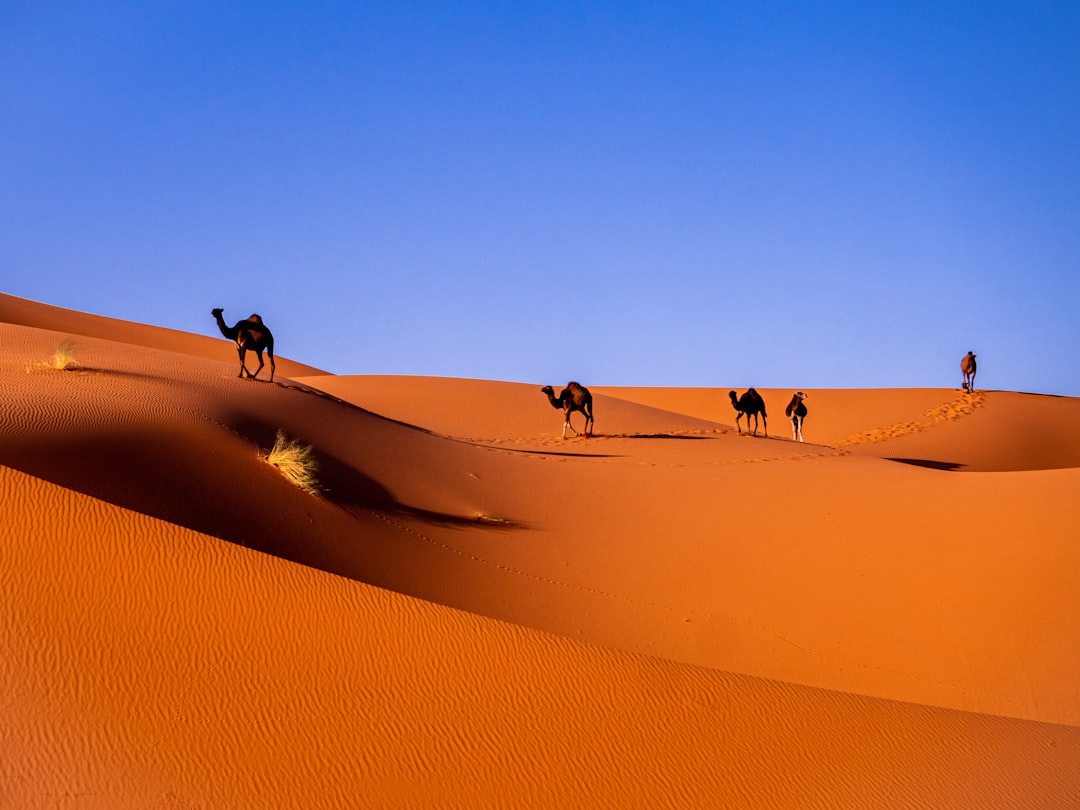
The Sahara doorstep: Erg Chebbi's 150-metre dunes, camel trains at dusk and nights under a full sky of stars.
- Best time to visit: March-May, September-November
- Daily budget (budget traveller): $60 to $150 USD
- Ideal trip length: 2 to 3 days
Merzouga is the tiny village at the edge of Erg Chebbi, the towering sand sea that most people picture when they imagine the Sahara. Dunes climb 150 metres, shifting from apricot to blood-orange between dawn and dusk. Camel trains cross to desert camps where Berber drummers play under a sky so clear the Milky Way casts shadows.
Merzouga is a village of mud-brick auberges and plastic-chair cafés wedged against Erg Chebbi, a sand sea that rises to roughly 150 metres and stretches about 28km north to south. It looks like the Sahara of every screensaver, and it earns it. The dunes go apricot at 4pm, blood orange by 6, and a flat, silvery blue once the sun drops. The drive in is half the story. Date palms thin out, the road runs straight through stony hamada, and then the first dune appears like a mistake in the horizon.
The classic trip is simple: ride a camel out for 60 to 90 minutes at sunset, sleep in a Berber tent camp, eat tagine and listen to drums by the fire, then climb a dune for sunrise. Do that and you have the headline. Stay a second night and you get the better version: Gnaoua trance music in Khamlia, a 4x4 loop to the Taouz mines and nomad tents, the Tuesday or Sunday souk in Rissani, flamingos at Dayet Srji after wet winters. The honest trade-off is distance. Merzouga is about 560km from Marrakech and 450km from Fes, so the desert only works if you plan the road as carefully as the camp.
Camps vary wildly, from a shared-bathroom tent at 350 MAD to a suite with a private plunge pool at 3,000 MAD, and the dunes look identical from all of them. What differs is distance from the village (a camp 20 minutes deeper in has darker skies and no generator hum), tent bedding for winter nights, and whether your guide is a real local or a middleman. Go March to May or September to November, book at least one night inside the erg rather than at the dune's edge, and carry a scarf. It is for sand in your teeth and stars you can read by.
How many days in Merzouga?
For Merzouga, we recommend 2 to 3 days.
| Trip length | What you'll see | Itinerary |
|---|---|---|
| 2 days · Recommended | Marrakech over the High Atlas to Dades; Todra Gorge to Merzouga and your first camel ride | Merzouga in 2 days |
| 3 days · Recommended | Adds: Sunrise, Khamlia and a 4x4 loop | Merzouga in 3 days |
| 4 days | Adds: Rissani, Erfoud and fossils | Merzouga in 4 days |
| 5 days | Adds: Taouz, black desert and sandboarding | Merzouga in 5 days |
| 7 days | Adds: Dayet Srji and slow day; Depart via Midelt to Fes | Merzouga in 7 days |
Merzouga itinerary
Marrakech over the High Atlas to Dades
Morning: Leave Marrakech by 7am. Cross the Tizi n'Tichka pass (2,260m) with a photo stop at the top. Tea in a roadside café before the descent.
Afternoon: Visit Ait Ben Haddou, the UNESCO ksar made famous by Gladiator (entry free, 10 MAD to cross the oued if dry, tip for rooftop view). Lunch at a terrace café, then drive through Ouarzazate, Skoura palm grove and the Rose Valley.
Evening: Arrive in the Dades Gorge (Boumalne Dades) for a simple guesthouse night, 250-400 MAD half-board. Watch the Monkey Fingers rocks fade at dusk, early bed.
Todra Gorge to Merzouga and your first camel ride
Morning: Todra Gorge at 8:30am (free), 300m limestone walls before the day-trip buses arrive. Mint tea in Tinghir.
Afternoon: Long drive via Tinghir, Erfoud, Rissani to Merzouga, about 4 hours. Reach the village edge by 4:30pm, meet your guide, change into long trousers.
Evening: Camel out at sunset (60 to 90 mins), arrive at camp for tea. Tagine, drumming and a fire, then lie flat in the sand for the Milky Way.
Sunrise, Khamlia and a 4x4 loop
Morning: Wake at 5:30am, climb the nearest tall dune barefoot for sunrise. Camel back to the village by 8am, shower and long breakfast at your auberge.
Afternoon: Hire a 4x4 (around 500-700 MAD per vehicle, split). Stop at nomad tents on the western erg, then the Khamlia Gnaoua village for a live trance session, tip around 100 MAD.
Evening: Sunset from a quiet ridge back near Merzouga. Dinner at your auberge, an early night, nothing scheduled.
Rissani, Erfoud and fossils
Morning: Shared grand taxi to Rissani (35km, about 30-40 MAD). Wander the old souk, strongest on Sunday, Tuesday and Thursday, and visit the Zawiya of Moulay Ali Cherif.
Afternoon: Eat madfouna, the stuffed pizza, at a Rissani café (about 40-60 MAD). Continue to Erfoud for fossil workshops cutting 350-million-year-old orthoceras stone, cheap to browse, bargain hard.
Evening: Return to Merzouga for the sunset ridge walk and a rooftop dinner. If you're lucky, a dune bonfire at your auberge.
Taouz, black desert and sandboarding
Morning: Early 4x4 south to Taouz, abandoned lead mines and the rocky black desert. Bring a scarf, the hamada winds are fierce.
Afternoon: Return to the erg, rent a sandboard (50-100 MAD) and spend an hour on the dunes. Siesta at your auberge during the 1-4pm heat.
Evening: Quad bike for 30 min at sunset if you must (300 MAD), otherwise a quiet terrace and a long mint-tea session.
Dayet Srji and slow day
Morning: Check whether the seasonal lake has water (after wet winters). If yes, flamingos at dawn. If dry, spend a lazy morning in Hassi Labied's palm groves.
Afternoon: Lunch at Kasbah Mohayut or another kasbah hotel, use their pool for 100-150 MAD day access if offered.
Evening: Second night in a camp, or the village. Last drums, last stars. Pack your bags tonight.
Depart via Midelt to Fes
Morning: Leave by 7am. Drive via Erfoud, Rich and Midelt through the Ziz gorges.
Afternoon: Lunch in Midelt (tagine 60-80 MAD), then over the Middle Atlas via Azrou and its cedar forest with Barbary macaques.
Evening: Arrive Fes by 6 to 7pm. Alternatively fly out of Errachidia.
Best neighbourhoods
- Erg Chebbi Dunes: The 28km-long sand sea with the tallest dunes in Morocco.
- Merzouga Village: The base settlement of guesthouses, cafes and tour operators.
- Hassi Labied: A quieter palm-fringed village a few kilometres north, popular with kasbah hotels.
- Khamlia: A Gnaoua village of Sudanese descent famous for its trance music sessions.
- Dayet Srji: A seasonal salt lake that draws flamingos after winter rains.
Must-do experiences
- Camel trek to a desert camp: Ride into the dunes at sunset and overnight in a Berber tent camp.
- Sunrise on Erg Chebbi: Climb the big dune before dawn for the light show over the sand sea.
- Gnaoua music in Khamlia: Hear live trance drumming and hear the village's Saharan history.
- 4x4 or sandboard the erg: Explore fossil beds, nomad camps and abandoned mines by desert vehicle.
Hidden gems
- Flamingos at Dayet Srji lake after a wet winter.
- The nomad families still living in tents on the erg's western side.
- Fossil workshops in Erfoud, 50km north, cutting 350-million-year-old seabed stone.
- The Todra and Dades gorges on the road back toward Marrakech.
Daily budget
- Accommodation: budget 250-450 MAD (auberge dorm or shared-bathroom desert tent with dinner and breakfast), mid-range 800-1,500 MAD (comfort camp with en-suite tent, or Riad Madu / Kasbah Mohayut double), splurge 2,500+ MAD (luxury camp with private plunge pool, or Kanz Erremal). Most camps price per person including camel, dinner and breakfast, so compare inclusions, not headline price. Ask if the bathroom is inside the tent.
- Food: budget 120-200 MAD / day (café omelettes, tagine, madfouna in Rissani), mid-range 300-500 MAD (auberge half-board plus one restaurant lunch), splurge 700+ MAD (hotel terrace dinners, licensed wine, private desert dinner setup). Camp dinner and breakfast are usually included. Lunch in a village café is 50-90 MAD for tagine, mint tea 10-15 MAD.
- Transport: budget 250-350 MAD (bus one way from Fes; check whether a direct Marrakech bus still runs) plus 30-40 MAD shared taxi to Rissani, mid-range 1,000-1,800 MAD (shared multi-day tour transport from Marrakech, 2 nights), splurge 3,500+ MAD (private driver-guide with 4x4 for 3 days from Marrakech or Fes). Hire cars are possible but Merzouga itself needs none. Camps arrange camel or 4x4 transfers from the village.
- Activities: budget 0-100 MAD (dune climb, sunrise, sandboarding board rental 50-100 MAD), mid-range 300-700 MAD (half-day 4x4 loop 500-700 MAD per vehicle, split between 4, Khamlia music tip), splurge 1,200+ MAD (private 4x4 full day, quad bikes 300 MAD/hr, hot air balloon over the erg). Camel trek is almost always bundled with the camp. Tip 100 MAD to the Gnaoua musicians in Khamlia, 50 MAD per person for your camel guide.
- Drinks & nightlife: budget 20-40 MAD (mint tea, soft drinks, bottled water), mid-range 100-200 MAD (a couple of beers at a licensed hotel, fresh orange juice), splurge 350+ MAD (wine on the terrace at a luxury kasbah, private bonfire with drumming). Nightlife means drums, a fire and stars. Beer, around 50-70 MAD, only at licensed hotels, not in village cafés or most camps.
Where to stay
- Social hostel in Merzouga Village (250-450 MAD / night with breakfast, 450-700 MAD with camel and camp dinner): Family-run auberges such as Auberge Yasmina or Auberge Du Sud offer dorm beds, rooftop terraces and bundled camel treks, with a mix of solos and small groups.
- Boutique hotel in Hassi Labied (700-1,400 MAD / night): Riad Madu or Kasbah Mohayut, mud-brick kasbah style, pool, air conditioning, restaurant and dune views, quieter than the village centre.
- Apartment in Merzouga Village (400-800 MAD / night): Self-catering guesthouse units and riad-style apartments are scarce, but a few exist on Booking with kitchens and terraces. Good for a 4+ night stay to base yourself for day trips.
- Splurge in Erg Chebbi, inside the dunes (2,200-4,500 MAD / night): Kanz Erremal or a luxury camp such as Merzouga Luxury Desert Camps. Suite tents with real beds, private bathrooms, some with plunge pools, and the darkest skies, 30 mins from the village.
What to eat
- Madfouna, the stuffed 'Berber pizza' baked in sand
- Tagine slow-cooked over embers at a desert camp
- Dates from the Tafilalt palm groves
- Sweet mint tea poured from height, endlessly
Day trips
- Rissani and Erfoud (35km and 80km, 40 to 90 min): Rissani is the old capital of the Tafilalt, with a big souk (Sunday, Tuesday, Thursday), a donkey park and the Zawiya of Moulay Ali Cherif. Erfoud, further north, is famed for fossil workshops and date groves. Eat madfouna for about 40-60 MAD. Shared grand taxi from Merzouga to Rissani, 30-40 MAD per seat, then another shared taxi to Erfoud. Or arrange a private driver for about 500-700 MAD return.
- Khamlia, Taouz and the black desert (10km to Khamlia, 45km to Taouz): Khamlia is a Gnaoua village of Sudanese descent with live trance drumming. Further south, Taouz has abandoned lead mines and the dark stony hamada, with fossil beds and nomad tents on the way. Half-day 4x4 from Merzouga, 500-800 MAD per vehicle for up to 4 people, or a full day at 900-1,300 MAD.
- Todra Gorge (190km, about 3 to 3.5 hours): Limestone walls over 300m high squeeze a narrow river. Best walked early before tour buses arrive, and combined with Tinghir's palm oasis. Works as a long day or on the road back to Marrakech. Private driver from Merzouga, about 900-1,500 MAD return, or grand taxi to Tinghir (60-80 MAD) then a local taxi to the gorge entrance.
When to visit
- Spring (March - May): 22-32°C by day, 10-18°C at night, occasional sandstorms (siroco) in April. Crowds: Busy at Easter and in Moroccan school holidays, otherwise manageable. The best window with autumn. Warm days, comfortable camp nights, green palm groves. Pack a buff for wind.
- Summer (June - August): 38-47°C, dune sand too hot to touch barefoot after 11am. Crowds: Very low, many camps close or run skeleton staff. Skip it. Midday heat is genuinely dangerous and sleeping in a tent is brutal. Only for the hardy with a 5am routine.
- Autumn (September - November): 25-34°C in September falling to 18-24°C in November, nights 8-14°C. Crowds: Moderate, peaks late October to early November. The photographers' favourite. Clear air, crisp light, and a chance of flamingos if early rains fall. Book camps ahead around Toussaint week.
- Winter (December - February): 15-20°C days, 0-5°C nights, sharp wind, rare rain or snow on the Atlas passes. Crowds: Moderate at New Year, low otherwise. Underrated. The light is superb and the sand glows, but you need a camp that gives three blankets or a heater. Cheapest rates in January.
Entry rules for your passport
Visa rules for Morocco depend on the passport you travel on. Check the official source before you book: Morocco Ministry of Foreign Affairs
Getting there
Merzouga is remote, and the journey is the main cost. Overland from Marrakech is about 560km and 9 to 10 hours, usually split into two days via Tizi n'Tichka, Ait Ben Haddou, Ouarzazate, the Dades and Todra gorges. From Fes it is about 450km and 7 to 8 hours via Ifrane, Midelt and Er-Rachidia. Supratours runs a daily bus to Merzouga from Fes, around 250-350 MAD one way. A direct Marrakech bus is not listed any more, so check before you plan around it. The nearest airport is Errachidia (ERH), roughly 1.5 to 2 hours from Merzouga, with limited domestic flights, so check schedules. Private transfers from Errachidia cost 600-900 MAD. Local grands taxis from Erfoud or Rissani cost 30-60 MAD per seat shared. Avoid driving at night, there are animals and unlit checkpoints. A hire car from Marrakech costs about 350-600 MAD a day, but you don't need it once in Merzouga.
Getting around
Merzouga is remote: roughly 9 to 10 hours by road from Marrakech (usually split over two days via Ait Ben Haddou and the Dades Gorge), 7 to 8 hours from Fes, and about two hours from Errachidia airport. Supratours runs a daily bus from Fes; check whether a direct Marrakech service is running. Once there, camps handle transfers by camel or 4x4; you don't need your own vehicle.
Safety
Merzouga is safe and heavily geared to tourism, with the main risks environmental rather than criminal. Summer temperatures exceed 45°C and desert nights drop near freezing in winter, so pack layers. Never walk far into the dunes alone or without water, sandstorms can arrive quickly in spring, and only book camps with clear licensing and reviews.
Solo travel tips
- Book the camp directly, not the first tout: Walk-in touts at the village edge quote anything. Use a camp with real reviews on Booking or Google, message on WhatsApp, and agree in writing what is included: camel, dinner, breakfast, bedding, toilet type. Expect 350-600 MAD solo for a standard camp.
- Join a shared tour from Marrakech or Fes: Going solo, the 3-day tour is the easy route, 1,500-2,500 MAD with a mixed group of 6 to 12. You get the Ait Ben Haddou, Dades and Todra stops, a driver for 560km, and instant company. Check that the camp night is inside the erg, not at the edge.
- Pick a camp with a communal fire: Smaller camps with 8 to 15 tents mean everyone eats at one table and ends up drumming together. Large camps of 50 tents feel like a hotel. Ask how many guests are booked that night.
- Solo female travellers: Merzouga is generally safe, but unwanted attention from touts is common. Dress in loose long layers, ask for a female-only tent if sleeping in a shared camp, and use camps that are reviewed by other solo women. Politely refuse private evening offers and never walk into the dunes alone after dark.
- Never wander the dunes alone: Distances deceive, dunes shift, and a sandstorm can erase all landmarks in ten minutes. Tell someone where you are going, carry 2 litres of water and a charged phone, and stay within sight of your camp for sunrise climbs.
- Charge everything before the camp: Most camps have one or two power points or a generator that runs a few hours. Bring a 20,000mAh power bank and a head torch. Phone signal usually fades past the first dune row.
Cultural etiquette
- Dress modestly in villages and towns. Shoulders and knees covered for everyone, scarves for sun and sand are practical and respected.
- Say salam alaykum and shake right hands, then touch your heart. Greetings matter more than speed, and you'll be offered mint tea. Accept at least one glass.
- Ask before photographing people, especially women, nomad families and Gnaoua musicians. A tip of 10-20 MAD is expected if someone poses for a portrait.
- Bargain in souks and for fossils, but not in restaurants or for fixed-price transport. Start at 40 to 50 percent, smile, walk away once.
- Use your right hand for eating and handing money. Remove shoes before entering tents and homes.
- During Ramadan (about 8 February to 9 March in 2027), many cafés close by day. Eat and drink discreetly, and expect camps to run later dinners.
- Don't climb dunes with a speaker. The quiet is the product, and camps and locals notice who brings noise.
Frequently asked questions
Is Merzouga worth visiting?
Yes, if you want the classic Sahara experience. Erg Chebbi's 150-metre dunes are the most dramatic in Morocco, and a night in a desert camp with camel trek, drumming and stargazing is a genuine highlight. Two nights lets you avoid rushing the very long drive.
How do you get to Merzouga from Marrakech?
It's about 560km and 9 to 10 hours of driving, so almost everyone does it as a two or three-day tour stopping at Ait Ben Haddou, Ouarzazate, the Dades Gorge and Todra Gorge. Supratours buses run from Fes, and flying to Errachidia then driving about two hours is the fastest option.
When is the best time to visit Merzouga?
March to May and September to November, with daytime highs of 22 to 30°C and cool but comfortable nights. Summer regularly tops 45°C and is genuinely dangerous at midday, while December and January nights can approach freezing in the camps, though the daytime light is superb.
How much does a Sahara desert camp cost?
Standard camps with shared facilities run roughly 300 to 600 dirhams per person including camel trek, dinner and breakfast. Comfort camps with en-suite tents cost 800 to 1,500 dirhams, and luxury camps go well beyond 2,000 dirhams. Multi-day tours from Marrakech typically run 1,500 to 3,500 dirhams.
Is Merzouga or Zagora better for the desert?
Merzouga, if you want real dunes. Erg Chebbi's sand sea is far more dramatic than Zagora's stony, low-dune desert, though Zagora is much closer to Marrakech at about 7 hours. Choose Zagora only if you're very short on time; otherwise Merzouga is worth the extra distance.
How long is the camel ride in Merzouga?
Typically 60 to 90 minutes each way between the village edge and the camp, timed for sunset going out and sunrise coming back. It's slow and scenic rather than strenuous, but the saddles are hard, so wear long trousers. Most camps offer 4x4 transfers if you'd rather not ride.
Is Merzouga safe?
Yes. It's a well-established tourism area with no notable crime issues, and camps are used to international guests. The genuine risks are heat exhaustion, dehydration, cold desert nights and disorientation in the dunes, so stay with guides, carry water, and check that your camp and operator are properly licensed.
More about Merzouga
- Where to Travel in 2027: 15 Places Worth Planning a Trip Around
- Total Solar Eclipse 2 August 2027: Where to Watch It and How to Plan Now
Tours and activities in Merzouga | Merzouga in 2 days | Merzouga in 3 days | Merzouga in 4 days | Merzouga in 5 days | Merzouga in 7 days
Joy Plus home | Destinations | Itineraries | Activities | Flights | Budget planner | Calendar | Map | Blog | Lifetime access