Destinations / Asia
Paro, Bhutan travel guide
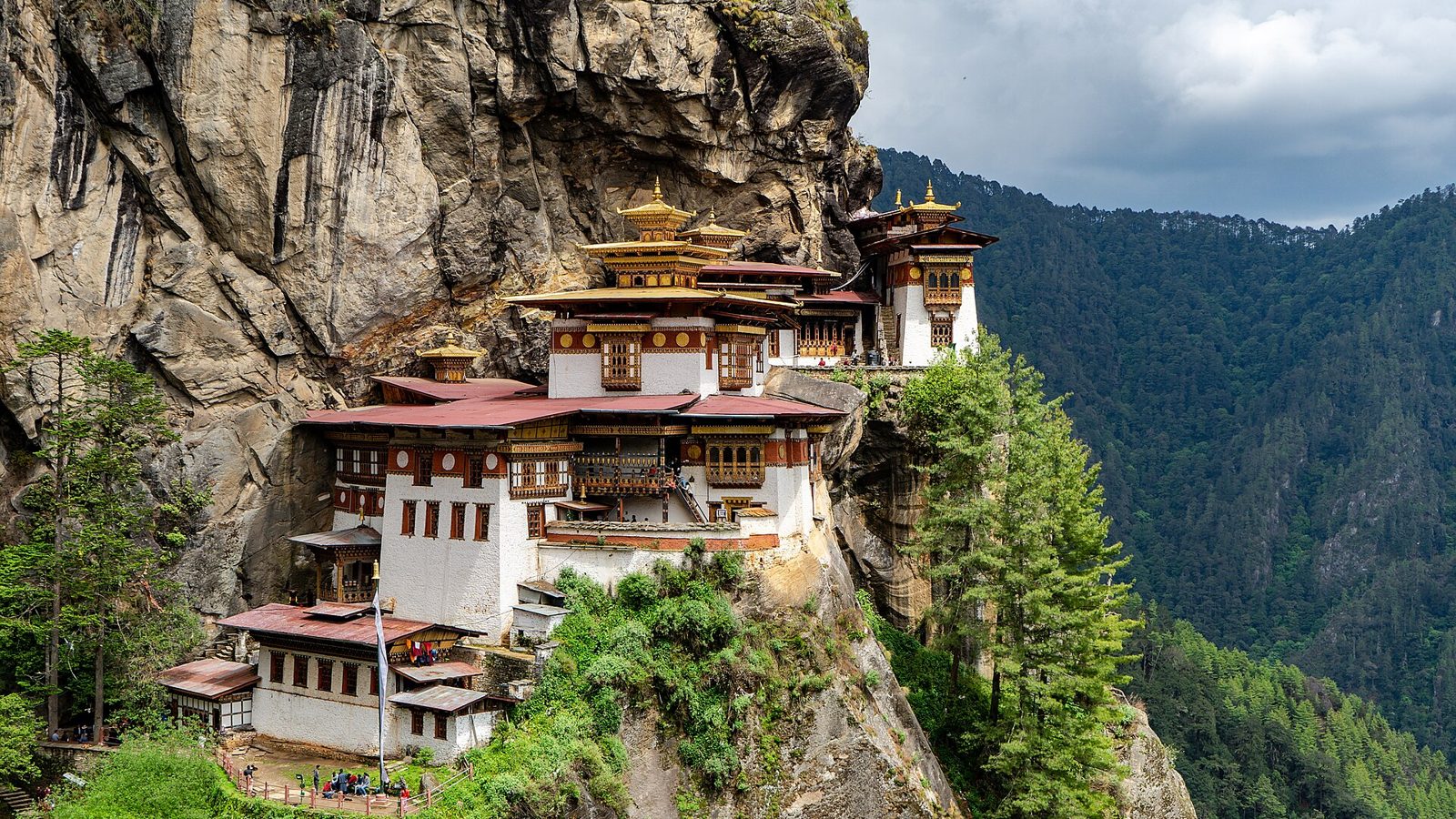
A wide green valley in western Bhutan where every international flight lands. You hike up to the Tiger's Nest on its cliff, walk across a wooden bridge to a huge white fortress and eat chillies and cheese in a valley full of farmhouses and prayer flags.
- Best time to visit: March to May and October to November
- Daily budget (budget traveller): $200 to $600 USD
- Ideal trip length: 3 to 5 days
Paro sits at about 2,200m in the widest valley in western Bhutan. Its airport is the only international one in the country, so almost everyone arrives here, usually after a dramatic landing between steep forested ridges. The town is small: a few streets of painted wooden shopfronts, with the Paro Chhu river running past and the great Rinpung Dzong on the hillside above. The rest of the valley is rice paddies, apple orchards, old farmhouses and temples, some of them well over a thousand years old. Most people come for Paro Taktsang, the Tiger's Nest monastery, which clings to a cliff about 900m above the valley floor. The hike up is the best day in most Bhutan trips. Bhutan is not a cheap place for a solo traveller. Every foreign visitor except Indian nationals pays a Sustainable Development Fee of $100 a night, and you need a licensed guide to go into the dzongs, temples and Tiger's Nest. Still, you can walk the town and the valley roads on your own, the air is clean, people are kind and the evenings are very quiet. For a few slow days at altitude, it is one of the most rewarding places in Asia.
Paro is the gateway to Bhutan and, for many visitors, the highlight. The valley is broad and fertile, at around 2,200m, with the Paro Chhu running down the middle. It has more than 150 temples and monasteries, and many families still live in big whitewashed farmhouses with carved wooden windows. The town itself is small. It was laid out in the 1980s, and its painted shopfronts sit beside the river below Rinpung Dzong, one of the finest fortresses in the country. Up the valley, the Tiger's Nest hangs on its cliff, where Guru Rinpoche is said to have meditated after flying there on a tigress. Most tour groups give Paro two nights at the start or end of a loop. Stay longer and you get a better trip: a slow first day to adjust to the altitude, the hike on a clear morning, a hot stone bath in a farmhouse and quiet walks along the river road.
Getting here takes planning. Every visitor except Indian, Bangladeshi and Maldivian nationals pays the Sustainable Development Fee of $100 a night, set at that rate until 31 August 2027, plus a one-off $40 visa fee. You book your visa online for fixed dates. You no longer have to buy an all-inclusive package, but you do need a licensed guide for temples, dzongs and travel beyond Paro and Thimphu. Flights come only with Drukair and Bhutan Airlines, mainly from Bangkok, Delhi and Kathmandu. Once you arrive, walk the town on your own, then book a guide and car for the days with sights.
Timing matters. Spring brings rhododendrons, mild weather and the Paro Tshechu, Bhutan's best-known festival of masked dances, which ran from 29 March to 2 April in 2026. Autumn has the clearest mountain views and the most visitors. The monsoon months are green and quieter, but often wet and cloudy, and winter is cold, bright and peaceful. Paro is very safe, and English is widely spoken by guides, hotel staff and shopkeepers. Evenings are early and calm, with a few bars and karaoke places rather than real nightlife. Come for the walks, the temples and the slow rhythm of the valley.
Paro itinerary
Land and take it easy
Morning: Fly in from Kathmandu, Delhi or Bangkok, sitting on the left on the Kathmandu flight for views of the Himalaya. Your guide or hotel meets you at the airport.
Afternoon: Check in, drink plenty of water and take a gentle walk around Paro town and the main street shops. No big climbs today.
Evening: Walk to Nyamai Zam to see the dzong lit up, then have momos and ema datshi in a café in town.
Dzong, museum and Zuri walk
Morning: With your guide, visit the National Museum in Ta Dzong, then walk down to Rinpung Dzong. Dress modestly for both.
Afternoon: Take the short forest path up to Zuri Dzong for views over the valley and the airport. Visit Dungtse Lhakhang on the way back.
Evening: Free time in town without a guide. Browse the handicraft shops and have an early night before the hike.
Tiger's Nest
Morning: Drive 20 to 30 minutes to the trailhead and start by 7.30am. Climb steadily to the cafeteria viewpoint, then on to the monastery (about Nu 1,000).
Afternoon: Visit the shrines with your guide, walk down and have a late lunch near the trailhead.
Evening: Soak tired legs in a farmhouse hot stone bath, often with a home-cooked dinner.
Upper valley and Kyichu
Morning: Visit Kyichu Lhakhang early, when locals are walking the prayer wheel circuit.
Afternoon: Drive up to Drukgyel Dzong at the head of the valley and walk among the farmhouses and paddies nearby.
Evening: Back in town for a quiet dinner and a look at the Sunday market if it is the weekend.
Chele La and Haa
Morning: Drive up to Chele La, at almost 4,000m, for views of Jomolhari on a clear morning. Walk slowly along the ridge through the prayer flags.
Afternoon: Continue down into the quiet Haa valley with your guide to see its white and black temples and village life.
Evening: Return over the pass to Paro, about 2.5 to 3 hours, or stay a night in a Haa farmhouse.
Day trip to Thimphu
Morning: Drive 1 to 1.5 hours to the capital. See the giant Buddha Dordenma and the weekend market if it is open.
Afternoon: Visit Tashichho Dzong and the Folk Heritage Museum, then have coffee in one of the cafés on Norzin Lam.
Evening: Drive back to Paro for a farewell dinner, and settle up tips with your guide and driver.
Slow morning and depart
Morning: Most flights leave early, so check out in good time. If yours is later, take a final walk by the river.
Afternoon: Transfer to the airport about 10 minutes away. Weather delays happen, so leave a buffer before onward flights.
Evening: Arrive in Bangkok, Delhi or Kathmandu, or carry on to your next stop.
Best neighbourhoods
- Paro town: A compact grid of streets lined with painted wooden shops, small hotels, cafés and handicraft stores, on the west bank of the Paro Chhu. You can walk to the dzong, the bridge and the weekend market from here. It is the only part of the valley where you can easily wander out to eat on your own in the evening, so it suits solo travellers best.
- Dzong and museum hillside: The slope just east of town, with Rinpung Dzong, the round Ta Dzong watchtower that houses the National Museum, and paths up to Zuri Dzong. A few hotels up here have views over the whole valley. It is quiet and close to the sights, but the walk back from town after dinner is uphill.
- Upper Paro valley: The road north towards Satsam and Drukgyel Dzong runs past farmhouses, paddies and the trailhead for the Tiger's Nest. This is where you will find the resort hotels and farmhouse stays. It is beautiful and peaceful, but you will need a car to reach town, which is 15 to 25 minutes away.
- Kyichu and the valley road: The middle of the valley, around the ancient Kyichu Lhakhang, about 15 minutes' drive from town. You get rice fields, small guesthouses and a lot of birdsong. It is a good compromise between quiet and access, and you can walk to the temple.
- Shaba and Bondey: Villages south of the airport on the road to Thimphu. They have some good-value hotels and farmhouses with traditional hot stone baths. This area works well if you are heading to Thimphu next or catching an early flight, but there is little to do in the evening.
Must-do experiences
- Hike to the Tiger's Nest: Paro Taktsang sits at 3,120m on a sheer cliff. The trail is about 4.5km each way and takes 4 to 6 hours return with your visit, climbing roughly 900m. Adult entry is about Nu 1,000 (around $12) in 2026, and you need a licensed guide. Horses can carry you as far as the halfway cafeteria.
- Explore Rinpung Dzong: The 'fortress on a heap of jewels' houses the district government and a monk body, with fine woodwork and courtyards. Go with your guide in the late afternoon, and cover your shoulders and legs. A small entry fee applies, and some areas close for ceremonies.
- Cross Nyamai Zam: The traditional covered cantilever bridge over the Paro Chhu is the classic way to walk up to the dzong. It is free and open to all, and the view of the fortress from the riverbank is the best photo in town, especially in late afternoon light.
- Visit the National Museum: The museum is in and around Ta Dzong, a 17th-century watchtower above Rinpung Dzong. It covers masks, thangkas, textiles and natural history, and it is the best way to understand what you will see in the temples. Bring your guide and allow an hour or two.
- See Kyichu Lhakhang: One of the oldest temples in Bhutan, said to date from the 7th century, with prayer wheels and orange trees in the courtyard. Locals walk around it at dawn and dusk. Go early, join the circuit clockwise and keep your camera away inside.
- Drive up to Chele La: The road pass between Paro and Haa reaches almost 4,000m. On a clear day you can see Jomolhari and the high peaks along the Tibetan border. It takes about 1 to 1.5 hours by car from town. Walk up the ridge through the prayer flags, but take it slowly because of the altitude.
- Try a hot stone bath: The dotsho is a wooden tub of river water heated with fire-hot stones and herbs, usually in a farmhouse. Expect roughly $20 to $40 USD, often with dinner. It is ideal after the Tiger's Nest hike. Book through your guide or hotel.
Hidden gems
- Zuri Dzong, a small fortress on the ridge above the museum, reached by a short forest walk with views over the whole valley and the airport
- Dungtse Lhakhang near the Paro Chhu, a chorten-shaped temple built by the iron bridge builder Thangtong Gyalpo, with painted floors that represent levels of Buddhist cosmology
- Watching planes from the road above the airport, where you can see aircraft bank between the ridges on their final turn
- The ruins and rebuilt walls of Drukgyel Dzong at the head of the valley, where Jomolhari sometimes shows itself on clear mornings
- The Sunday vegetable market by the river, where farmers sell red rice, dried chillies, chunks of hard yak cheese and betel nut
Daily budget
- Accommodation: budget $40 to $70 USD / night (certified 2 to 3 star hotel), mid-range $100 to $200 USD (4 star or heritage hotel), splurge $600+ USD (COMO Uma Paro, Six Senses or Amankora). Tourists must stay in government-certified hotels or homestays. Rooms are often doubles, so solo travellers pay the full room rate. A 5% GST applies to tourism services.
- Food: budget $15 to $25 USD / day (local cafés, momos, ema datshi), mid-range $30 to $50 USD (hotel meals and café lunches), splurge $80+ USD (lodge dining with wine). A local plate of rice and curry costs Nu 200 to 400. Many tourist hotels serve buffets, so eat in town when you can for better food.
- Transport: budget $0 to $10 USD / day (walking, short taxi hops), mid-range $80 to $100 USD (guide and car for the day), splurge $150+ USD (private SUV, Haa or Punakha trips). The guide and car rate covers airport transfers and valley sightseeing. Walk in town on your free days to keep this cost down.
- Activities: budget $0 to $15 USD / day (town walks, Tiger's Nest at about Nu 1,000), mid-range $20 to $40 USD (dzong, museum, temples, hot stone bath), splurge $100+ USD (archery sessions, cooking classes, trekking). Entry fees are small compared with the SDF. Tipping your guide and driver adds about $16 to $25 USD a day.
- Drinks & nightlife: budget $2 to $5 USD (a local Druk or Red Panda beer), mid-range $10 to $25 USD (a few drinks at a hotel bar), splurge $40+ USD (cocktails at a luxury lodge). Tuesday is traditionally a dry day, when bars do not serve alcohol. Nightlife means quiet bars and karaoke, and most places close early.
Where to stay
- Budget hotel in Paro town ($40 to $70 USD / night): Small certified 2 to 3 star hotels on and around the main street put you within walking distance of cafés, the bridge and the dzong. They suit days when you explore without a guide.
- Farmhouse stay in Kyichu, Shaba or the upper valley ($50 to $90 USD / night): Certified farmhouse homestays give you home-cooked meals, a hot stone bath and a real glimpse of rural life. You need a car to get into town.
- Heritage hotel in Upper valley or the dzong hillside ($200 to $400 USD / night): Zhiwa Ling Heritage and similar hotels are built in traditional style with painted wood, in-house temples and valley views. They offer comfort without the full luxury price.
- Splurge in Hillsides above the valley ($600 to $1,500+ USD / night): COMO Uma Paro, Six Senses Paro and Amankora Paro offer spas, fine dining and big views among the pine forests. Some include guiding and activities in their rates.
What to eat
- Ema datshi: chillies cooked in melted cheese, the national dish. Ask for it 'less spicy' if you are not used to it
- Red rice: the slightly nutty local rice grown in the Paro valley, served with almost every meal
- Momos: steamed dumplings filled with cheese, vegetables or beef, sold in small cafés in town for a few dollars a plate
- Shakam paa and phaksha paa: dried beef or pork cooked with chillies and radish, heavy and very good after a cold day
- Suja and ara: salted butter tea and the local spirit made from rice or maize, often offered in farmhouses
- Coffee and cake at Champaca Café, or a local lunch at Sonam Trophel in town, a break from the buffet food in tourist hotels
Day trips
- Chele La pass (About 35km from Paro, 1 to 1.5 hours by road): The highest motor road pass in Bhutan, close to 4,000m, with prayer flags, forests of rhododendron and views of Jomolhari on clear days. It is good for short ridge walks. Go by car with your guide, ideally early in the morning before the cloud builds. Take warm clothes, and check road conditions in winter, when snow can close the pass.
- Thimphu (About 55km east, 1 to 1.5 hours by road): Bhutan's small, lively capital, with a huge seated Buddha, a working dzong, a weekend market and the country's best cafés. It is a good contrast to rural Paro. Drive with your guide and car. You can walk around town on your own, but the dzong and museums need a guide. Return the same day or stay a night.
- Haa valley (About 65km west over Chele La, 2.5 to 3 hours by road): A remote, quiet valley with old temples, farmhouses and very few visitors. It feels like Bhutan before tourism and makes a good overnight with a farmhouse stay. Haa is outside the Paro and Thimphu zone, so you need a licensed guide and a route permit. Your operator arranges both. Go via Chele La and allow a full day.
When to visit
- Spring (March - May): 12-24°C by day, cool nights, some afternoon showers by May. Crowds: Busy around the Paro Tshechu, moderate otherwise. Excellent for hiking and festivals, with rhododendrons on the passes. Haze can hide the high peaks. Book festival dates months ahead.
- Monsoon (June - August): 18-26°C, humid, frequent rain and low cloud. Crowds: Low. Lush and quiet, but mountain views are rare, trails get muddy and flights and roads can be disrupted. Fine if you mainly want temples and calm.
- Autumn (September - November): 12-23°C, clear and dry from October, cold nights. Crowds: High in October, moderate in November. The best weather and views of the year. October is the peak month, so November is often the better choice for solo travellers.
- Winter (December - February): 10-16°C by day, often below freezing at night, mostly dry. Crowds: Low. Crisp, sunny days and empty trails, with good views. Pack warm layers, as rooms and temples can be cold. Snow can close Chele La.
Entry rules for your passport
Visa rules for Bhutan depend on the passport you travel on. Check the official source before you book: Bhutan Department of Immigration
Getting there
Paro International Airport, at about 2,235m, is Bhutan's only international airport, and only Drukair and Bhutan Airlines fly there. There are no long-haul direct flights, so you connect via Bangkok, Delhi or Kathmandu, which all have daily services, or via Singapore, Kolkata, Dhaka, Guwahati or Dubai on fewer days a week. Typical one-way fares in 2026 run from about $200 to $280 USD from Kathmandu to $360 to $490 USD from Bangkok. Book as soon as your dates are fixed, because seats are limited. On the flight from Kathmandu, sit on the left for views of Everest and Kanchenjunga. Overland, you can enter from India at Phuentsholing, about 4 hours from Bagdogra airport, and then drive about 5 to 6 hours to Paro with your guide. Before you go, apply for your e-visa online ($40 USD), prepay the $100 USD nightly Sustainable Development Fee and arrange travel insurance. The airport is about 10 minutes from town.
Getting around
Paro town is small and flat enough to walk. It takes about 10 minutes from the main street to Nyamai Zam, then a steady climb up to the dzong and the museum. The valley stretches more than 15km, though, and the Tiger's Nest trailhead is about 10km north of town, so for most sights you will travel by car. Tourists usually book a guide and car together. Expect about $80 to $100 USD a day for both, and less on days when you only need a driver. You do not need a guide to walk around Paro town, shop or eat, so plan one or two free days on foot to save money. Taxis wait near the town centre for short hops, and your hotel can call one. Agree the price first. Roads are narrow and winding, and the drive to Thimphu takes about 1 to 1.5 hours. Travel beyond Paro and Thimphu, including Haa and Punakha, needs a guide and route permit. There is no public transport worth relying on for visitors, and you cannot rent a car without arranging permits through an operator.
Safety
Paro is one of the safest places in Asia, and crime against visitors is rare. The real risks are altitude, roads and weather. The town is at about 2,200m, the Tiger's Nest at 3,120m and Chele La close to 4,000m, so take a gentle first day, drink plenty of water and go easy on alcohol until you have adjusted. Tell your guide if you get a bad headache, nausea or breathlessness. The Tiger's Nest trail is steep, dusty or muddy depending on the season, and has long drops and hundreds of steps near the top. Wear proper shoes and do not lean over the edges. Roads are narrow with sharp bends, and landslides are common during the June to September monsoon. Stray dogs bark loudly at night and can be territorial, so give them space. Tap water is not safe to drink. Use filtered or bottled water. Emergency numbers are 113 for police, 112 for ambulance and 110 for fire. Travel insurance with medical and evacuation cover is essential.
Solo travel tips
- Save on guide-free days: You only need a guide for temples, dzongs and travel beyond Paro and Thimphu. Plan town walks, café afternoons and market visits for days without one to cut costs.
- Give yourself a day to adjust: Do not hike the Tiger's Nest the day you land. A gentle first day at 2,200m makes the climb to 3,120m much easier and far more enjoyable.
- Ask about single rooms: Many hotels price by the room, not the person. Ask for single rates or small rooms when you book, and compare a few certified hotels in town.
- Build a buffer around flights: Paro flights run in daylight only and get delayed by cloud and wind. Leave at least half a day, ideally a night, before any connecting flight.
- Safety for solo travellers: Crime is rare, so the main risks are altitude, steep trails and night-time dogs. Carry a torch after dark, keep your guide's number saved and never rush the climb.
- Get to know your guide: On a solo trip, your guide is your companion, translator and friend. Ask about their family, archery or festivals, and they will often take you to places groups never see.
Cultural etiquette
- Greet people with 'kuzuzangpo la' (hello) and say 'kadrinchhey la' (thank you). Adding 'la' is a sign of respect.
- Walk clockwise around chortens, temples, prayer wheels and mani walls, and keep them on your right.
- Wear long sleeves and long trousers or skirts for dzongs and temples. Remove your hat and, where asked, your shoes, and do not take photos inside shrines.
- Do not point your feet at altars or people, and do not touch anyone's head, including children's.
- Speak respectfully about the royal family and the monarchy. Bhutanese people hold them in very high regard.
- Ask before photographing people, especially monks and older villagers, and at festivals follow your guide's lead on where to stand.
- Smoking is restricted in public places, and Tuesday is a traditional dry day, so check before lighting up or ordering a drink.
Frequently asked questions
How do I get to Paro?
Almost everyone flies. Only Drukair and Bhutan Airlines fly into Paro, with daily flights from Bangkok, Delhi and Kathmandu and less frequent ones from Singapore, Kolkata, Dhaka and a few other cities. Typical one-way fares in 2026 are roughly $200 to $280 USD from Kathmandu, $220 to $340 USD from Delhi and $360 to $490 USD from Bangkok. Fares hardly drop if you book early, but seats sell out in peak season. The airport is about 10 minutes from town, and your guide or hotel normally meets you.
How many days do I need in Paro?
Three days covers the town, Rinpung Dzong, the museum and the Tiger's Nest, with a day to adjust to the altitude first. Four or five days lets you add Kyichu Lhakhang, Drukgyel Dzong, Chele La and a hot stone bath. With a week, you can add day trips to Thimphu and the Haa valley, or start a trek such as the Druk Path.
When is the best time to visit Paro?
March to May brings rhododendrons, mild days and the Paro Tshechu festival. In 2026 it ran from 29 March to 2 April. October and November have the clearest skies and the best mountain views, though October is the busiest month. June to August is the monsoon, so expect cloud, rain and occasional flight delays. December to February is cold at night but often bright, cheap and quiet.
Do I need a guide in Paro?
For some things, yes. You can walk around Paro town and Thimphu, shop and eat without a guide. You need a licensed guide to go inside dzongs, temples and monasteries, including Rinpung Dzong and the Tiger's Nest, and to travel beyond Paro and Thimphu. A guide and car together cost roughly $80 to $100 USD a day. Tipping is customary, at around $10 to $15 USD a day for a guide and $6 to $10 USD for a driver.
How hard is the Tiger's Nest hike?
It is moderate but steady. The trail is about 4.5km each way and climbs roughly 900m to 3,120m, finishing with several hundred steps down and up across a gorge. Most people take 4 to 6 hours return, including the visit. Start early, carry water and do it on your second or third day. Horses can take you to the halfway cafeteria for about Nu 500 to 1,000, but everyone walks the final section.
How much does a day in Paro really cost?
For most foreign visitors, the Sustainable Development Fee alone is $100 a night, fixed until 31 August 2027. On top of that, a certified budget hotel costs roughly $40 to $70 USD, food $15 to $30 USD, and a guide and car around $80 to $100 USD on the days you need them. A 5% GST now applies to tourism services such as hotels and guides. A careful solo traveller spends about $200 to $260 USD a day, and much more in the luxury lodges.
Is Paro safe for solo female travellers?
Yes. Bhutan is very safe, harassment is uncommon and people are polite and reserved. Many guides are women, and you can request one through your operator. The town is quiet after dark and has few streetlights, so carry a torch and watch out for dogs. Dress modestly, especially at religious sites.
What entry rules apply to Bhutan in 2026?
All visitors except Indian, Bangladeshi and Maldivian nationals need an e-visa before they travel. You apply online, pay the $40 USD fee and prepay the $100 USD a night Sustainable Development Fee for every night of your stay. Children aged 6 to 11 pay half, and under-6s pay nothing. You need a passport valid for at least six months and travel insurance. Indian nationals pay INR 1,200 a night and get an entry permit instead. Check the official Bhutan Department of Tourism and immigration websites before you book.
Tours and activities in Paro | Paro in 2 days | Paro in 3 days | Paro in 4 days | Paro in 5 days | Paro in 7 days
Can't decide? Compare Paro with...
Joy Plus home | Destinations | Itineraries | Activities | Flights | Budget planner | Calendar | Map | Blog | Lifetime access