Destinations / Europe
Regensburg, Germany travel guide
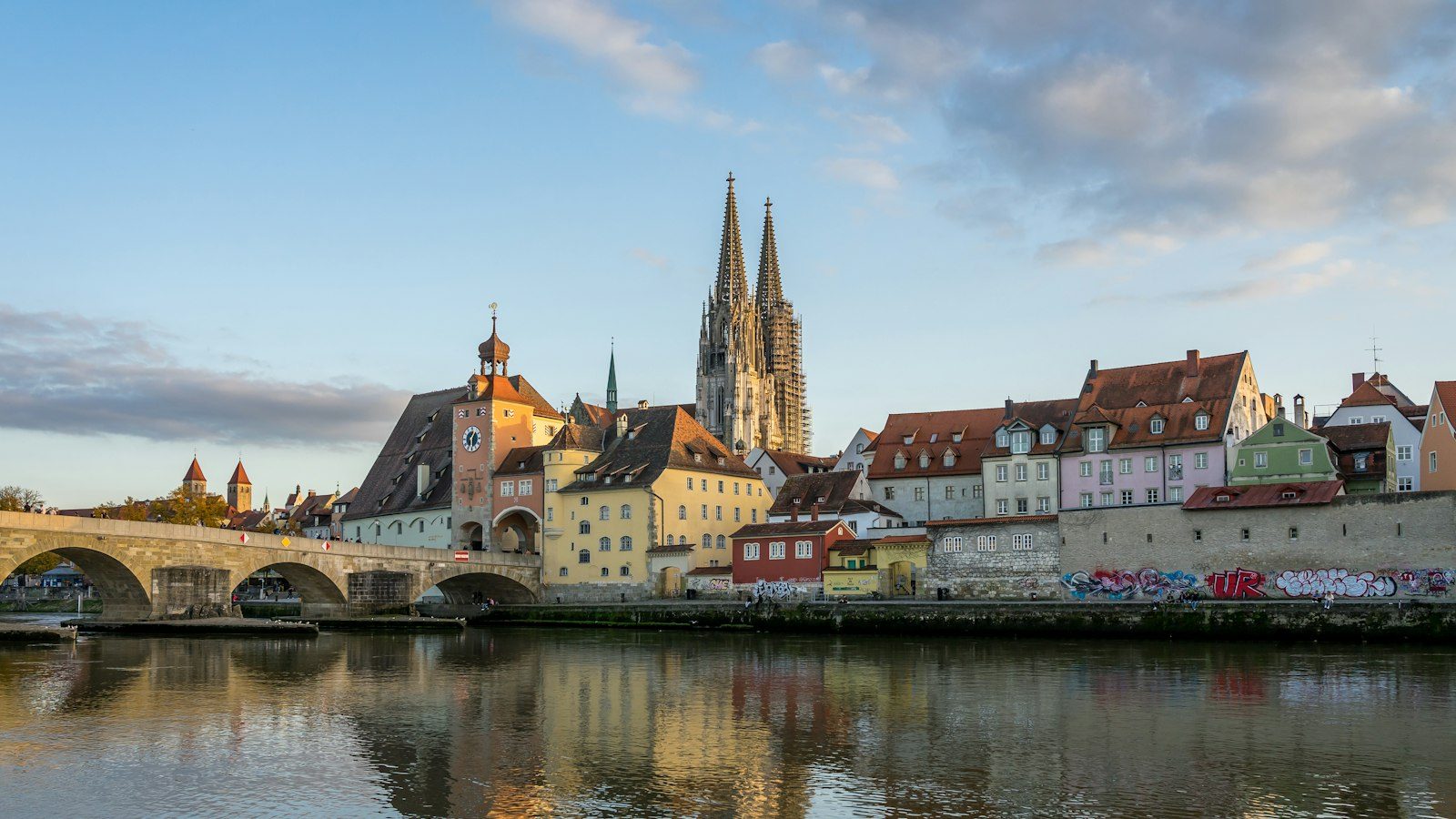
A medieval Bavarian city on the Danube that came through the war almost untouched. You cross a 12th-century stone bridge for sausages by the river, walk lanes lined with patrician towers and take a boat downstream to a marble temple on a hill.
- Best time to visit: May to June and September
- Daily budget (budget traveller): $80 to $250 USD
- Ideal trip length: 3 to 5 days
Regensburg sits where the Regen river meets the Danube in eastern Bavaria, about 1.5 hours from Munich by train and an hour from Nuremberg. It is one of the few large medieval city centres in Germany that escaped serious bombing in the Second World War, and the old town and Stadtamhof across the river are a UNESCO World Heritage Site. The Romans built a fort here, emperors held their parliament here for nearly 150 years and rich merchants built tall stone towers to show off, and you can still see all of it on foot. The Gothic cathedral is free to enter, the Stone Bridge has been carrying people over the Danube since the 12th century and the old sausage kitchen beside it has been feeding them for almost as long. Around 30,000 students keep the place young, so the beer gardens and bars feel lively rather than touristy. Boats run downstream to Walhalla in season, and the Danube Gorge at Weltenburg is an easy day out. Rooms cost less than in Munich, the centre is compact and most of the best things are free or cheap, so Regensburg suits a solo traveller who wants history, river walks and a cold beer without big-city prices.
Regensburg is one of the best-preserved medieval cities in Germany, home to around 160,000 people on a bend of the Danube in eastern Bavaria. The Romans founded a legionary fortress here in 179 AD, and a chunk of its gate, the Porta Praetoria, still stands near the cathedral. In the Middle Ages the city grew rich on trade along the river, and its merchants built tall tower houses in the Italian style. From 1663 to 1806 the Holy Roman Empire's parliament met in the Old Town Hall. The city was barely bombed in the Second World War, so the old town and Stadtamhof survive almost intact and together form a UNESCO World Heritage Site. Most visitors come for a few hours from a Danube cruise or from Munich. Stay a few nights and you get the better version: the Stone Bridge empty at dawn, a beer garden by the river at dusk and the student bars buzzing in the lanes.
Getting here is simple. Regional trains run from Munich in about 1.5 hours and from Nuremberg in about one to 1.5 hours, and direct regional trains run from Munich Airport via Freising and Landshut. ICE trains continue to Passau and Vienna. Once you are here, walk. The old town is small and mostly car-free, and it takes about 15 minutes from the station to the river. Stay near Haidplatz for bars and restaurants, in Stadtamhof for quiet evenings or on the Wöhrd islands for the hostel and riverside paths. Use RVV buses for Donaustauf and the edges of town, and regional trains for Weltenburg, Nuremberg and Passau.
Timing shapes the trip. From May to September the beer gardens are full, the boats run daily to Walhalla and the Danube Gorge and the Dult folk festivals fill the fairground in May and late summer. The boat season ends in October, and from late November to 23 December the Christmas markets take over, with the palace market charging entry and rooms filling up at weekends. January to March is cold and quiet, with short days and few boats, but museums are calm and rooms are cheap. Regensburg is very safe, English is widely spoken by younger people and the beer is cheaper than in Munich. If you want big nightlife, go to Munich. If you want a medieval city that still feels lived in, stay here.
Regensburg itinerary
Arrive and find your feet
Morning: Take a train from Munich or Nuremberg. Drop your bag and walk through the old town to the Stone Bridge for your first view of the cathedral spires.
Afternoon: Have sausages at the Wurstkuchl by the river, then visit St Peter's Cathedral (free) and the Roman Porta Praetoria round the corner.
Evening: Cross the bridge to Stadtamhof and have dinner and a beer in the Spitalgarten beer garden as the light fades over the river.
Imperial and Jewish Regensburg
Morning: Join a guided tour of the Reichstag Museum in the Old Town Hall (around €7.50), then wander Haidplatz and look up at the patrician towers.
Afternoon: See Dani Karavan's memorial on Neupfarrplatz and, if a tour fits, go below ground at Document Neupfarrplatz. Then spend an hour or two in the Haus der Bayerischen Geschichte (€7, closed on Mondays).
Evening: Dinner at Kneitinger on Arnulfsplatz, then a drink in the student bars of the western old town.
Walhalla by boat
Morning: From April to October, take the boat from the quay near the Wurstkuchl to Walhalla (about €15 one way). In winter, take bus line 5 to Donaustauf and walk up.
Afternoon: Visit the hall of busts (€5), then sit on the steps for the view over the Danube plain. Walk down to Donaustauf and climb to the castle ruins, then take the boat or bus back.
Evening: A quiet evening in Stadtamhof, then a walk across the lit-up Stone Bridge.
Palace, abbey and churches
Morning: Take a guided tour of the Thurn und Taxis Palace (around €14-16) and see the cloisters of St Emmeram. Look into the Baroque basilica next door.
Afternoon: Walk to the Scots Church of St Jakob for its carved Romanesque doorway, then relax in the Fürst-Anselm-Allee park or on Jahninsel.
Evening: In Advent, visit the Christmas markets on Neupfarrplatz and in the palace courtyard. In summer, take a picnic to the riverbank instead.
Weltenburg and the Danube Gorge
Morning: Take a regional train to Saal (Donau) and a bus to Kelheim. Catch a boat through the Danube Gorge to Weltenburg Abbey (€12.50 one way), running daily from May to early October.
Afternoon: See the Baroque abbey church and have lunch and a dark beer in the monastery beer garden. Walk back over the hill to Kelheim, or take the boat.
Evening: Train back to Regensburg. Have a simple dinner and an early night.
A day in Nuremberg
Morning: Take a train to Nuremberg (about one to 1.5 hours). Walk up to the Imperial Castle and through the old town.
Afternoon: Visit the Documentation Centre at the former Nazi party rally grounds or the Germanisches Nationalmuseum. Try Nuremberg sausages for lunch.
Evening: Train back to Regensburg and a last drink in a Haidplatz bar.
Slow morning and depart
Morning: Walk the Stone Bridge at dawn, then have breakfast at Café Prinzess or a bakery near the cathedral.
Afternoon: Climb to the Dreifaltigkeitsberg church for a last view, buy sweet mustard to take home and catch a train onwards.
Evening: Arrive in Munich, Vienna or your next stop.
Best neighbourhoods
- Cathedral quarter and Neupfarrplatz: The eastern half of the old town, around the cathedral, the Roman Porta Praetoria and the Neupfarrplatz square. You have the Haus der Bayerischen Geschichte, the Danube quays and the Christkindlmarkt in winter. It is central and full of sights, but it gets crowded with tour groups by mid-morning.
- Haidplatz and the western old town: The area around Haidplatz, the Old Town Hall and Arnulfsplatz, with the best density of bars, cafés and small restaurants. The lanes here are full of student pubs and wine bars, so it is lively until late at weekends. Pick a room on a courtyard if you sleep lightly.
- Stadtamhof: The old island suburb across the Stone Bridge, part of the World Heritage Site and much quieter than the main old town. It has pastel houses, small galleries and the Spitalgarten beer garden on the river. It is a lovely base for evenings, and the cathedral is only ten minutes away on foot.
- Unterer and Oberer Wöhrd: Two long, green islands in the Danube just east of the old town. You will find the youth hostel, a couple of hotels, riverside paths and swimming pools. They are calm and good for runs and picnics, though you walk 10 to 15 minutes into the centre.
- Station area and St Emmeram: The southern edge of the old town, between the Hauptbahnhof, the Thurn und Taxis Palace and the Fürst-Anselm-Allee park. It is practical, with chain hotels and the bus hub, and the palace grounds host the most famous Christmas market. It feels less charming but the old town starts five minutes away.
Must-do experiences
- Cross the Stone Bridge: Built in the 12th century, the Steinerne Brücke was a model for later bridges across Europe and is now closed to traffic. Walk it at sunrise or after dark for the view of the cathedral spires over the roofs. It is free, and the small museum in the bridge tower costs a few euros.
- Eat at the Historische Wurstkuchl: This tiny kitchen beside the bridge claims to be one of the oldest sausage restaurants in the world. Order small grilled sausages with sauerkraut and its sweet mustard, for roughly €12-15 for six. Sit outside by the river, and expect a queue at lunchtime in summer.
- Visit St Peter's Cathedral: Regensburg's Gothic cathedral is free to enter and has some of the finest medieval stained glass in Germany. Look out for the smiling angel on one of the pillars. If you are here on a Sunday in term time, the boys' choir known as the Regensburger Domspatzen usually sings at the morning Mass.
- See where the Holy Roman Empire met: The Old Town Hall hosted the Perpetual Imperial Diet from 1663 to 1806, and the Reichstag Museum inside shows the hall and the old torture chamber. Entry is by guided tour only, for around €7.50. Check the times of English tours before you go.
- Learn Bavaria's story at the Haus der Bayerischen Geschichte: This modern museum on the Danube covers Bavaria from 1806 to today. Adult entry is €7, students under 30 get in free and it is closed on Mondays. The foyer and the 360-degree film about Regensburg's earlier history are free.
- Take the boat to Walhalla: King Ludwig I's marble copy of the Parthenon sits high above the Danube about 10km downstream. Boats leave from the quay near the Wurstkuchl between April and October, for about €15 one way or €21 return. Entry to the hall of busts is €5, and the terrace and view are free.
- Tour the Thurn und Taxis Palace: The princely family who ran Europe's postal service turned the old abbey of St Emmeram into their home. Guided tours of the state rooms and cloisters cost around €14-16, and numbers are limited. In late November and December the courtyard hosts a Christmas market with a separate entry fee.
Hidden gems
- The Scots Church of St Jakob, whose 12th-century north doorway is covered in strange Romanesque carvings of beasts and figures that nobody has fully explained
- Dani Karavan's white stone memorial on Neupfarrplatz, which traces the outline of the medieval synagogue destroyed in 1519, with the excavated Jewish quarter below it
- The Dreifaltigkeitsberg church on the hill above Stadtamhof, where a short climb gives you a quiet view over the bridge and the spires
- Jahninsel, the small green island between the old town and Stadtamhof, where students gather with beers on summer evenings
- The vineyard paths on the Winzerer Höhen, a 30-minute walk west along the river, with views back to the cathedral and almost no visitors
Daily budget
- Accommodation: budget €30-45 / night (hostel dorm), mid-range €100-170 (3-star or boutique hotel in the old town), splurge €220+ (historic 4-star or suite). Prices rise during the Christmas markets, at the Dult festivals and on summer weekends. Single rooms in the old town go fast in Advent, so book early.
- Food: budget €20-30 / day (bakery breakfast, Wurstkuchl or butcher lunch, supermarket picnic), mid-range €40-60 (café lunch and a brewery pub dinner), splurge €90+ (tasting menu with wine). Six sausages at the Wurstkuchl cost roughly €12-15, and beer garden mains about €12-18. Prices are rough guides.
- Transport: budget €0-6 / day (walking, a bus ticket), mid-range €15-30 (Walhalla boat, regional train trip), splurge €63 (Deutschlandticket for a month of regional travel). The Walhalla boat costs about €15 one way or €21 return. The Weltenburg gorge boat from Kelheim is €12.50 one way or €21.50 return in 2026.
- Activities: budget €0-10 / day (cathedral free, Walhalla terrace free, Walhalla hall €5), mid-range €10-25 (Haus der Bayerischen Geschichte €7, Reichstag Museum about €7.50, palace tour), splurge €40+ (private guided walk, concerts). The Haus der Bayerischen Geschichte is free for students under 30 and closed on Mondays. The Thurn und Taxis Christmas market costs €6.50-13.50 depending on the day.
- Drinks & nightlife: budget €5-10 (a half-litre of beer in a beer garden), mid-range €15-30 (a few drinks in student bars), splurge €50+ (cocktails and wine bars). A coffee costs about €3-4 and a half-litre of local beer about €4.50-5.50. Bottles carry a deposit, so return them to supermarkets.
Where to stay
- Social hostel in Old town or Unterer Wöhrd (€30-45 / night (dorm)): Brook Lane Hostel is a small, central hostel in the old town lanes, close to the bars and the cathedral. The larger DJH youth hostel sits on the Unterer Wöhrd island, a 10 to 15-minute walk from the centre by the river.
- Boutique hotel in Cathedral quarter (€130-220 / night): Hotel Goliath am Dom is a stylish small hotel a minute from the cathedral, with a roof terrace looking over the spires. The bridge, the Wurstkuchl and the museums are all on the doorstep.
- Historic inn in Cathedral quarter (€110-200 / night): Hotel Bischofshof am Dom occupies the former bishops' residence next to the cathedral, with a brewery restaurant and a courtyard beer garden. Rooms are traditional and the location is hard to beat.
- Splurge in Near the station (€180-350+ / night): Eurostars Park Hotel Maximilian is a grand neo-Rococo hotel opposite the park, five minutes from the station and the old town. It suits you if you want high ceilings and an easy arrival.
What to eat
- Regensburger sausages: short, fat pork sausages served grilled at the Wurstkuchl, or sliced cold in a salad with vinegar and onions
- Beer garden food: roast pork, half chickens and pretzels at the Spitalgarten in Stadtamhof, one of the oldest breweries in town
- Kneitinger and Bischofshof beers: drink the local dark lager or a strong winter bock in the brewery pubs on Arnulfsplatz and near the cathedral
- Obatzda: a soft cheese spread with butter, onion and paprika, eaten on rye bread or with a pretzel for a cheap lunch
- Dampfnudeln: steamed yeast dumplings with a caramel crust, served with vanilla sauce in cafés around the old town
- Coffee and cake at Café Prinzess, which claims to be the oldest coffee house in Germany, or a Leberkäse roll from a butcher for breakfast
Day trips
- Walhalla and Donaustauf (About 10km east of Regensburg, around 45 minutes by boat or 25 minutes by bus): A white marble temple modelled on the Parthenon, filled with busts of famous Germans and set high above the Danube. Below it, the village of Donaustauf has a ruined castle on a hill. From April to October, take the boat from the quay near the Wurstkuchl for about €15 one way or €21 return. All year, take city bus line 5 to Donaustauf and walk 20 minutes uphill. Entry to the hall is €5.
- Weltenburg Abbey and the Danube Gorge (About 35km south-west, roughly an hour each way by train, bus and boat): The Danube squeezes between limestone cliffs on its way to a Baroque abbey with one of the oldest monastery breweries in the world. Above Kelheim, the round Befreiungshalle looks out over the valley. Take a regional train to Saal (Donau), then a bus to Kelheim. Boats run to Weltenburg for €12.50 one way or €21.50 return. In 2026 they ran daily from May to early October, then at weekends until early November.
- Nuremberg (About 100km north-west, one to 1.5 hours by train): Franconia's biggest city, with an imperial castle, a rebuilt old town, excellent museums and the former Nazi party rally grounds. It is a good contrast to compact Regensburg. Take an ICE or regional train from the Hauptbahnhof. Regional trains are covered by the Deutschlandticket. Trains run at least hourly in both directions.
When to visit
- Spring (April - May): 12-20°C, mild with showers, cool evenings. Crowds: Low to moderate, busier at Easter and during the Maidult in May. Good for walking and cheap rooms. Walhalla boats start in April, beer gardens open on warm days and the Weltenburg boats run daily from May.
- Early summer (June): 20-25°C, long days, the odd thunderstorm. Crowds: Moderate, with river cruise groups by day. Arguably the best month. Beer gardens, long light evenings and every boat running. Explore early before the cruise passengers arrive.
- High summer and early autumn (July - September): 22-28°C in July and August, then 16-22°C in September. Crowds: Busy in July and August, calmer in September. Great for beer gardens, river walks and day trips. September is the local pick, with the Herbstdult, warm days and fewer crowds.
- Late autumn and winter (October - March): 10-14°C in October, then -2 to 6°C in winter, often grey and foggy. Crowds: Quiet, except during the Christmas markets from late November to 23 December. October is pleasant but boats wind down. Advent is magical but busy and pricier. January to March is cheap, cold and peaceful, with indoor sights at their best.
Entry rules for your passport
Visa rules for Germany depend on the passport you travel on. Check the official source before you book: European Commission: Schengen visa policy
Getting there
Regensburg has no airport. The nearest is Munich, about 1.5 hours away by direct regional train via Freising and Landshut, and Nuremberg airport is a similar distance by train with a change. From Munich Hauptbahnhof, regional trains take about 1.5 hours, and from Nuremberg, ICE and regional trains take about one to 1.5 hours. ICE trains also link Regensburg with Frankfurt, Passau and Vienna. Regional trains are covered by the Deutschlandticket, which costs €63 a month in 2026, and saver fares on ICE trains are cheapest when booked ahead. Long-distance buses run from Munich, Prague and other cities to a stop near the station. By river, Danube cruise ships moor on the quays, and in summer local boats run between Kelheim and Regensburg. If you drive, the old town has restricted access, so use the garages at its edge or park-and-ride. German motorways are free for cars.
Border checks: non-EU visitors (other than Swiss, Norwegian, Icelandic, Liechtenstein, Andorran, Monegasque, San Marinese and Vatican citizens, and holders of an EU residence permit or long-stay visa) are registered in the EU's Entry/Exit System (EES) instead of getting a passport stamp. On your first crossing, officers take your photo and/or fingerprints, so allow extra time at passport control. ETIAS, the planned travel authorisation, is not in operation yet, so don't pay any website for one.
Getting around
Regensburg's old town is compact and mostly pedestrianised, so you will walk almost everywhere. It takes about 15 minutes from the Hauptbahnhof to the Stone Bridge, and cobbles are uneven, so wear decent shoes. RVV buses link the station, the old town edges, the Wöhrd islands and the suburbs, and most lines meet at the station or Albertstraße. A single city ticket costs a couple of euros, and day tickets are good value if you take several rides. You can buy tickets from machines, from drivers on many lines or in the RVV app. If you are staying a while or taking regional trains, the Deutschlandticket costs €63 a month in 2026 and covers local buses and regional trains across Germany, though not ICE or IC trains. It is a subscription, so cancel before the end of the month. Bike hire is easy and the Danube cycle path runs right through town. Taxis wait at the station and Arnulfsplatz. Driving in the old town is restricted, so use the park-and-ride or garages at the edges.
Safety
Regensburg is very safe, and serious crime against visitors is rare. Keep an eye on your bag in the Christmas markets and crowded beer gardens. At weekends the student bars around Haidplatz can get loud and drunk late at night, but trouble is uncommon. The real risks are uneven cobbles, cyclists in pedestrian zones and the Danube itself. Do not swim in the river: the current is strong, cargo boats pass often and people drown here most summers. The river also floods, so heed closures of the lower quays after heavy rain. In winter, stone steps and bridges can be icy. Tap water is safe to drink. The emergency number is 112, and the police number is 110. EU travellers should carry an EHIC and UK travellers a GHIC, and everyone else needs travel insurance with medical cover.
Solo travel tips
- Stay in or near the old town: Everything worth seeing is within a 20-minute walk, so a central bed saves time and bus fares. Stadtamhof is quieter, while Haidplatz puts the bars on your doorstep.
- Get out early: River cruise groups arrive mid-morning and fill the bridge, the cathedral and the Wurstkuchl. Go before 10am or after 5pm and you will have them almost to yourself.
- Plan around boat seasons and tours: The Walhalla and Weltenburg boats run mainly from spring to autumn, and the Reichstag Museum and palace are tour-only. Book those slots first, then fit the rest around them.
- Eat and drink cheaply: Beer gardens let you bring your own food in the self-service areas in many cases, and a butcher's Leberkäse roll costs a few euros. Save the brewery pub dinner for one good night.
- Safety for solo travellers: The main risks are slippery cobbles, cyclists and the Danube's strong current. Never swim in the river, keep to lit streets late at night and use a taxi from the station if you arrive after midnight.
- Meet people at a beer garden or on a walk: Join a guided walking tour of the old town or share a long table in the Spitalgarten, where sitting with strangers is normal. The hostel common room and Jahninsel on summer evenings are also easy places to start a conversation.
Cultural etiquette
- Greet people with 'Grüß Gott' or 'Servus' in Bavaria, and say 'danke' (thank you). A simple 'Hallo' is fine too.
- Wait for the green man at pedestrian crossings. Locals rarely cross on red, even when the road is empty.
- Stay out of red-marked bike lanes. Cyclists move fast and will not be pleased to find you there.
- Dress modestly in the cathedral and churches, and keep quiet or stay at the back if a service or choir rehearsal is on.
- At beer gardens, it is normal to share a long table. Ask 'Ist hier noch frei?' before you sit down.
- When paying, tell the server the total including tip, usually rounded up or about 5-10%, rather than leaving coins on the table.
- Most shops close on Sundays, so buy supplies on Saturday. Return bottles for the deposit and sort your rubbish.
Frequently asked questions
How do I get to Regensburg and from the station to my room?
Most people arrive by train. Regional trains from Munich take about 1.5 hours, and ICE and regional trains from Nuremberg take about one to 1.5 hours. Direct regional trains also run from Munich Airport via Freising and Landshut in about 1.5 hours. The Hauptbahnhof is on the southern edge of the old town, and the Stone Bridge is about 15 minutes away on foot. Most hotels and hostels are within a 20-minute walk, or you can take a bus from the station forecourt.
How many days do I need in Regensburg?
Two nights covers the old town, the cathedral, the Stone Bridge and a museum or two. Three to five nights lets you add the Walhalla boat, the Thurn und Taxis Palace and a day at Weltenburg Abbey and the Danube Gorge. A week works if you want to slow down and add day trips to Nuremberg or Passau.
When is the best time to visit Regensburg?
May, June and September are best. Beer gardens are open, the boats to Walhalla and Weltenburg run daily and the evenings are long. July and August are warm and busy but still pleasant. Late November to 23 December brings the Christmas markets, which are lovely but crowded. January to March is cold, grey and quiet, and most boats do not run.
Is the Deutschlandticket worth it for a visit?
It costs €63 a month in 2026 and covers local buses and regional trains across Germany, including the routes to Munich, Nuremberg, Passau and Saal for Weltenburg. If you plan two or three regional day trips, it usually pays for itself. It is a monthly subscription, so cancel before the end of the month if you only need it once. It does not cover ICE or IC trains.
How do I get to Walhalla and Weltenburg?
From April to October, boats sail from the quay near the Wurstkuchl to Walhalla for about €15 one way or €21 return, and city bus line 5 goes to Donaustauf all year, followed by a 20-minute uphill walk. For Weltenburg, take a regional train to Saal (Donau) and a bus to Kelheim, then a boat through the Danube Gorge for €12.50 one way or €21.50 return. In 2026 the gorge boats run daily from May to early October, then only at weekends until early November.
What are the Regensburg Christmas markets like?
There are several. The Christkindlmarkt on Neupfarrplatz is free and central. The Romantic Christmas Market in the courtyard of the Thurn und Taxis Palace runs from 20 November to 23 December 2026 and charges entry: €6.50 on Mondays, €9.50 from Tuesday to Friday and on Sundays, and €13.50 on Saturdays. It is closed on 22 November. Go on a weekday evening to avoid the worst crowds.
Is Regensburg safe for solo female travellers?
Yes. It is a calm, well-lit university city and very easy to explore alone. The old town stays busy into the evening, and beer gardens are relaxed places to sit on your own. Take normal care with drinks in bars at weekends, avoid the unlit riverbanks and islands late at night and use a taxi from the station if you arrive very late.
What entry rules apply to Germany in 2026?
Germany is in the EU and the Schengen area. Many non-EU visitors, including those from the UK, US, Canada and Australia, can stay visa-free for up to 90 days in any 180-day period across Schengen. The EU's Entry/Exit System has been fully running since April 2026 and records non-EU travellers' fingerprints and photos at the external border. ETIAS is not running yet, and the EU has not set a start date, so do not pay any website for it. Check the rules on official EU and German government websites and your own government's travel advice.
More about Regensburg
Tours and activities in Regensburg | Regensburg in 2 days | Regensburg in 3 days | Regensburg in 4 days | Regensburg in 5 days | Regensburg in 7 days
Joy Plus home | Destinations | Itineraries | Activities | Flights | Budget planner | Calendar | Map | Blog | Lifetime access