Trogir in 2 days
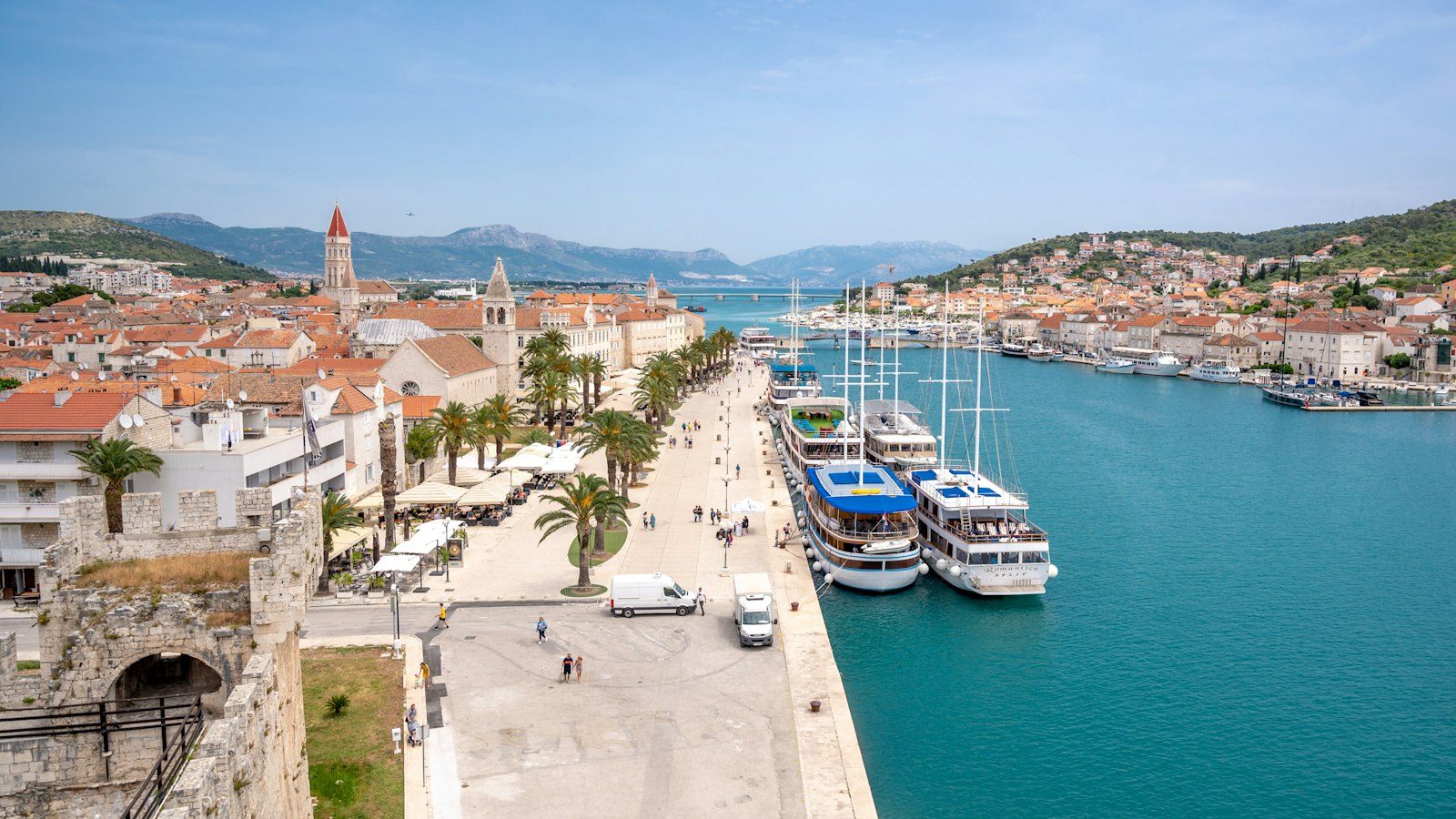
A walled medieval town on a tiny island between the Dalmatian mainland and Čiovo, half an hour from Split. You wander marble lanes past a Romanesque cathedral, climb its bell tower, swim off Čiovo's pebble beaches and watch the sun set behind Kamerlengo Fortress. Best time to visit: May to June and September. Daily budget (budget traveller): $80 to $250 USD.
Arrive and find your feet
Morning: Fly into Split and take bus 37 to Trogir (about 20 minutes). Drop your bag and walk in through the Land Gate.
Afternoon: Wander the lanes to John Paul II Square and look at Radovan's portal. Pick up fruit at the green market by the bus station.
Evening: Walk the Riva at sunset, then have pizza or grilled sardines on a back-lane terrace.
Cathedral, tower and fortress
Morning: Buy the €10 red ticket and see the cathedral, the baptistery and the bell tower before the crowds. Cover shoulders and knees.
Afternoon: Escape the heat in the Town Museum and the Convent of St Nicholas to see the Kairos relief. Then swim at Pasike.
Evening: Walk the walls of Kamerlengo Fortress (about €5) for sunset, then dinner at a konoba such as Trs.
Heading home: Buy rafioli or wine for home, then catch bus 37 or a taxi to Split Airport. Fly out, or carry on south to Split and the islands.
What to eat in Trogir
- Trogirski rafioli: the town's own sweet pastry, filled with almonds and traditionally made for weddings and feast days, found in some bakeries and cake shops
- Pašticada with gnocchi: Dalmatian beef slow-cooked in wine and prunes, on the menu at most konobas, including Konoba Trs in the old town
- Grilled sardines (srdele) or a whole fish sold by weight on the Riva. Ask the price per kilo before you order
- Black risotto with cuttlefish ink, or peka (meat or octopus baked under a bell), which you usually have to order a day ahead
- Pošip and Plavac Mali wines, plus Babić from nearby Primošten, at a few euros a glass
- Burek from a bakery for breakfast, fruit from the green market by the bus station and fritule (small doughnuts) in the evening
Hidden gems
- The Kairos relief in the Convent of St Nicholas, a Greek carving of the god of the fleeting moment, kept in the small convent museum near the South Gate
- The tiny Church of St Barbara near the main square, one of the oldest buildings in Trogir and part of the cathedral ticket options
- Marmont's Gloriette, a small classical pavilion built by the French at the western end of the island near Kamerlengo, quiet at dusk
- The town loggia on the main square, with its old stone judges' table and a carved relief by the sculptor Ivan Meštrović
- The hermitage church of Our Lady of Prizidnica on the south coast of Čiovo, built into the rock above a quiet bay
Getting around
The old town is car-free, and you will walk everywhere on it. It takes about 10 minutes to cross. The streets are polished stone and some are steep, so wear shoes with grip. The bus station and green market are just over the small bridge on the mainland side, and the larger bridge to Čiovo is at the south side of the island. Promet Split bus 37 links Trogir with Split Airport and Split, running from about 4am to after midnight. A ticket to the airport costs €2.50 from the driver or about half that in the Promet Split app. Intercity buses from Split's main bus station take about 30 minutes for roughly €4.80-6.50. Local buses cross to Okrug Gornji and Slatine on Čiovo, and in summer small taxi boats run from the Riva to the Čiovo beaches. From May to October, Bura Line boats sail to Split via Slatine for €10. Ride-hailing apps and taxis work around Trogir, but traffic on the bridges can be slow in high season.
Safety
Trogir is very safe, and violent crime against visitors is rare. Keep an eye on your bag on the crowded Riva and on packed buses to Split in summer. The real risks are physical. The marble streets get slippery, the bell tower stairs are steep and narrow, and summer heat is intense. Carry water and rest in the shade at midday. Cars and scooters use the busy road along the Čiovo shore, so take care walking to the beaches. In the sea, watch for sea urchins on rocky entry points and occasional jellyfish, and keep clear of boat lanes near the marina. In winter, the bura wind can be fierce and the jugo brings rain and big waves. Tap water is safe to drink. The EU emergency number is 112. EU travellers should carry an EHIC and UK travellers a GHIC, and everyone else needs travel insurance with medical cover.
Frequently asked questions
What does this 2-day Trogir itinerary cover?
Day 1: Arrive and find your feet. Day 2: Cathedral, tower and fortress.
Is 2 days enough for Trogir?
Our recommended trip length for Trogir is 3 to 5 days. This 2-day plan focuses on the highlights and groups sights by area so you spend less time travelling between them.
How much does 2 days in Trogir cost?
A budget traveller spends about $80 to $250 USD a day in Trogir, so roughly $160 to $500 USD for 2 days, not counting flights.
Where should I stay for 2 days in Trogir?
Old town island: The UNESCO-listed core, set around John Paul II Square with the cathedral, the town loggia and the Ćipiko Palace. Čiovo by the bridge: The Čiovo side of the channel facing the old town, with the marina, the Bura Line boat stop, small supermarkets and cheaper guesthouses.
When is the best time to visit Trogir?
The best time to visit Trogir is May to June and September.
How do I get around Trogir?
The old town is car-free, and you will walk everywhere on it. It takes about 10 minutes to cross.
Is Trogir safe for solo travellers?
Trogir is very safe, and violent crime against visitors is rare. Keep an eye on your bag on the crowded Riva and on packed buses to Split in summer.
More 2-day guides
- Makarska in 2 days
- Zadar in 2 days
- Dubrovnik in 2 days
- Split in 2 days
- Zagreb in 2 days
- Plitvice Lakes in 2 days
- Hvar in 2 days
- Pula in 2 days
Trogir in 3 days | Trogir in 4 days | Trogir in 5 days | Trogir in 7 days | Full Trogir guide
Joy Plus home | Destinations | Itineraries | Activities | Flights | Budget planner | Calendar | Map | Blog | Lifetime access