Destinations / Europe
Monschau, Germany travel guide
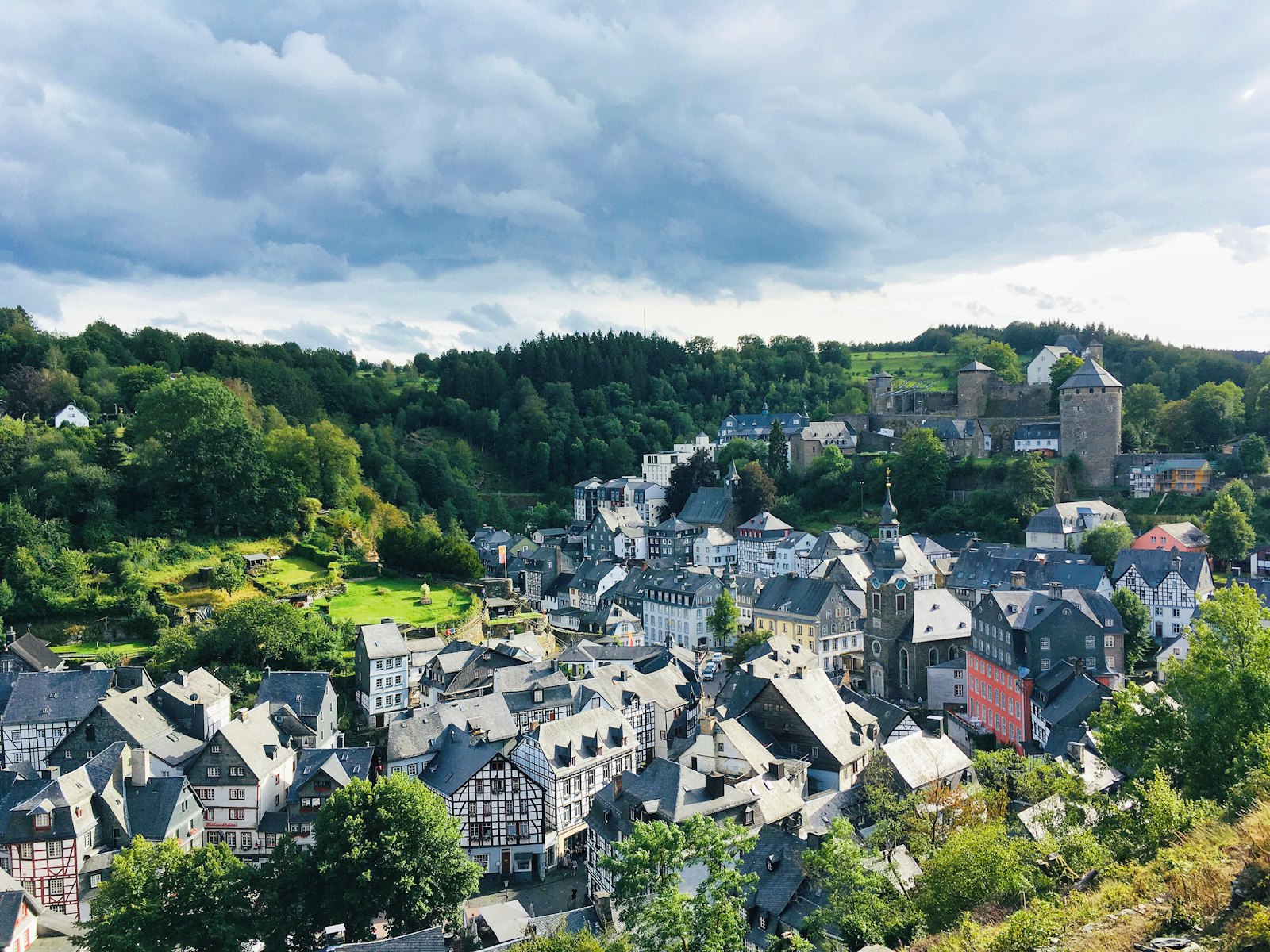
A small slate-roofed town in a narrow Eifel valley on the Rur, with half-timbered lanes, a castle on the rock above, a working mustard mill, and moorland and forest trails starting a short walk from the market square.
- Best time to visit: May to October
- Daily budget (budget traveller): $85 to $300 USD
- Ideal trip length: 2 to 5 days
Monschau is a small town in the far west of Germany, about 30km south of Aachen and a few kilometres from the Belgian border. The old town sits at the bottom of a steep valley where the Rur river bends. It is a tight cluster of half-timbered and slate-hung houses, many built for cloth merchants in the 18th century. A castle stands on the rock above it, and the ruin of the Haller watchtower faces it across the valley. Day trippers from Aachen, Cologne and Belgium fill the lanes at weekend lunchtimes, and the Christmas market draws big crowds on Advent weekends. Stay overnight and you get the quieter version: empty lanes after 6pm, mist on the river in the morning and the Eifelsteig trail leaving straight from town. Monschau is not a party place. Most cafés close in the early evening and the shops are aimed at visitors. It is easy to manage alone, safe and walkable, and it makes a good base for the Eifel National Park and the High Fens moorland over the border in Belgium.
Monschau grew rich on fine wool cloth in the 18th century, and the town still shows it. Grand merchant houses line the Rur, the Rotes Haus is furnished as the Scheibler family left it, and more than 300 buildings are listed. The old town fills a narrow valley at about 400m above sea level, with Burg Monschau on one side and the Haller ruin on the other. It is small enough to walk end to end in 15 minutes. At midday on a summer Saturday or an Advent weekend it is crowded, but at 8am or 7pm you often have the lanes to yourself. That is the main reason to stay overnight rather than come on a day trip from Aachen.
Getting here is simple. Take a train to Aachen, then the SB66 bus, which takes about an hour to the old town. Base yourself in the Altstadt for atmosphere, at the castle youth hostel for the cheapest bed and the best view, or in Höfen or Kalterherberg if you want a self-catering flat near the trails. You will not need a car for the town or the Eifelsteig, because the buses link the villages. A car or bike does make the Belgian High Fens easier. Most cafés close early, so buy supper supplies in Imgenbroich if you are self-catering.
The seasons shape a visit. April brings the Rotes Haus reopening and, from mid-April, wild narcissus in the Perlenbach and Fuhrtsbach valleys. Summer is mild rather than hot, which is good for walking, and open-air concerts are held at the castle. Autumn colours the beech woods. In winter, most museums close and snow is possible on the plateau, until the Christmas market fills the town on Advent weekends. Monschau is safe, calm and easy to manage alone. People speak German first, with plenty of English and some Dutch and French because of the border.
Monschau itinerary
Arrive and find your bearings
Morning: This plan assumes you arrive on a Tuesday. Take a train to Aachen Hbf, then the SB66 bus to Monschau, which takes about an hour. Leave your bag at your accommodation.
Afternoon: Walk the Markt, Stadtstraße and Rurstraße, then stop at the tourist information for trail maps. Coffee and a Dütchen at a café on the Markt.
Evening: Climb to the Haller ruin for the view over the rooftops at sunset. Dinner and a beer at the Felsenkeller.
Rotes Haus and the mustard mill
Morning: Join the 11:00 Senfmühle tour on Laufenstraße, which runs on Wednesdays and Fridays from March to October, then taste and buy mustard in the shop.
Afternoon: Tour the Rotes Haus, which has entry on the hour and costs €5. Then visit the Aukirche next door and the Aukloster cloister.
Evening: Walk up to Burg Monschau as the light goes. Picnic supper or a simple dinner in the old town.
Eifelsteig to Einruhr
Morning: Set off early on Eifelsteig stage 3 from Monschau. The route follows the Rur valley, then climbs onto the open plateau. Carry lunch and water.
Afternoon: Arrive in Einruhr on the Obersee. Rest your feet by the water and check bus times back towards Simmerath and Monschau.
Evening: Bus back to Monschau. Early night after a long walk.
Höfen, narcissus valleys and Kalterherberg
Morning: Bus up to Höfen and walk into the Perlenbach valley. From mid-April to early May the meadows are full of wild narcissus. Outside spring it is still a quiet stream walk.
Afternoon: Continue to Kalterherberg to see the twin-towered 'Eifeldom' church. Bus or walk back down to Monschau.
Evening: Wander the empty old town after the day visitors leave, then eat Eifel trout or Döppekooche for dinner.
The High Fens
Morning: Bus to Mützenich, then walk over the Belgian border onto the Brackvenn boardwalks across the open moorland. Wear waterproofs.
Afternoon: Extend the walk on the marked Venn trails, or head back to Monschau and visit the Glashütte to watch the glassblowers.
Evening: Self-cater with supplies from Imgenbroich to give your budget a rest.
Day trip to Aachen
Morning: SB66 bus to Aachen. Visit Aachen Cathedral, Charlemagne's chapel and a UNESCO World Heritage Site, before the tour groups arrive.
Afternoon: Lunch near the Markt, buy Printen to take home, and visit the Cathedral Treasury before it closes in the late afternoon.
Evening: Dinner in Aachen, then an early bus back. Check the last connection, because evening services are thin.
Vennbahn morning and leave
Morning: Walk or cycle a stretch of the Vennbahn path above town, or take a last slow loop of the river path through Burgau.
Afternoon: Pick up mustard and Printen, then take the SB66 to Aachen for your onward train.
Evening: Connect onwards from Aachen to Cologne, Brussels or Liège.
Best neighbourhoods
- Altstadt (Old Town): The car-free core along the Rur, around the Markt, Stadtstraße and Rurstraße. Most cafés, guesthouses, the tourist information and the Christmas market are here. Busy at midday, very quiet at night, and the most atmospheric base if you do not mind cobbles and steps.
- Laufenstraße: The lane that runs downstream from the centre. It takes in the Rotes Haus museum, the Aukirche and, further along, the historic Senfmühle. It is a little calmer than the Markt, and it is still only a few minutes' walk from everything.
- Burg and Haller heights: The hillsides above the old town. Burg Monschau houses a youth hostel, and paths climb to the Haller ruin for the classic view over the rooftops. Expect steep steps, and expect the best sunsets in town.
- Imgenbroich: The modern part of town on the plateau above the valley. It has supermarkets, cheaper chain shops, the bus hub and Christmas market park and ride. It is practical rather than pretty, so come here for errands and cheaper groceries.
- Höfen and Kalterherberg: Villages on the plateau south of town, on the edge of the Eifel National Park. Here you will find holiday flats, tall beech hedges, the narcissus valleys in spring and the large village church nicknamed the 'Eifeldom'. They suit walkers and cyclists who want space and lower prices.
Must-do experiences
- Walk up to the Haller viewpoint: A short, steep climb from the old town takes you to the ruined Haller watchtower, with views across the slate roofs to the castle. Go early in the morning or near sunset, when the day-trip crowds have gone.
- Tour the Rotes Haus: This red-fronted merchant's house was built around 1760 for the cloth maker Johann Heinrich Scheibler and is still fully furnished. It is famous for its carved free-standing staircase. It opens from 1 April to 30 November, Tuesday to Sunday, with entry on the hour. Adults pay €5 and under-18s go free.
- Visit the historic mustard mill: The Senfmühle on Laufenstraße has made mustard since the late 19th century and is still run by the Breuer family. The shop is open most days. Guided tours have run on Wednesdays and Fridays at 11:00 and 14:00 from March to October for about €5. Book ahead in the holidays.
- Hike the Eifelsteig to Einruhr: Stage 3 of the Eifelsteig leaves Monschau and follows the Rur valley and the open plateau to Einruhr on the Obersee reservoir. It is a long but steady day. Check the bus back before you set off.
- Watch glassblowing at the Glashütte: Glashütte Monschau, upstream in the Burgau area, has glassblowers working in front of visitors. From April to October it opens daily from 10:00 to 18:00, and it opens at weekends in winter. Check the entry fee locally.
- Walk the Brackvenn boardwalk: Just over the Belgian border near Mützenich, wooden boardwalks cross the open High Fens moorland. It feels nothing like the wooded valley below. Stay on the boards and bring a layer, because the weather changes fast up there.
- See the Christmas market on an Advent weekend: In 2026 it runs on four weekends: 27 to 29 November, 4 to 6, 11 to 13 and 18 to 20 December. It opens on Fridays and Saturdays from 11:00 to 21:00 and on Sundays from 11:00 to 20:00. Entry is free. The old town is closed to cars, so use the park and ride shuttles.
Hidden gems
- The cloister of the Aukloster by the Aukirche, a quiet corner off Laufenstraße that hosts craft stalls on two Advent weekends in 2026
- The upstream riverside path through Burgau towards the Glashütte, which is much calmer than the Markt even on busy Saturdays
- The village church in Kalterherberg, known locally as the 'Eifeldom', a surprisingly large twin-towered church for such a small village
- The Vennbahn cycle path, a former railway line that passes above Monschau and runs on to Belgium and Luxembourg, almost flat and good for an easy day on a hired bike
- The castle courtyard at Burg Monschau early in the morning, before the youth hostel groups wake up, with a view straight down into the old town
Daily budget
- Accommodation: budget €25-50 / night (castle youth hostel dorm or single), mid-range €80-140 (guesthouse or hotel in the old town), splurge €170+ (best rooms in the old town, Christmas market weekends). The DJH castle hostel lists dorm beds from about €24.90 and singles from about €44.90 with breakfast in 2026. Prices jump on Advent weekends, so book months ahead. Holiday flats in Höfen and Kalterherberg often have a minimum stay.
- Food: budget €20-35 / day (bakery breakfast, supermarket picnic), mid-range €40-65 (café lunch, sit-down dinner), splurge €80+ (multi-course regional dinner with wine). Supermarkets in Imgenbroich are much cheaper than the old town. Coffee and cake cost roughly €7-10, and mains roughly €15-25. Many kitchens close by 20:00 or 21:00.
- Transport: budget €0-10 / day (walking, Deutschlandticket or single bus fares), mid-range €15-30 (bike hire or day tickets), splurge €60+ (car hire or taxis to the High Fens). Aachen to Monschau costs roughly €8-10 single. The Deutschlandticket costs €63 a month in 2026 and covers local buses and regional trains. Parking in town is paid and fills up at weekends.
- Activities: budget €0-5 / day (hiking, viewpoints, the Christmas market), mid-range €5-15 (Rotes Haus, mustard mill tour, Glashütte), splurge €40+ (concert at the castle, guided tours). Rotes Haus: €5 for adults, free for under-18s. Mustard mill tour: about €5 on weekdays and €6 on Sundays and holidays. Most of the best things here, such as trails, views and the Venn, are free.
- Drinks & nightlife: budget €5-10 (one beer in a pub), mid-range €15-30 (a few drinks with dinner), splurge €40+ (wine tasting, mulled wine rounds at the market). A large local beer costs roughly €4-5.50. Nightlife means a quiet pub or a restaurant terrace. Aachen has more going on if you want a night out.
Where to stay
- Social hostel in Burg Monschau (€25-50 / night): The DJH youth hostel is inside the medieval castle above the old town, with dorms, private rooms and views over the rooftops. It is the cheapest bed in town, about 300m from the bus stop, with no parking.
- Boutique hotel in Altstadt (€80-150 / night): Small, often family-run hotels and guesthouses in historic houses along the Rur put you right in the lanes for quiet evenings. Expect stairs and no lifts in older buildings, and book well ahead for Advent weekends.
- Apartment in Höfen or Kalterherberg (€60-110 / night): Holiday flats on the plateau come with kitchens, sit next to the national park and narcissus trails, and are cheaper than the old town. Buses link them to Monschau, but some flats have a minimum stay.
- Splurge in Altstadt (€170-260+ / night): The best rooms in the old town, with river views and a good restaurant downstairs, are the treat here. Prices peak on Christmas market weekends.
What to eat
- Monschau mustard: try the many flavours at the Senfmühle, from mild honey mustard to strong varieties, and buy a stoneware jar to take home
- Monschauer Dütchen: a crisp rolled wafer filled with whipped cream, the town's classic café treat
- Aachener Printen: hard, spiced gingerbread from nearby Aachen, sold all over town and at the Christmas market
- Eifel trout: often served whole or smoked in local restaurants, a good lighter option after a long walk
- Döppekooche: a hearty Eifel potato bake made with bacon, usually eaten with apple sauce, and best on a cold day
- A beer and a plate of regional food at the Felsenkeller brewery restaurant on St.-Vither-Straße, in Monschau's old brewery
Day trips
- Aachen (About 30km, around 1 hour by SB66 bus): A lively university city with Charlemagne's cathedral, a UNESCO World Heritage Site, plus the Treasury, a big market square and bakeries selling Printen. It has more restaurants and nightlife than Monschau. Take the SB66 from Monschau to Aachen Bushof, about 1 hour, roughly €8-10 single or covered by the Deutschlandticket. Check the last bus back in the evening.
- High Fens (Hohes Venn) and Signal de Botrange (About 5-15km west and south-west, just over the Belgian border): Open raised bog and heather crossed by boardwalks, quite different from the wooded Eifel valleys. Signal de Botrange, at about 694m, is the highest point in Belgium. For the Brackvenn, take a bus to Mützenich and walk over the border. Botrange is easier by car or bike. Paths can close in dry spells, so check locally.
- Einruhr and the Rursee lakes (About 15km north-east, a full day's walk on the Eifelsteig): A lakeside village on the Obersee, at the edge of the Eifel National Park. Walk there on Eifelsteig stage 3, then rest by the water. The former Vogelsang site is further on. Walk the Eifelsteig from Monschau, or travel by bus via Simmerath. Check connections, because services are limited at weekends.
When to visit
- Spring (April - May): 8-17°C, changeable, cold mornings. Crowds: Moderate, with busy Easter and Whitsun weekends. Museums reopen and the narcissus meadows near Höfen flower from mid-April to early May. Pack layers and a rain jacket.
- Summer (June - August): 16-24°C, mild, some heavy showers. Crowds: Busy at weekends, calmer midweek. The best hiking weather and the longest days. Stay midweek if you can, and book beds early for summer weekends.
- Autumn (September - November): 5-16°C, misty mornings, more rain later. Crowds: Moderate, quieter after October half term. The locals' pick. Beech woods turn gold, trails are quiet and the Rotes Haus is open until 30 November. Some attractions shorten their hours from November.
- Winter (December - March): -3 to 5°C, frost, snow possible on the plateau. Crowds: Very busy on Advent weekends, very quiet from January. Come for the Christmas market, or for empty frosty lanes in January. The Rotes Haus is closed and several sights open only at weekends.
Entry rules for your passport
Visa rules for Germany depend on the passport you travel on. Check the official source before you book: European Commission: Schengen visa policy
Getting there
The nearest big airports are Cologne Bonn, Düsseldorf, Brussels and Liège, and Maastricht Aachen Airport has a limited schedule. From all of them, head to Aachen Hbf by train. Regional and ICE trains from Cologne take about 40 to 70 minutes, and there are through trains from Brussels and Liège. From Aachen, the SB66 bus runs via Brand, Roetgen and Konzen to Monschau in about an hour, with connections roughly hourly in the daytime. Some journeys involve a change in Roetgen. A single costs roughly €8-10, or it is covered by the Deutschlandticket (€63 a month in 2026). Rome2rio-style estimates put Cologne to Monschau at about two hours by public transport. By car, Aachen is about 40 minutes away. Use the paid car parks around the edge of the old town, and use park and ride on Christmas market weekends. Germany is in the Schengen Area, so check entry rules for your nationality.
Border checks: non-EU visitors (other than Swiss, Norwegian, Icelandic, Liechtenstein, Andorran, Monegasque, San Marinese and Vatican citizens, and holders of an EU residence permit or long-stay visa) are registered in the EU's Entry/Exit System (EES) instead of getting a passport stamp. On your first crossing, officers take your photo and/or fingerprints, so allow extra time at passport control. ETIAS, the planned travel authorisation, is not in operation yet, so don't pay any website for one.
Getting around
The old town is small and largely car-free, so you walk everywhere. Wear proper shoes, because the lanes are cobbled and the paths up to the castle and Haller are steep. Regional buses run by the AVV link Monschau with Imgenbroich, Höfen, Kalterherberg, Konzen and Mützenich. The fast SB66 goes to Aachen via Roetgen. Services thin out in the evening and on Sundays, so check times in the AVV or DB Navigator app. A single to Aachen costs roughly €8-10. If you are in Germany for a few weeks, the Deutschlandticket costs €63 a month in 2026 and covers all local buses and regional trains. Note that it is a subscription, so you need to cancel it in time, and the price rises to €66.80 from January 2027. In season, buses with bike trailers have run on Sundays and holidays to the national park and Kalterherberg. The Vennbahn cycle path makes cycling an easy option, but the valley roads are steep. A car helps for the Belgian High Fens, but parking in town is limited and fills up at weekends.
Safety
Monschau is very safe, and crime against visitors is rare. The main risks are underfoot. Cobbles and steps are slippery when wet or icy, and the castle and Haller paths are steep. On the High Fens, fog and rain can come in quickly. Stay on the marked paths and boardwalks, because some moorland zones are protected and access can be restricted in dry spells when the fire risk is high. Ticks are common in long grass and woodland, so check yourself after hikes. The Rur can rise fast after heavy rain. The July 2021 floods badly damaged the old town, so take flood and weather warnings seriously. Drivers and motorcyclists take the winding B258 fast, so take care walking along roads without pavements. The emergency number is 112 in Germany and Belgium.
Solo travel tips
- Stay at least one night: Monschau changes completely after the last tour buses leave. Evenings and early mornings are when it feels like a real town, and you get the viewpoints to yourself.
- Plan hikes around the buses: Rural bus services are thin in the evening and on Sundays. Check the AVV or DB Navigator app for the last bus back before you start a long walk, and screenshot the times.
- Use the youth hostel for company: The castle hostel is the most social place to sleep in town and has single rooms if you want privacy. School groups can be noisy in term time, so ask about dates when you book.
- Eat early: Kitchens often close by 20:00 or 21:00, and some places shut one or two days a week. Book dinner on weekends, or keep a picnic in your bag.
- Safety for solo travellers: Monschau is very safe. The real risks are slippery cobbles, steep paths and fast-changing weather on the High Fens. Tell your host your route if you hike alone, and stay on marked paths.
- Avoid Saturday lunchtimes: Day trippers peak on weekend middays. Do the museums then, and save the lanes, the viewpoints and photos for the morning or evening. Download offline maps, because signal drops in the valley and on the Venn.
Cultural etiquette
- Say 'Guten Tag' or 'Hallo' when you walk into a small shop or café, and 'Tschüss' or 'Auf Wiedersehen' when you leave.
- Sunday is a rest day. Supermarkets and most ordinary shops close, although some tourist shops and cafés in the old town stay open.
- Keep the noise down in the old town after 22:00. People live in these houses, and sound carries in the narrow lanes.
- Stay on marked paths and boardwalks in the Eifel National Park and on the High Fens, and follow any closure signs or warning flags.
- Ask before photographing people, and do not climb on walls or into private gardens for a better angle of the half-timbered houses.
- Return bottles marked 'Pfand' to supermarket machines for your deposit, and sort rubbish into the right bins at your accommodation.
Frequently asked questions
How do I get to Monschau without a car?
Take a train to Aachen Hbf. Trains from Cologne take roughly 40 to 70 minutes, and there are also direct trains from Brussels and Liège. Then take an AVV bus to Monschau. The fast SB66 runs from Aachen Bushof via Roetgen and Konzen and takes about an hour, with connections roughly hourly in the daytime. Some journeys need a change in Roetgen. A single costs roughly €8-10, or nothing extra if you have a Deutschlandticket.
How many days do I need in Monschau?
One day covers the old town, the Haller view and one museum. Two to three days lets you add the Senfmühle, a long hike and an evening when the lanes are empty. Four or five days works well if you want the High Fens, the Eifel National Park and a day in Aachen.
When is the best time to visit Monschau?
May to October brings the mildest weather and the longest walking days. Mid-April to early May is narcissus season in the valleys around Höfen. Late September and October bring autumn colour and fewer people. The Christmas market is lovely, but it is very busy on Advent weekends. In January to March many attractions close, although the town is quiet and often frosty.
When is the Monschau Christmas market in 2026?
It runs on the four Advent weekends: 27 to 29 November, 4 to 6 December, 11 to 13 December and 18 to 20 December 2026. Hours are 11:00 to 21:00 on Fridays and Saturdays and 11:00 to 20:00 on Sundays, and entry is free. The old town is closed to normal traffic, so use the park and ride shuttle buses from Imgenbroich or Höfen. Visit on a Friday if you can, because Saturdays are busiest.
Is there a hostel in Monschau?
Yes. The DJH youth hostel inside Burg Monschau lists 2026 prices from about €24.90 per person in a dorm with breakfast, and from about €44.90 in a single room. It is open from 7:00 to 22:00, has no parking, and buses stop about 300m away. There is a second DJH hostel, Monschau-Hargard. Both take groups, so book early in term time.
Are the museums open all year?
No. The Rotes Haus opens from 1 April to 30 November, Tuesday to Sunday, from 10:00 to 13:00 and 14:00 to 17:00, and it is closed on Mondays. The Glashütte opens daily from April to October and at weekends in winter. Mustard mill tours run on set days from March to October. Check times before you go, especially out of season.
Do I need cash in Monschau?
Carry some. Cards are widely accepted in hotels, larger restaurants and shops, but some small cafés, bakeries and Christmas market stalls still prefer cash. There are ATMs in town and in Imgenbroich. Germany uses the euro, and so does Belgium if you cross into the High Fens.
What entry rules apply to Germany in 2026?
Germany is in the Schengen Area. Many non-EU visitors can stay visa-free for up to 90 days in any 180-day period. The EU Entry/Exit System now records non-EU travellers' fingerprints and photos at the external border, and the ETIAS travel authorisation is due to follow. Rules depend on your nationality and can change, so check the official EU and German Foreign Office websites before you book.
More about Monschau
Tours and activities in Monschau | Monschau in 2 days | Monschau in 3 days | Monschau in 4 days | Monschau in 5 days | Monschau in 7 days
Joy Plus home | Destinations | Itineraries | Activities | Flights | Budget planner | Calendar | Map | Blog | Lifetime access