Monschau in 7 days
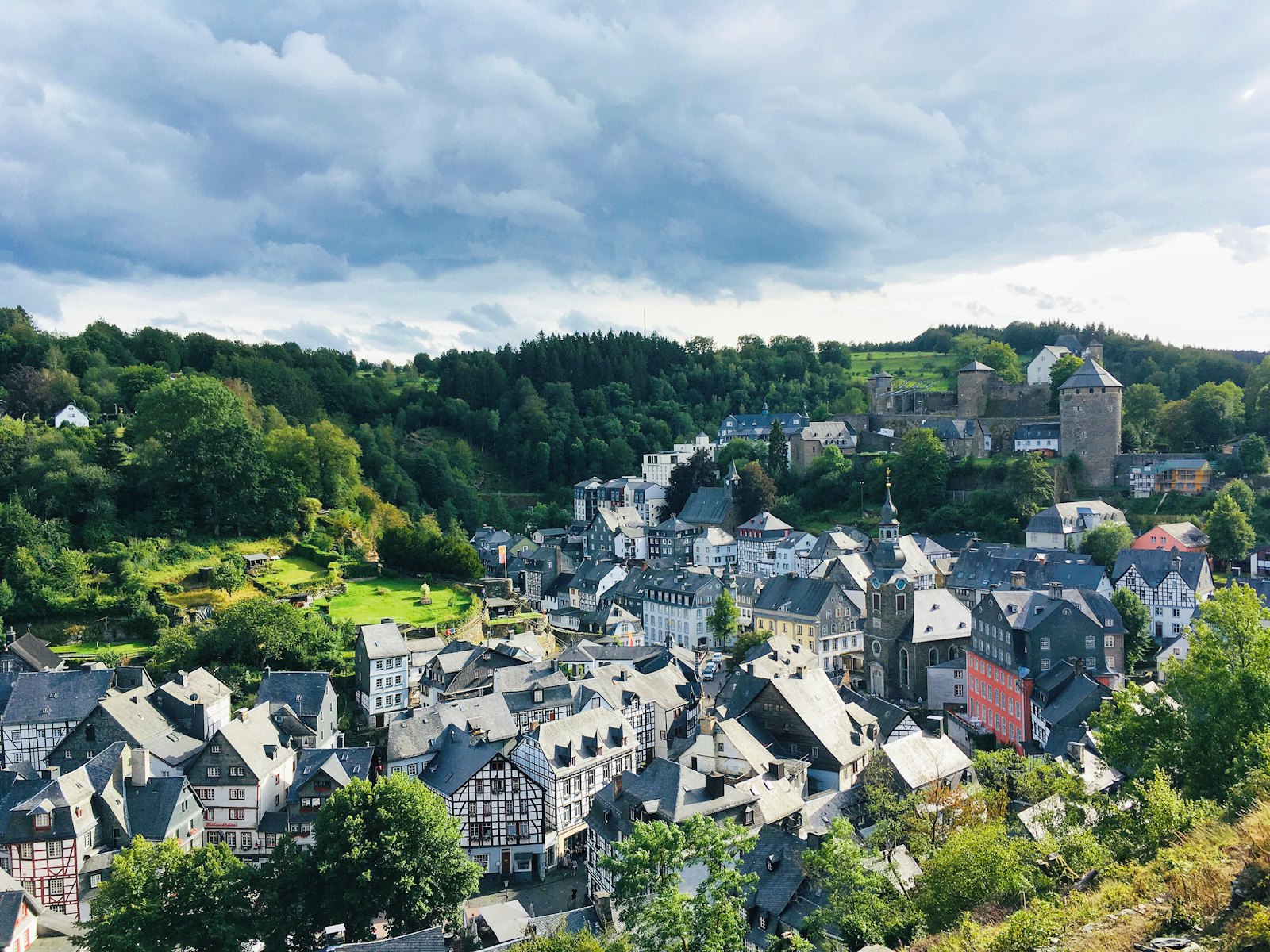
A small slate-roofed town in a narrow Eifel valley on the Rur, with half-timbered lanes, a castle on the rock above, a working mustard mill, and moorland and forest trails starting a short walk from the market square. Best time to visit: May to October. Daily budget (budget traveller): $85 to $300 USD.
Arrive and find your bearings
Morning: This plan assumes you arrive on a Tuesday. Take a train to Aachen Hbf, then the SB66 bus to Monschau, which takes about an hour. Leave your bag at your accommodation.
Afternoon: Walk the Markt, Stadtstraße and Rurstraße, then stop at the tourist information for trail maps. Coffee and a Dütchen at a café on the Markt.
Evening: Climb to the Haller ruin for the view over the rooftops at sunset. Dinner and a beer at the Felsenkeller.
Rotes Haus and the mustard mill
Morning: Join the 11:00 Senfmühle tour on Laufenstraße, which runs on Wednesdays and Fridays from March to October, then taste and buy mustard in the shop.
Afternoon: Tour the Rotes Haus, which has entry on the hour and costs €5. Then visit the Aukirche next door and the Aukloster cloister.
Evening: Walk up to Burg Monschau as the light goes. Picnic supper or a simple dinner in the old town.
Eifelsteig to Einruhr
Morning: Set off early on Eifelsteig stage 3 from Monschau. The route follows the Rur valley, then climbs onto the open plateau. Carry lunch and water.
Afternoon: Arrive in Einruhr on the Obersee. Rest your feet by the water and check bus times back towards Simmerath and Monschau.
Evening: Bus back to Monschau. Early night after a long walk.
Höfen, narcissus valleys and Kalterherberg
Morning: Bus up to Höfen and walk into the Perlenbach valley. From mid-April to early May the meadows are full of wild narcissus. Outside spring it is still a quiet stream walk.
Afternoon: Continue to Kalterherberg to see the twin-towered 'Eifeldom' church. Bus or walk back down to Monschau.
Evening: Wander the empty old town after the day visitors leave, then eat Eifel trout or Döppekooche for dinner.
The High Fens
Morning: Bus to Mützenich, then walk over the Belgian border onto the Brackvenn boardwalks across the open moorland. Wear waterproofs.
Afternoon: Extend the walk on the marked Venn trails, or head back to Monschau and visit the Glashütte to watch the glassblowers.
Evening: Self-cater with supplies from Imgenbroich to give your budget a rest.
Day trip to Aachen
Morning: SB66 bus to Aachen. Visit Aachen Cathedral, Charlemagne's chapel and a UNESCO World Heritage Site, before the tour groups arrive.
Afternoon: Lunch near the Markt, buy Printen to take home, and visit the Cathedral Treasury before it closes in the late afternoon.
Evening: Dinner in Aachen, then an early bus back. Check the last connection, because evening services are thin.
Vennbahn morning and leave
Morning: Walk or cycle a stretch of the Vennbahn path above town, or take a last slow loop of the river path through Burgau.
Afternoon: Pick up mustard and Printen, then take the SB66 to Aachen for your onward train.
Evening: Connect onwards from Aachen to Cologne, Brussels or Liège.
What to eat in Monschau
- Monschau mustard: try the many flavours at the Senfmühle, from mild honey mustard to strong varieties, and buy a stoneware jar to take home
- Monschauer Dütchen: a crisp rolled wafer filled with whipped cream, the town's classic café treat
- Aachener Printen: hard, spiced gingerbread from nearby Aachen, sold all over town and at the Christmas market
- Eifel trout: often served whole or smoked in local restaurants, a good lighter option after a long walk
- Döppekooche: a hearty Eifel potato bake made with bacon, usually eaten with apple sauce, and best on a cold day
- A beer and a plate of regional food at the Felsenkeller brewery restaurant on St.-Vither-Straße, in Monschau's old brewery
Hidden gems
- The cloister of the Aukloster by the Aukirche, a quiet corner off Laufenstraße that hosts craft stalls on two Advent weekends in 2026
- The upstream riverside path through Burgau towards the Glashütte, which is much calmer than the Markt even on busy Saturdays
- The village church in Kalterherberg, known locally as the 'Eifeldom', a surprisingly large twin-towered church for such a small village
- The Vennbahn cycle path, a former railway line that passes above Monschau and runs on to Belgium and Luxembourg, almost flat and good for an easy day on a hired bike
- The castle courtyard at Burg Monschau early in the morning, before the youth hostel groups wake up, with a view straight down into the old town
Getting around
The old town is small and largely car-free, so you walk everywhere. Wear proper shoes, because the lanes are cobbled and the paths up to the castle and Haller are steep. Regional buses run by the AVV link Monschau with Imgenbroich, Höfen, Kalterherberg, Konzen and Mützenich. The fast SB66 goes to Aachen via Roetgen. Services thin out in the evening and on Sundays, so check times in the AVV or DB Navigator app. A single to Aachen costs roughly €8-10. If you are in Germany for a few weeks, the Deutschlandticket costs €63 a month in 2026 and covers all local buses and regional trains. Note that it is a subscription, so you need to cancel it in time, and the price rises to €66.80 from January 2027. In season, buses with bike trailers have run on Sundays and holidays to the national park and Kalterherberg. The Vennbahn cycle path makes cycling an easy option, but the valley roads are steep. A car helps for the Belgian High Fens, but parking in town is limited and fills up at weekends.
Safety
Monschau is very safe, and crime against visitors is rare. The main risks are underfoot. Cobbles and steps are slippery when wet or icy, and the castle and Haller paths are steep. On the High Fens, fog and rain can come in quickly. Stay on the marked paths and boardwalks, because some moorland zones are protected and access can be restricted in dry spells when the fire risk is high. Ticks are common in long grass and woodland, so check yourself after hikes. The Rur can rise fast after heavy rain. The July 2021 floods badly damaged the old town, so take flood and weather warnings seriously. Drivers and motorcyclists take the winding B258 fast, so take care walking along roads without pavements. The emergency number is 112 in Germany and Belgium.
Frequently asked questions
What does this 7-day Monschau itinerary cover?
Day 1: Arrive and find your bearings. Day 2: Rotes Haus and the mustard mill. Day 3: Eifelsteig to Einruhr. Day 4: Höfen, narcissus valleys and Kalterherberg. Day 5: The High Fens. Day 6: Day trip to Aachen. Day 7: Vennbahn morning and leave.
Is 7 days enough for Monschau?
Our recommended trip length for Monschau is 2 to 5 days. This 7-day plan focuses on the highlights and groups sights by area so you spend less time travelling between them.
How much does 7 days in Monschau cost?
A budget traveller spends about $85 to $300 USD a day in Monschau, so roughly $595 to $2,100 USD for 7 days, not counting flights.
Where should I stay for 7 days in Monschau?
Altstadt (Old Town): The car-free core along the Rur, around the Markt, Stadtstraße and Rurstraße. Laufenstraße: The lane that runs downstream from the centre.
When is the best time to visit Monschau?
The best time to visit Monschau is May to October.
How do I get around Monschau?
The old town is small and largely car-free, so you walk everywhere. Wear proper shoes, because the lanes are cobbled and the paths up to the castle and Haller are steep.
Is Monschau safe for solo travellers?
Monschau is very safe, and crime against visitors is rare. The main risks are underfoot.
Read more about Monschau
More 7-day guides
- Quedlinburg in 7 days
- Füssen in 7 days
- Lübeck in 7 days
- Regensburg in 7 days
- Stuttgart in 7 days
- Berlin in 7 days
- Munich in 7 days
- Hamburg in 7 days
Monschau in 2 days | Monschau in 3 days | Monschau in 4 days | Monschau in 5 days | Full Monschau guide
Joy Plus home | Destinations | Itineraries | Activities | Flights | Budget planner | Calendar | Map | Blog | Lifetime access