Destinations / Asia
Sukhothai, Thailand travel guide
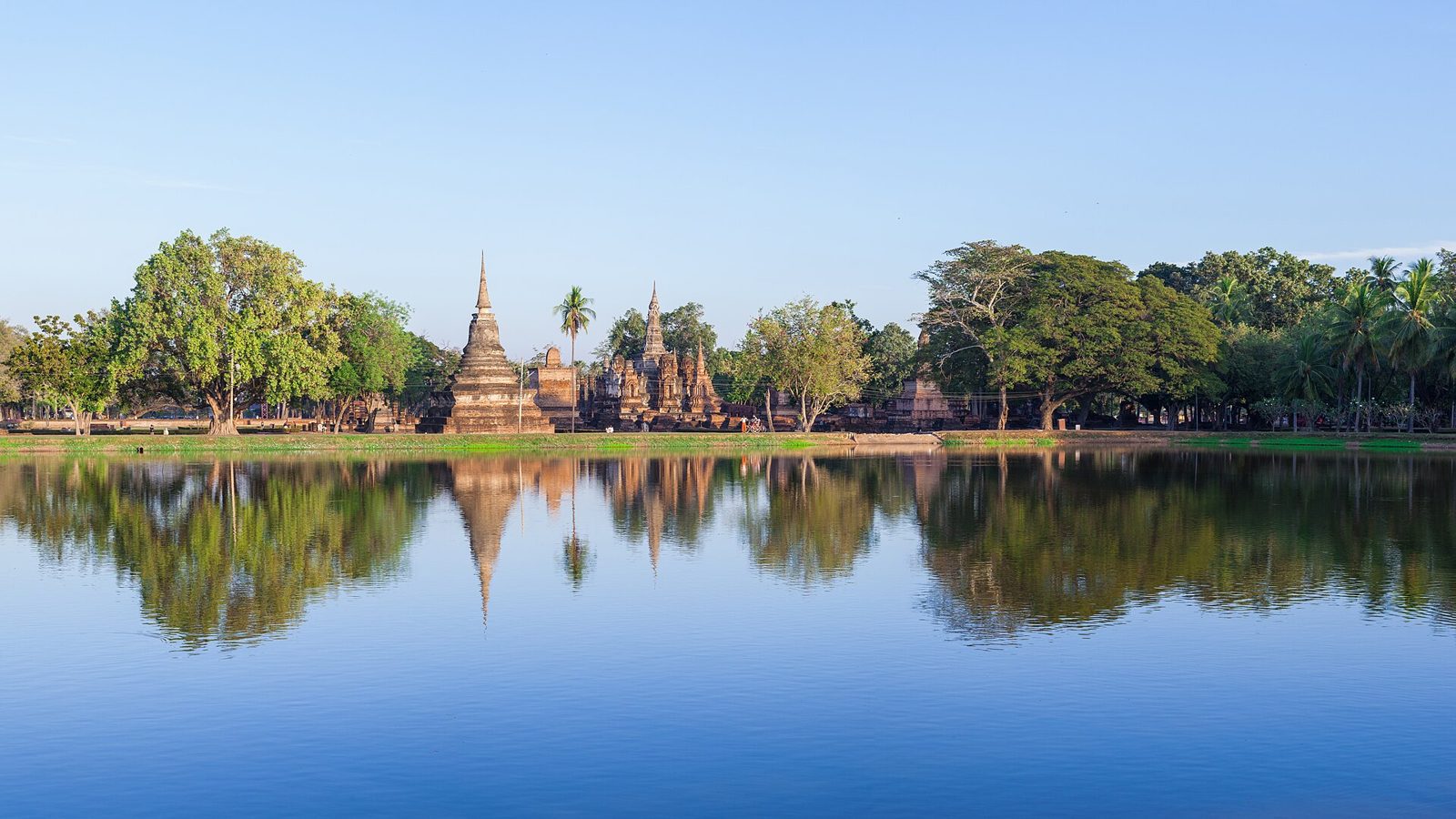
The ruined first capital of Siam, set among lotus ponds and rice fields in Thailand's lower north. You cycle between seated Buddhas at dawn, eat bowls of sweet and sour Sukhothai noodles and watch the sun drop behind chedis that are more than 700 years old.
- Best time to visit: November to February
- Daily budget (budget traveller): $30 to $110 USD
- Ideal trip length: 3 to 5 days
Sukhothai was the capital of the first Thai kingdom in the 13th and 14th centuries. Its ruins now make up a UNESCO-listed historical park about 12km west of the modern town. There are two Sukhothais. New Sukhothai is a busy, ordinary provincial town on the Yom River, with the bus station, markets and cheap rooms. Old Sukhothai (Mueang Kao) is the walled ancient city, where guesthouses line the road outside the east gate and the main ruins are a short bike ride away. Most visitors come for a single day between Bangkok and Chiang Mai. Stay longer and you get the better version: the central zone at 6:30am with mist on the ponds, a bike ride through the rice fields to the giant Buddha at Wat Si Chum, and a quiet day at the less-visited ruins of Si Satchanalai. The land is flat and the distances are short, so you can cycle almost everything. Entry fees for foreigners have gone up and the midday heat is fierce. Even so, cheap guesthouses, 30-baht songthaews and noodle bowls under $2 make it one of the easiest and best-value places in Thailand for a solo traveller to slow down.
Sukhothai means 'dawn of happiness', and for about two centuries from the mid-1200s it was the heart of the first Thai kingdom. The old city has moats and earth walls, with nearly 200 ruined temples, Buddha images and ponds spread inside and around it. Today it is a UNESCO-listed historical park. It is less crowded than Ayutthaya and calmer than Chiang Mai, and the Buddha images here, with their gentle smiles and walking poses, are some of the finest in Thai art. Most visitors give it a few hours on the way north. Stay a few nights and you get the better version: mist on the lotus ponds at dawn, empty rice-field lanes on a rented bike, a giant Buddha in a roofless hall and bowls of local noodles in the new town. Entry fees for foreigners have risen, but cheap rooms, bikes and food keep it one of the best-value stops in Thailand.
Getting here takes time rather than effort. Buses from Bangkok's Mo Chit 2 take about 6.5 to 8 hours for around 400-500 baht, and buses from Chiang Mai take roughly 5 to 6 hours. Bangkok Airways flies from Suvarnabhumi to Sukhothai airport, which is about 35-45 minutes from town by shuttle. Trains stop at Phitsanulok, about an hour away by bus or van. Once you are here, rent a bike. Base yourself by the old city's east gate for early starts in the ruins, or in New Sukhothai for markets and cheaper rooms. Shared songthaews link the two for about 30 baht during the day.
Timing shapes the trip. November to February is cool and dry, with the best cycling and Loy Krathong, which in 2026 runs from 15 to 24 November in the park. March to May is very hot, so you have to see the ruins early and late. From June to October the rains turn the fields green and prices drop, though downpours can wash out afternoons. Sukhothai is safe and relaxed, and English is spoken in guesthouses but less in shops and markets. Evenings are quiet. The old city goes to sleep early, and the new town's night market is the main entertainment. If you want bars, go to Chiang Mai. If you want ruins, rice fields and a slow pace, stay here.
Sukhothai itinerary
Arrive and find your feet
Morning: Take an early bus from Bangkok Mo Chit 2 (about 6.5 to 8 hours), or fly into Sukhothai airport if you are short on time.
Afternoon: Take a songthaew from the terminal to the old city, check in near the east gate and rent a bike for the next day.
Evening: Cycle to Wat Traphang Thong and the edge of the central zone for sunset, then have dinner at a garden restaurant by the gate.
Central zone and the museum
Morning: Be at the central zone gate at 6:30am (200 baht plus 10 baht for the bike). Start at Wat Mahathat, then loop to Wat Sa Si, Wat Si Sawai and Wat Trapang Ngoen.
Afternoon: Escape the heat in the Ramkhamhaeng National Museum (about 150 baht) and then have a long lunch and a nap.
Evening: Go back to the ponds for the evening light. If it is a Saturday, check whether the central zone is open late with lit monuments.
North and west zones
Morning: Cycle to Wat Si Chum in the north zone (about 120 baht) early, then ride on through rice-field lanes to the west zone.
Afternoon: Climb the slate path to Wat Saphan Hin while it is still bearable, then rest at your guesthouse through the hottest hours.
Evening: Visit Wat Chang Lom in the free east zone at dusk, then have noodles or curry near the gate.
Si Satchanalai day trip
Morning: Take an early bus from the Sukhothai terminal towards Si Satchanalai (about 1 hour, 50-60 baht), or share a driver for the day.
Afternoon: Hire a bike near the gate and explore Wat Chang Lom and Wat Chedi Chet Thaeo in the forest, then visit Wat Phra Si Rattana Mahathat at Chaliang.
Evening: Catch a bus back before the last one passes in the late afternoon. Check the time with the driver in the morning.
New Sukhothai
Morning: Move to the new town, or visit by songthaew. Walk the fresh market for breakfast and coffee by the Yom River.
Afternoon: Try two or three Sukhothai noodle shops for lunch, then rest somewhere with air-conditioning.
Evening: Eat your way around the night market, then walk along the river as the town cools down.
Ramkhamhaeng National Park
Morning: With a driver or scooter, head about 40km south to Khao Luang in Ramkhamhaeng National Park. Start the summit trail early in the cool season.
Afternoon: Rest at the waterfall on the way down, or choose a shorter walk if it is hot.
Evening: Back in town for a simple dinner and an early night.
Slow morning and depart
Morning: Take a last early ride through the central zone or the rice fields, then have a market breakfast.
Afternoon: Catch a bus to Chiang Mai (about 5 to 6 hours), Bangkok or Phitsanulok for the train. Check times the day before.
Evening: Arrive at your next stop, or take an overnight bus if you planned it that way.
Best neighbourhoods
- Old Sukhothai and the east gate: The small village outside the east wall of the ancient city, where most guesthouses, bike rental shops and cafés sit along the main road. The central zone and the Ramkhamhaeng National Museum are a few minutes away by bike. It is very quiet after dark, so it suits early risers rather than night owls.
- Around the walls, north and west: Rice fields, lotus ponds and village lanes just outside the old city walls, with a handful of homestays and garden bungalows. You are close to Wat Si Chum and the forest temples of the west zone. It is peaceful and pretty, but you will need a bike or scooter to get anywhere, including dinner.
- New Sukhothai centre: The modern town on both banks of the Yom River, about 12km east of the ruins. This is where you will find the night market, the best noodle shops, banks, pharmacies and the cheapest rooms. It has more life in the evenings, and songthaews to the old city leave from the centre during the day.
- Road 12 between the two towns: The main road linking new and old Sukhothai, lined with mid-range resorts, guesthouses with pools and a few restaurants. It works well if you want a pool and a bit more space for less money. Songthaews pass along it, but walking at night is not pleasant because of fast traffic.
- Si Satchanalai and Chaliang: The sister city about 55km north, with forested ruins on the Yom River and a few simple places to stay near the park. Most people visit on a day trip, but a night here means you get the ruins almost to yourself in the early morning. Food and transport options are limited.
Must-do experiences
- Cycle the central zone at sunrise: The central zone opens at around 6:30am, and the first hour is cool and nearly empty. Foreigners now pay 200 baht (about $6), plus 10 baht for a bike. Start at Wat Mahathat, with its rows of standing Buddhas and lotus-bud chedi, then loop round the ponds to Wat Sa Si and Wat Si Sawai.
- Meet the giant Buddha at Wat Si Chum: In the north zone, a huge seated Buddha fills a roofless brick hall, and you see its face through a narrow gap in the wall. The north zone ticket is about 120 baht. Go in the late afternoon, when the light is warm and the tour groups have left.
- Climb to Wat Saphan Hin: In the forested west zone, a path of old slate slabs leads up a hill to a standing Buddha looking back towards the city. The climb takes about 15 minutes. Go early, carry water and wear proper shoes, because the stones are uneven and slippery after rain.
- Spend the midday heat in the museum: The Ramkhamhaeng National Museum by the central zone holds Buddha images, Sangkhalok ceramics and finds from the excavations. It is open daily from 9am to 4pm, and foreigners pay about 150 baht. Allow an hour or two, and use the free lockers for big bags.
- Day trip to Si Satchanalai: Sukhothai's sister city sits in quiet forest about 55km north and gets a fraction of the visitors. Entry to the main zone is around 200 baht, and you can hire a bike near the gate. Add Wat Phra Si Rattana Mahathat at Chaliang, which has its own small ticket.
- Eat Sukhothai noodles: The local bowl comes with thin rice noodles, pork, green beans, peanuts and a sweet, sour and spicy kick. It costs around 40-60 baht (about $1.20-1.80). Try a few shops in the new town at lunch, as most close by mid-afternoon.
- See Loy Krathong where it started: Sukhothai claims the festival as its own, and the historical park hosts a ten-night celebration from 15 to 24 November 2026, with the main night on the 24th. Candles, lanterns and krathong floats are free to watch. The light and sound show costs 500, 900 or 1,200 baht.
Hidden gems
- Wat Chang Lom in the east zone, a chedi ringed by elephant sculptures, set among the hotels on Road 12 and free to visit
- The lanes through the rice fields between the north and west zones, which are flat, shady in places and almost empty early in the morning
- Wat Traphang Thong, a small temple on an island in a pond just outside the east gate, reached by a footbridge and still used by local monks
- The fresh market in the new town at dawn, where you can buy sticky rice, grilled pork and fruit before taking the first songthaew to the ruins
- The old kiln sites near Si Satchanalai, where Sangkhalok celadon was fired and traded across Asia, worth a stop if you are cycling or have a driver
Daily budget
- Accommodation: budget $10-20 / night (fan room or simple guesthouse), mid-range $30-60 (air-conditioned room with a pool), splurge $100+ (resort such as Sukhothai Heritage Resort). Prices rise sharply during Loy Krathong and over New Year. Single rooms are easy to find. Book Loy Krathong dates weeks ahead.
- Food: budget $6-10 / day (noodle shops, market stalls, fruit), mid-range $15-25 (garden restaurants and a café or two), splurge $40+ (resort dining with drinks). A bowl of Sukhothai noodles is about 40-60 baht and a night market meal 30-80 baht. Old city restaurants cost a little more than the new town.
- Transport: budget $1-3 / day (bike hire, songthaews), mid-range $10-20 (e-bike, scooter or tuk-tuk hire), splurge $50-65 (private driver for Si Satchanalai). Bangkok buses cost about 400-500 baht each way and flights roughly 1,700-3,000 baht. Songthaews between the towns are about 30 baht and bike hire 30-50 baht a day.
- Activities: budget $6-12 / day (central zone 200 baht, north or west zone 120 baht), mid-range $15-25 (all zones, museum, Si Satchanalai), splurge $30+ (private guide, Loy Krathong light and sound show). Add 10 baht per zone for a bike. The museum is about 150 baht. Some guides still show 100 baht a zone, so check at the booth.
- Drinks & nightlife: budget $1-3 (a large beer from a 7-Eleven or a street stall), mid-range $5-12 (beers or cocktails at a guesthouse bar), splurge $20+ (wine at a resort). Iced coffee costs about 30-50 baht and a large beer around 60-90 baht in shops. Nightlife is very low-key. Alcohol sales are restricted at certain hours and on Buddhist holidays.
Where to stay
- Social hostel in Old city east gate or New Sukhothai ($10-20 / night): Sukhothai has few true party hostels. Instead, it has simple family guesthouses with fan or air-conditioned rooms, shared breakfast tables and bikes to rent. They are friendly, cheap and the easiest way to meet other travellers here.
- Boutique hotel in New Sukhothai ($35-70 / night): Teak-house hotels such as Ruean Thai Hotel give you Thai-style rooms around a pool, close to the night market and noodle shops. They are good if you want comfort and evenings in town.
- Apartment in Around the walls, north and west ($20-45 / night): Garden bungalows and homestays among the rice fields give you space, quiet and often a small kitchen or terrace. You will need a bike or scooter, and it is dark at night, so check the exact location first.
- Splurge in Near Sukhothai airport ($100-200+ / night): Sukhothai Heritage Resort sits among lotus ponds near the airport, with buildings inspired by the old temples and a big pool. It is a drive from the ruins, but very peaceful.
What to eat
- Kuay teow Sukhothai: the town's own noodle soup or dry noodles with pork, green beans, peanuts and lime, at simple shops in the new town for about 40-60 baht
- Night market stalls in New Sukhothai: grilled meat on sticks, papaya salad, fried chicken and roti, with most dishes for 30-80 baht
- Khao man gai and khao kha moo: chicken rice and stewed pork leg on rice, cheap single-plate lunches that are easy to find near the market
- Garden restaurants in the old city: Thai curries, stir-fries and fruit shakes at the cafés around the east gate, usually 80-200 baht a dish
- Fresh fruit and sticky rice from the morning market, plus sweet Thai desserts wrapped in banana leaf, for a cheap breakfast on the bike
- Iced Thai coffee or tea from a roadside stand, around 30-50 baht, as the best way to get through a hot afternoon
Day trips
- Si Satchanalai Historical Park and Chaliang (About 55km north of Sukhothai, around 1 hour by bus): Sukhothai's sister city sits in forest by the Yom River, with elephant-ringed chedis, a hilltop temple and far fewer visitors. It is part of the same UNESCO listing and feels wilder and quieter. Take a bus from Sukhothai terminal towards Si Satchanalai or Chiang Rai and ask to get off at the park (about 50-60 baht). The park entrance is a few kilometres from the road, so hire a bike nearby. Entry is about 200 baht, and a driver for the day costs roughly 2,000 baht.
- Ramkhamhaeng National Park (Khao Luang) (About 40km south of Sukhothai): A forested mountain with a steep trail of about 4km past a waterfall to a summit of around 1,180m, where the views on clear cool-season mornings are excellent. It is a hard climb in the heat. There is no easy public transport, so hire a driver or ride a scooter. Park entry is about 100 baht for foreigners. Go from November to February and start early with plenty of water.
- Phitsanulok (About 60km east, around 1 hour by bus or van): A bigger riverside city with Wat Phra Si Rattana Mahathat, home to one of Thailand's most revered Buddha images, the Phra Phuttha Chinnarat. It also has a lively night market by the Nan River and the nearest railway station. Buses and vans leave Sukhothai terminal through the day for about 70-120 baht. It is easy to combine with an onward train to Bangkok or Chiang Mai.
When to visit
- Cool season (November - February): 17-31°C, dry, cool mornings and sunny days. Crowds: Moderate, very busy around Loy Krathong in November and at New Year. The best time to come. Cycling is comfortable all morning, skies are clear and sunsets are reliable. Book early for Loy Krathong.
- Hot season (March - May): 25-40°C, very hot and hazy, occasional storms in May. Crowds: Low, apart from Thai holidays and Songkran in mid-April. Doable if you start at dawn and rest from late morning to 4pm. Rooms are cheaper. Expect Songkran water fights in the new town.
- Early rains (June - August): 25-34°C, humid, with afternoon showers. Crowds: Low. Green fields, quiet ruins and low prices. Mornings are usually dry, so plan cycling early and keep afternoons flexible.
- Late rains (September - October): 24-33°C, the wettest months, with heavy downpours. Crowds: Low, rising in late October. The riskiest time. The Yom River can flood low parts of the new town. Still fine for a short visit if you check the forecast and keep plans loose.
Entry rules for your passport
Visa rules for Thailand depend on the passport you travel on. Check the official source before you book: Thailand's official e-Visa site (Ministry of Foreign Affairs)
Getting there
Sukhothai has a small airport about 35-45 minutes from town. Bangkok Airways flies there from Bangkok Suvarnabhumi in about 1 hour 20 minutes, with fares of roughly 1,700-3,000 baht ($52-92). Shuttles and taxis into town cost about 200-500 baht. Most people come by bus. From Bangkok's Mo Chit 2 terminal, Win Tour, Phitsanulok Yanyon, Cherdchai and Transport Co run day and night services. They take about 6.5 to 8 hours, and fares are around 400-500 baht ($12-15). Some morning buses go on to the historical park. The others stop at Sukhothai bus terminal, where a shared songthaew to the old city costs about 30 baht. From Chiang Mai's Arcade terminal, buses take about 5 to 6 hours. There is no railway in Sukhothai. Take the train from Bangkok to Phitsanulok, then a bus or van for about an hour (around 70-120 baht). Buy bus tickets a day ahead at weekends and during Loy Krathong. Online booking sites and the terminal counters both work.
Getting around
Sukhothai is two places, so plan your transport around that. Blue songthaews (shared pick-up trucks) run between New Sukhothai and the old city for about 30 baht (around $1) and take roughly 30 minutes. They leave from the new town centre during the day and stop running in the late afternoon. From the bus terminal outside the new town, a shared songthaew to the old city costs about 30 baht too, and a tuk-tuk will cost more. Once you are in the old city, rent a bicycle. Shops by the east gate charge about 30-50 baht a day. The park is flat but spread out, and each paid zone charges 10 baht to bring a bike in. Electric bikes, golf carts and a park tram are also available, and a tuk-tuk for a couple of hours costs around 500 baht. Scooters cost about 200-300 baht a day, but only ride one if you have a valid licence and insurance that covers it. Ride-hailing coverage is patchy here, so ask your guesthouse to call a taxi. For Si Satchanalai, take a bus from the terminal (about an hour, roughly 50-60 baht) or hire a driver for the day.
Safety
Sukhothai is calm and safe, and crime against visitors is rare. The main risks are the heat, the roads and the dogs. From March to May temperatures can pass 38°C, so explore early and late, carry plenty of water and rest in the middle of the day. Road 12 between the towns carries fast traffic, so wear a helmet on a scooter and use lights on a bike after dusk. Stray and temple dogs can be territorial, especially around the outer temples at dawn, so slow down and give them space. The slate path up to Wat Saphan Hin is uneven. Mosquitoes carry dengue, especially in the rainy season, so use repellent. Do not drink the tap water. Bottled and filtered water is cheap everywhere. Emergency numbers are 191 for police, 1669 for ambulance and 1155 for the Tourist Police, who speak English. Bring travel insurance with medical cover, as serious cases go to Phitsanulok or Bangkok.
Solo travel tips
- Sleep by the east gate: Staying in the old city means you can be cycling through the central zone at 6:30am, before the heat and the tour buses. Breakfast after the ruins is one of the best things about Sukhothai.
- Work around the heat: See the ruins from dawn to about 10am and again from 4pm to dusk. Use the middle of the day for the museum, lunch and a nap, especially from March to May.
- Carry cash in small notes: Ticket booths, bike shops, songthaews and noodle stalls mostly want cash. Some booths now take QR payments, but card machines are still rare out at the zones.
- Check the last bus: Songthaews between the towns stop in the late afternoon, and the last bus back from Si Satchanalai leaves early. Ask your guesthouse for the current times and plan around them.
- Safety for solo travellers: The main risks are heat, traffic on Road 12 and dogs at quieter temples. Carry water, wear a helmet on a scooter, use lights after dark and give dogs a wide berth.
- Meet people on a bike tour: Guesthouses by the gate run small group cycling tours through villages and ruins. Night market tables and guesthouse breakfast areas are also easy places to start a conversation.
Cultural etiquette
- Greet people with 'sawasdee kha' (if you are a woman) or 'sawasdee khrap' (if you are a man), and say 'khop khun' for thank you.
- Cover your shoulders and knees at temples. This includes the ruins, which are still sacred sites for many Thais.
- Never climb on Buddha images or chedis, and do not pose for photos in ways that put your head above or your back casually to a Buddha.
- Take your shoes off before entering any active temple hall or someone's home, and do not point your feet at people or Buddha images.
- Speak about the Thai royal family with respect. Criticism is a serious criminal offence.
- Women should not touch monks or hand things directly to them. Place items down or give them to a man to pass on.
- Keep your voice down and stay calm in disagreements. Raising your voice or losing your temper makes things worse.
Frequently asked questions
How do I get to Sukhothai and from the bus station to my room?
Most people take a bus from Bangkok's Mo Chit 2 terminal. Win Tour, Phitsanulok Yanyon, Cherdchai and Transport Co run through the day, taking about 6.5 to 8 hours for roughly 400-500 baht ($12-15). A few services carry on to the historical park. The rest stop at Sukhothai bus terminal outside the new town, where shared songthaews run to the old city for about 30 baht during the day. If you arrive late, book a pickup through your guesthouse. Bangkok Airways also flies from Suvarnabhumi in about 1 hour 20 minutes.
How many days do I need in Sukhothai?
Two nights is the minimum. It gives you the central zone at sunrise and the north and west zones the next day. Three to five nights lets you add a full day at Si Satchanalai, an evening in the new town and a slow, unrushed bike ride through the countryside. A week works if you want to hike in Ramkhamhaeng National Park or are here for Loy Krathong.
When is the best time to visit Sukhothai?
November to February is the cool, dry season, with clear mornings and comfortable cycling. It is also the busiest, especially around Loy Krathong. March to May is very hot, so you have to see the ruins at dawn and dusk. June to October is the rainy season. It brings green fields, fewer visitors and lower prices, but also heavy afternoon downpours and the odd flood.
How much does it cost to enter the historical park?
Each paid zone has its own ticket. In 2026 most sources list 200 baht for foreigners in the central zone and 120 baht each for the north and west zones, and a combined ticket for around 400 baht has been reported. Some guides still show the older rate of 100 baht, so check at the booth. Bikes cost 10 baht per zone. The east and south zones are free. The museum and Si Satchanalai are ticketed separately.
Should I stay in the old city or New Sukhothai?
Stay in the old city if the ruins are why you came. You can be cycling through the central zone at 6:30am and back for breakfast. Stay in New Sukhothai if you want night markets, more food choices and cheaper rooms, and you do not mind a 30-minute songthaew ride each way. Many solo travellers do one night in each.
What happens at Loy Krathong in Sukhothai?
Sukhothai is said to be where the festival began. In 2026 the park hosts a ten-night celebration from 15 to 24 November, with candles among the ruins, fireworks, parades and krathong floats on the ponds. The main night is 24 November. The light and sound show costs 500, 900 or 1,200 baht. Rooms sell out, so book as early as you can and expect higher prices.
Is Sukhothai safe for solo female travellers?
Yes. It is a quiet, friendly provincial town, and locals are used to visitors. The old city is very dark and empty at night, so carry a torch and avoid cycling unlit lanes alone after dark. Dress modestly at temples, take normal care with drinks and use a guesthouse-booked taxi rather than flagging down strangers late at night.
What entry rules apply to Thailand in 2026?
Since 15 September 2026, citizens of 60 countries and territories, including the UK, US, Canada, Australia and EU states, can stay visa-free for up to 30 days for tourism, down from 60. You can extend once by 30 days at an immigration office for 1,900 baht. Every foreign visitor must fill in the free Thailand Digital Arrival Card (TDAC) online within three days before arrival. Use only the official site, as fake sites charge fees. A tourist entry fee has been proposed but was not being charged as of October 2026. Your passport needs at least six months' validity, and you may be asked for an onward ticket. Check the Thai embassy and your own government's travel advice before you go.
More about Sukhothai
- Best Time to Visit Southeast Asia: Month by Month and Where to Go
- Solo Travel Southeast Asia Itinerary 2026: 2, 3 and 4 Week Overland Routes
- Solo Travel in Southeast Asia: The 2026 Beginner's Guide to Visas, Money and Safety
- Bangkok on $30 a Day? A Realistic Budget Guide for 2026
Tours and activities in Sukhothai | Sukhothai in 2 days | Sukhothai in 3 days | Sukhothai in 4 days | Sukhothai in 5 days | Sukhothai in 7 days
Can't decide? Compare Sukhothai with...
Joy Plus home | Destinations | Itineraries | Activities | Flights | Budget planner | Calendar | Map | Blog | Lifetime access